







Question: (a) 1 (b) 0 (c) 0.5 (d) 1 (e) Not enough information to predict. 16. Consiler the model defined in the previous quastion with perameten
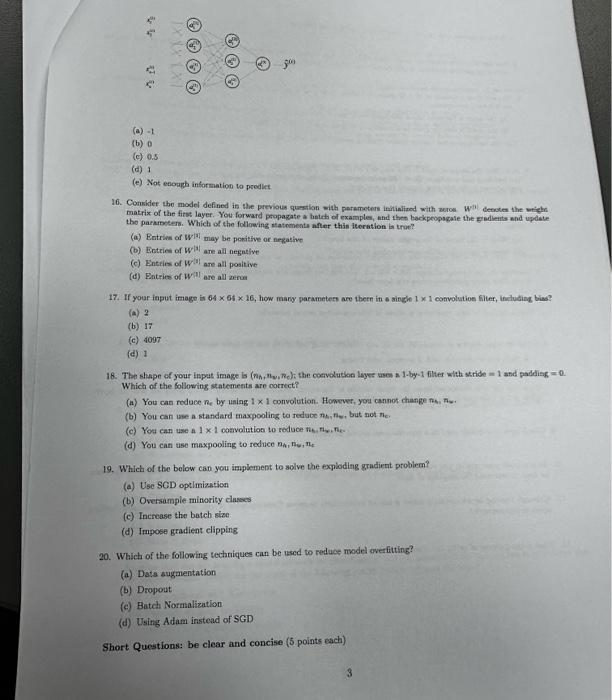
(a) 1 (b) 0 (c) 0.5 (d) 1 (e) Not enough information to predict. 16. Consiler the model defined in the previous quastion with perameten initialinod with zeros will denotes the wiegh matrix of the first layer. You forward propagate a hoted of examples, and then backpeopsgate the gradlents and uploue the parampters. Which of the following matoments after this iteration is troe? (a) Entrian of w in may be ponitive or negative (b) Eostries of Wa are all negntive (c) Entrirs of Wi are all positive (d) Phtries of w ill are all werua 17. If your iaput image is 646416, how many parameteen are thern in a ainghe 11 convolution filier, includiag bins? (a) 2 (b) 17 (c) 4097 (d) 1 18. The shape of your inpat image is (nh,nw,c) the coevolution loye asen a 1 -by-1 filter with stride =1 and paddias =0. Which of the following statements are correct? (a) You can reduce neby by uning 11 convolution. Howewer, you cannot change ns, fur. (b) You can use a standard maxpooling to reduce nt, nes , but not ne. (c) You can use a 11 comvolution to reduce tis, tic, nee- (d) You can use maxpooling to reduce nh,nw,ne 19. Which of the below can you irnplement to ablve the exploding gradient problem? (a) Use SGD optlmizetion (b) Oversample minority claseses (c) Increase the batch sire. (d) Irapose gradient clipping. 20. Which of the following techniques can be used to reduce mode overfitting? (a) Data augmentation (b) Dropout (c) Batch Nornalization (d) Using Adam instead of SGD Short Questions: be clear and concise (5 points each)
Step by Step Solution
There are 3 Steps involved in it

Get step-by-step solutions from verified subject matter experts
 Study Help