





Question: a. (10 Points for this Subpart) Explain the differences between the formal Alternative Dispute Resolution (ADR) forms - Arbitration and Mediation. [HINT: You may answer
a. (10 Points for this Subpart) Explain the
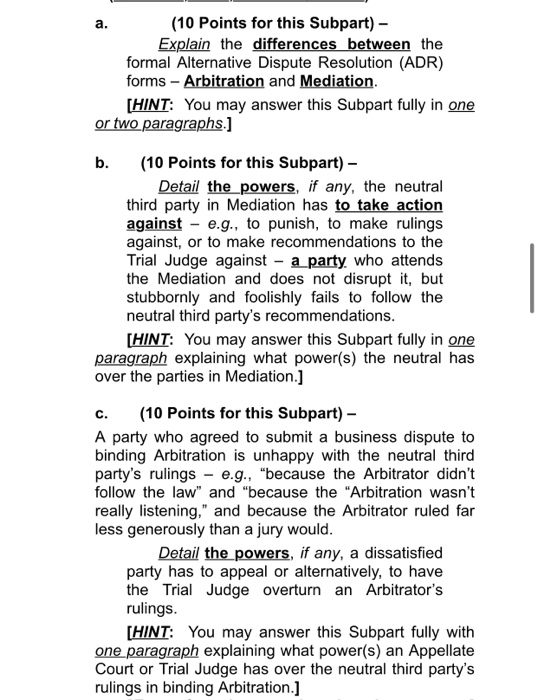
a. (10 Points for this Subpart) Explain the differences between the formal Alternative Dispute Resolution (ADR) forms - Arbitration and Mediation. [HINT: You may answer this Subpart fully in one or two paragraphs.) b. (10 Points for this Subpart) Detail the powers, if any, the neutral third party in Mediation has to take action against - e.g., to punish, to make rulings against, or to make recommendations to the Trial Judge against - a party, who attends the Mediation and does not disrupt it, but stubbornly and foolishly fails to follow the neutral third party's recommendations. [HINT: You may answer this Subpart fully in one paragraph explaining what power(s) the neutral has over the parties in Mediation.] c. (10 Points for this Subpart) A party who agreed to submit a business dispute to binding Arbitration is unhappy with the neutral third party's rulings - e.g., "because the Arbitrator didn't follow the law" and "because the "Arbitration wasn't really listening," and because the Arbitrator ruled far less generously than a jury would. Detail the powers, if any, a dissatisfied party has to appeal or alternatively, to have the Trial Judge overturn an Arbitrator's rulings. [HINT: You may answer this Subpart fully with one paragraph explaining what power(s) an Appellate Court or Trial Judge has over the neutral third party's rulings in binding Arbitration.]

Step by Step Solution

There are 3 Steps involved in it

1 Expert Approved Answer
Step: 1 Unlock blur-text-image

Question Has Been Solved by an Expert!

Get step-by-step solutions from verified subject matter experts

Step: 2 Unlock
Step: 3 Unlock

Students Have Also Explored These Related General Management Questions!