







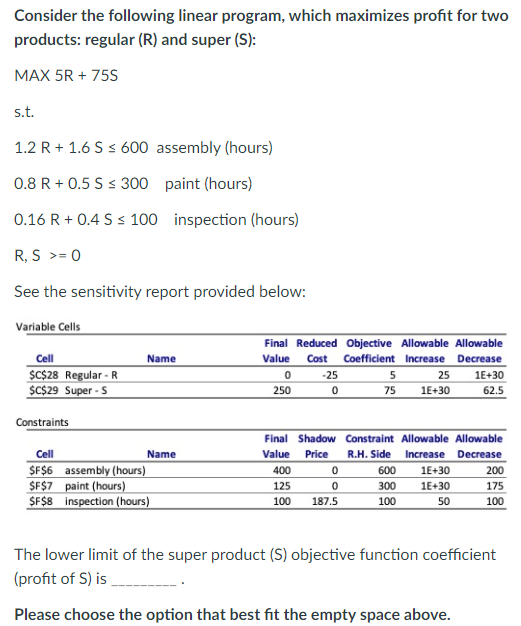
Question: a. 120 b. 12.5 c. 10.8 d. It is infinity, so there is no lower limit. e. None of the above Consider the following linear
a. 120
b. 12.5
c. 10.8
d. It is "infinity", so there is no lower limit.
e. None of the above
Consider the following linear program, which maximizes profit for two products: regular (R) and super (S): MAX 5R + 755 s.t. 1.2 R + 1.6 S 3 600 assembly (hours) 0.8 R +0.5 S S 300 paint (hours) 0.16 R+0.4 5 100 inspection (hours) R, S >= 0 See the sensitivity report provided below: Variable Cells Name Cell $C$28 Regular-R $C$29 Super - 5 Final Reduced Objective Allowable Allowable Value Cost Coefficient Increase Decrease 0 -25 5 25 1E+30 250 0 75 1E+30 62.5 Constraints Cell Name $F$6 assembly (hours) $F$7 paint (hours) $F$8 inspection (hours) Final Shadow Constraint Allowable Allowable Value Price R.H. Side Increase Decrease 400 0 600 1E+30 200 125 0 300 1E+30 175 100 187.5 100 50 100 The lower limit of the super product (S) objective function coefficient (profit of S) is Please choose the option that best fit the empty space aboveStep by Step Solution
There are 3 Steps involved in it
1 Expert Approved Answer
Step: 1 Unlock

Question Has Been Solved by an Expert!
Get step-by-step solutions from verified subject matter experts
Step: 2 Unlock
Step: 3 Unlock
 Study Help