







Question: A = 14kg/h B = 15 Celsius make a fully labeled flow chart PROBLEM. Using fermentation to produce raw materials for biodegradable polymers Biodegradable polymers
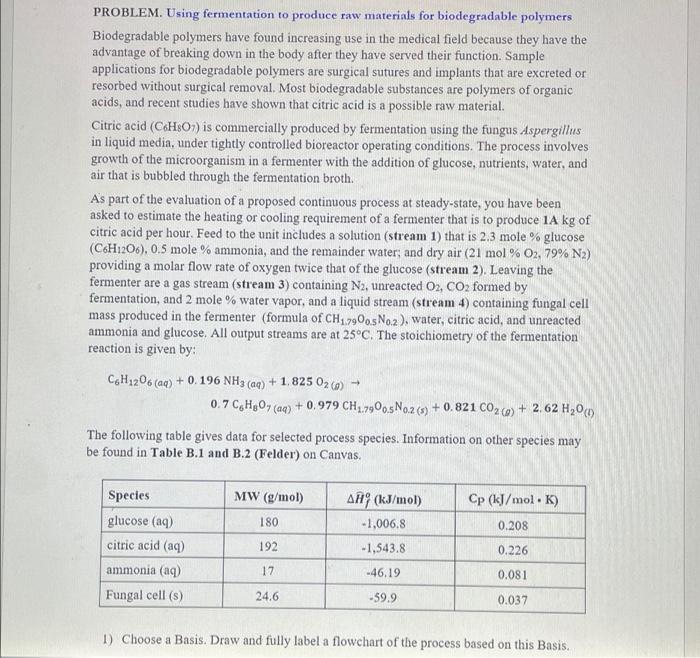
PROBLEM. Using fermentation to produce raw materials for biodegradable polymers Biodegradable polymers have found increasing use in the medical field because they have the advantage of breaking down in the body after they have served their function. Sample applications for biodegradable polymers are surgical sutures and implants that are excreted or resorbed without surgical removal. Most biodegradable substances are polymers of organic acids, and recent studies have shown that citric acid is a possible raw material. Citric acid (C6H3O) is commercially produced by fermentation using the fungus Aspergillus in liquid media, under tightly controlled bioreactor operating conditions. The process involves growth of the microorganism in a fermenter with the addition of glucose, nutrients, water, and air that is bubbled through the fermentation broth. As part of the evaluation of a proposed continuous process at steady-state, you have been asked to estimate the heating or cooling requirement of a fermenter that is to produce 1A kg of citric acid per hour. Feed to the unit includes a solution (stream 1) that is 2.3 mole % glucose (C6H12O6), 0.5 mole % ammonia, and the remainder water, and dry air (21 mol % O2, 79% N2) providing a molar flow rate of oxygen twice that of the glucose (stream 2). Leaving the fermenter are a gas stream (stream 3) containing N2, unreacted O2, CO2 formed by fermentation, and 2 mole % water vapor, and a liquid stream (stream 4) containing fungal cell mass produced in the fermenter (formula of CH1790o.No.2), water, citric acid, and unreacted ammonia and glucose. All output streams are at 25C. The stoichiometry of the fermentation reaction is given by: CH1206 (aq) + 0.196 NH3 (aq) + 1.825 0260) 0.7 C,H,O4 (aq) +0.979 CH2.7900.5 No.2 (8) + 0.821 CO2 + 2.62 H,00) The following table gives data for selected process species. Information on other species may be found in Table B.1 and B.2 (Felder) on Canvas. MW (g/mol) Cp (kJ/mol. K) 180 0.208 Species glucose (aq) citric acid (aq) ammonia (aq) Fungal cell (5) ? (kJ/mol) - 1,006,8 -1,543.8 -46.19 192 0.226 17 0.081 24.6 -39.9 0.037 1) Choose a Basis. Draw and fully label a flowchart of the process based on this Basis
Step by Step Solution
There are 3 Steps involved in it

Get step-by-step solutions from verified subject matter experts
 Study Help