







Question: A 16 element int array alpha is stored in memory starting with address Ox1000. Assume the current values of the array are: alpha[0]= 1, alpha[1]
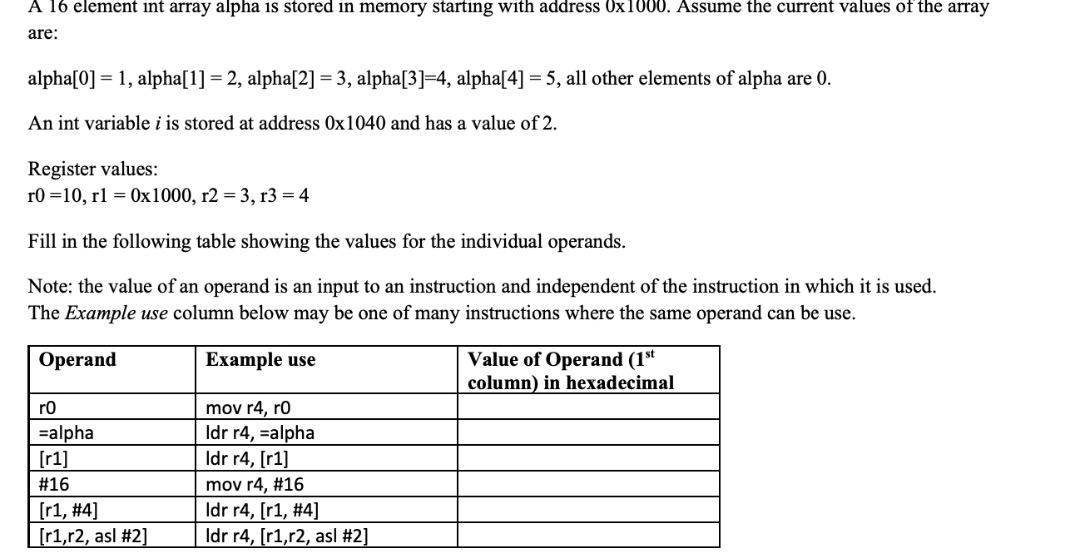
A 16 element int array alpha is stored in memory starting with address Ox1000. Assume the current values of the array are: alpha[0]= 1, alpha[1] = 2, alpha[2] = 3, alpha[3]=4, alpha[4] =5, all other elements of alpha are 0. An int variable i is stored at address Ox 1040 and has a value of 2. Register values: r0 =10, rl = 0x1000, r2 = 3, r3 = 4 Fill in the following table showing the values for the individual operands. Note: the value of an operand is an input to an instruction and independent of the instruction in which it is used. The Example use column below may be one of many instructions where the same operand can be use. Operand Example use Value of Operand (1st column) in hexadecimal ro =alpha [r1] #16 [r1, #4] [r1,r2, asl #2] mov r4, ro Idr r4, ralpha Idr r4, [r1] mov r4, #16 Idr r4, [r1, #4] Idr r4, [r1,r2, asl #2] A 16 element int array alpha is stored in memory starting with address Ox1000. Assume the current values of the array are: alpha[0]= 1, alpha[1] = 2, alpha[2] = 3, alpha[3]=4, alpha[4] =5, all other elements of alpha are 0. An int variable i is stored at address Ox 1040 and has a value of 2. Register values: r0 =10, rl = 0x1000, r2 = 3, r3 = 4 Fill in the following table showing the values for the individual operands. Note: the value of an operand is an input to an instruction and independent of the instruction in which it is used. The Example use column below may be one of many instructions where the same operand can be use. Operand Example use Value of Operand (1st column) in hexadecimal ro =alpha [r1] #16 [r1, #4] [r1,r2, asl #2] mov r4, ro Idr r4, ralpha Idr r4, [r1] mov r4, #16 Idr r4, [r1, #4] Idr r4, [r1,r2, asl #2]
Step by Step Solution
There are 3 Steps involved in it

Get step-by-step solutions from verified subject matter experts
 Study Help