



Question: a. 8. When the government wants to reduce the risks to health and the environment, the most governmental control over industrial activities can be achieved
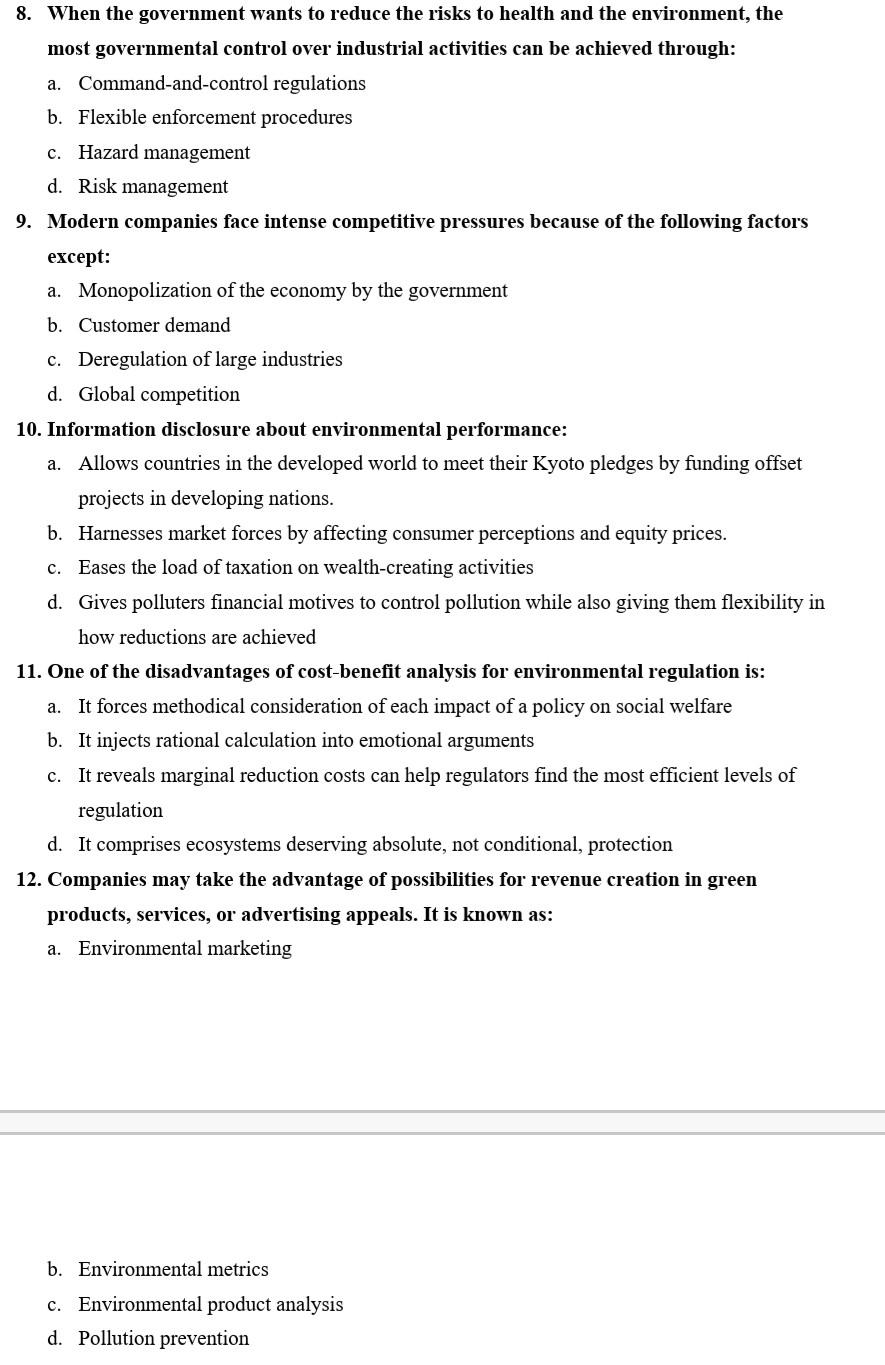
a. 8. When the government wants to reduce the risks to health and the environment, the most governmental control over industrial activities can be achieved through: a. Command-and-control regulations b. Flexible enforcement procedures c. Hazard management d. Risk management 9. Modern companies face intense competitive pressures because of the following factors except: a. Monopolization of the economy by the government b. Customer demand c. Deregulation of large industries d. Global competition 10. Information disclosure about environmental performance: Allows cou in the developed world to meet their Kyoto pledges by funding fset projects in developing nations. b. Harnesses market forces by affecting consumer perceptions and equity prices. c. Eases the load of taxation on wealth-creating activities d. Gives polluters financial motives to control pollution while also giving them flexibility in how reductions are achieved 11. One of the disadvantages of cost-benefit analysis for environmental regulation is: a. It forces methodical consideration of each impact of a policy on social welfare b. It injects rational calculation into emotional arguments c. It reveals marginal reduction costs can help regulators find the most efficient levels of regulation d. It comprises ecosystems deserving absolute, not conditional, protection 12. Companies may take the advantage of possibilities for revenue creation in green products, services, or advertising appeals. It is known as: a. Environmental marketing b. Environmental metrics c. Environmental product analysis d. Pollution prevention a. 8. When the government wants to reduce the risks to health and the environment, the most governmental control over industrial activities can be achieved through: a. Command-and-control regulations b. Flexible enforcement procedures c. Hazard management d. Risk management 9. Modern companies face intense competitive pressures because of the following factors except: a. Monopolization of the economy by the government b. Customer demand c. Deregulation of large industries d. Global competition 10. Information disclosure about environmental performance: Allows cou in the developed world to meet their Kyoto pledges by funding fset projects in developing nations. b. Harnesses market forces by affecting consumer perceptions and equity prices. c. Eases the load of taxation on wealth-creating activities d. Gives polluters financial motives to control pollution while also giving them flexibility in how reductions are achieved 11. One of the disadvantages of cost-benefit analysis for environmental regulation is: a. It forces methodical consideration of each impact of a policy on social welfare b. It injects rational calculation into emotional arguments c. It reveals marginal reduction costs can help regulators find the most efficient levels of regulation d. It comprises ecosystems deserving absolute, not conditional, protection 12. Companies may take the advantage of possibilities for revenue creation in green products, services, or advertising appeals. It is known as: a. Environmental marketing b. Environmental metrics c. Environmental product analysis d. Pollution prevention
Step by Step Solution
There are 3 Steps involved in it
1 Expert Approved Answer
Step: 1 Unlock

Question Has Been Solved by an Expert!
Get step-by-step solutions from verified subject matter experts
Step: 2 Unlock
Step: 3 Unlock