





Question: a (a) For what conditions is the Leveque approximation valid? (b) For the Leveque problem derived in class for a pipe with diameter d and
 a (a) For what conditions is the Leveque approximation valid? (b)

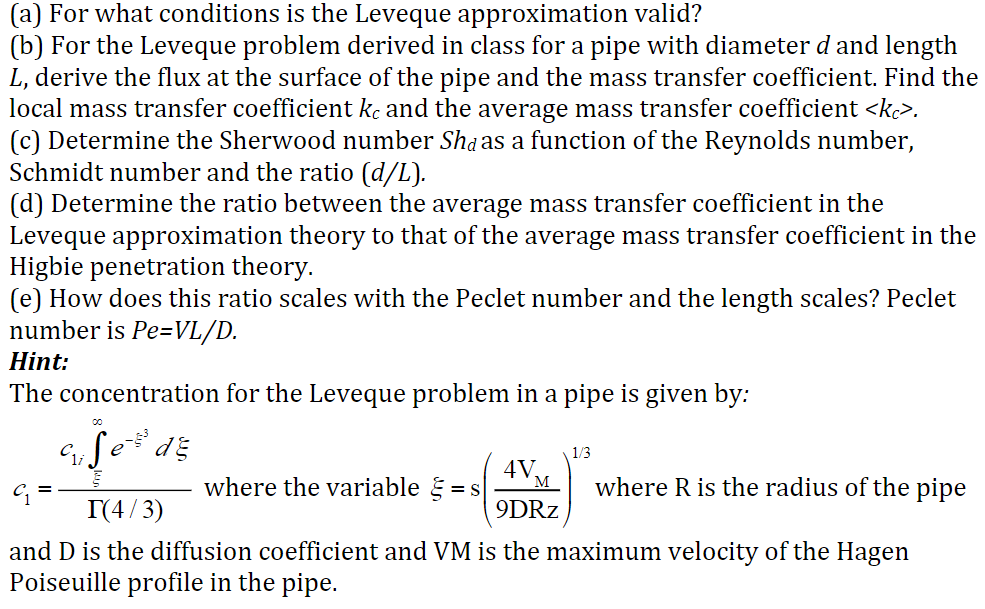
a (a) For what conditions is the Leveque approximation valid? (b) For the Leveque problem derived in class for a pipe with diameter d and length L, derive the flux at the surface of the pipe and the mass transfer coefficient. Find the local mass transfer coefficient kc and the average mass transfer coefficient . (c) Determine the Sherwood number Shaas a function of the Reynolds number, Schmidt number and the ratio (d/L). (d) Determine the ratio between the average mass transfer coefficient in the Leveque approximation theory to that of the average mass transfer coefficient in the Higbie penetration theory. (e) How does this ratio scales with the Peclet number and the length scales? Peclet number is Pe=VL/D. Hint: The concentration for the Leveque problem in a pipe is given by: a je de 13 4V, C M. where the variable &=s where R is the radius of the pipe T(4/3) 9DRz and D is the diffusion coefficient and VM is the maximum velocity of the Hagen Poiseuille profile in the pipe

Step by Step Solution

There are 3 Steps involved in it

1 Expert Approved Answer
Step: 1 Unlock blur-text-image
Question Has Been Solved by an Expert!

Get step-by-step solutions from verified subject matter experts

Step: 2 Unlock
Step: 3 Unlock

Students Have Also Explored These Related Chemical Engineering Questions!