







Question: a) A lab scale absorption column with 4 equilibrium stages is being used to acquire equilibrium data for the ammonia-water system. The column is operated
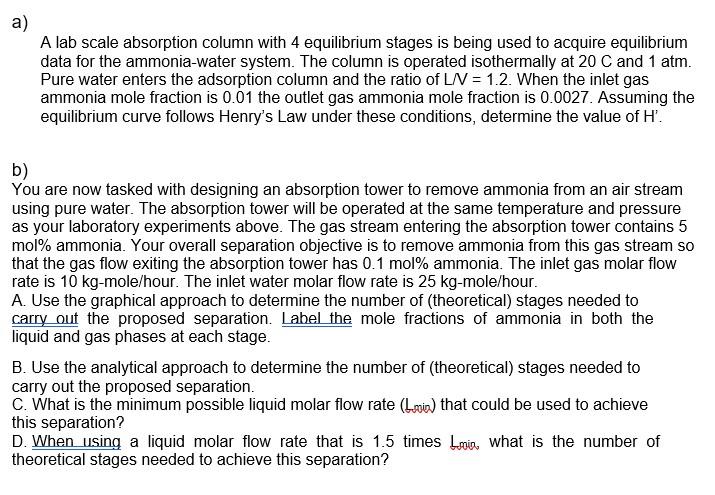
a) A lab scale absorption column with 4 equilibrium stages is being used to acquire equilibrium data for the ammonia-water system. The column is operated isothermally at 20 C and 1 atm. Pure water enters the adsorption column and the ratio of LN = 1.2. When the inlet gas ammonia mole fraction is 0.01 the outlet gas ammonia mole fraction is 0.0027. Assuming the equilibrium curve follows Henry's Law under these conditions, determine the value of H'. b) You are now tasked with designing an absorption tower to remove ammonia from an air stream using pure water. The absorption tower will be operated at the same temperature and pressure as your laboratory experiments above. The gas stream entering the absorption tower contains 5 mol% ammonia. Your overall separation objective is to remove ammonia from this gas stream so that the gas flow exiting the absorption tower has 0.1 mol% ammonia. The inlet gas molar flow rate is 10 kg-mole/hour. The inlet water molar flow rate is 25 kg-mole/hour. A. Use the graphical approach to determine the number of (theoretical) stages needed to carry out the proposed separation. Label the mole fractions of ammonia in both the liquid and gas phases at each stage. B. Use the analytical approach to determine the number of (theoretical) stages needed to carry out the proposed separation. C. What is the minimum possible liquid molar flow rate (Louis) that could be used to achieve this separation? D. When using a liquid molar flow rate that is 1.5 times Loia, what is the number of theoretical stages needed to achieve this separation
Step by Step Solution
There are 3 Steps involved in it

Get step-by-step solutions from verified subject matter experts
 Study Help