Question: a. Analysis by Shell Company. (Reding 5:Pp.22-23) As Shell describes it, the Transformation represented the most thorough and far-reaching review for more than 30 years
a. Analysis by Shell Company. (Reding 5:Pp.22-23)
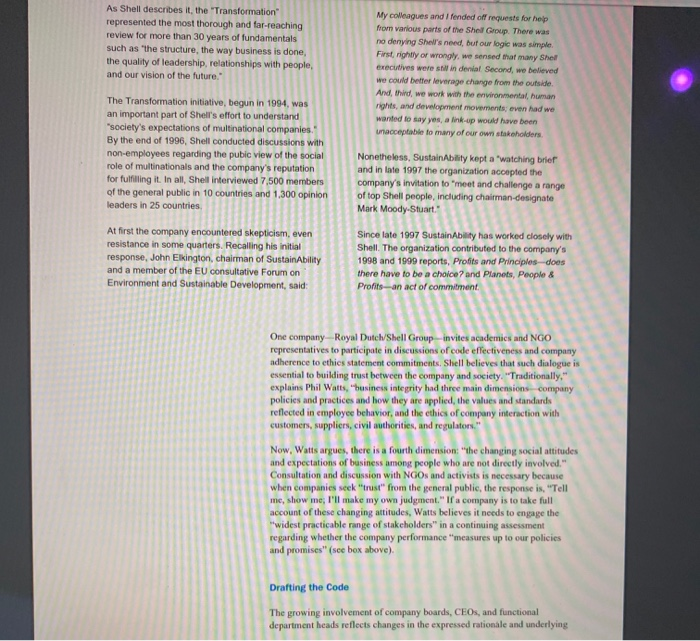
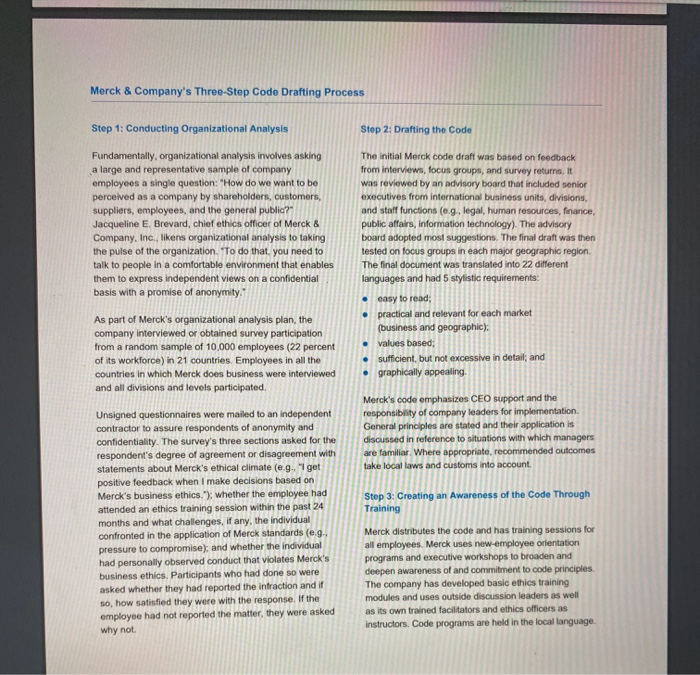
As Shell describes it, the Transformation represented the most thorough and far-reaching review for more than 30 years of fundamentals such as the structure, the way business is done, the quality of leadership, relationships with people, and our vision of the future." My colleagues and I fended off requests for help from various parts of the Shell Group. There was no denying Shell's need, but our logic was simple. First, rightly or wrongly, we sense that many Shell executives were still in denial Second, we believed we could better leverage change from the outside And, third, we work with the environmental, human rights, and development movements, even had we wanted to say yes, a link-up would have been unacceptable to many of our own stakeholders The Transformation initiative, begun in 1994, was an important part of Shell's effort to understand "society's expectations of multinational companies." By the end of 1996, Shell conducted discussions with non-employees regarding the pubic view of the social role of multinationals and the company's reputation for fulfilling it. In all, Shell interviewed 7,500 members of the general public in 10 countries and 1.300 opinion leaders in 25 countries Nonetheless, SustainAbility kept a 'watching brief and in late 1997 the organization accepted the company's invitation to meet and challenge a range of top Shell people, including chairman-designate Mark Moody-Stuart At first the company encountered skepticism, even resistance in some quarters, Recalling his initial response, John Elkington, chairman of SustainAbility and a member of the EU consultative Forum on Environment and Sustainable Development, said: Since late 1997 Sustain Ability has worked closely with Shell. The organization contributed to the company's 1998 and 1999 reports, Profits and Principles does there have to be a choice and Planets, People & Profits-an act of commitment One company Royal DutchShell Group invites academics and NGO representatives to participate in discussions of effectiveness and company adherence to ethics statement commitments Shell believes that such dialogue is essential to building trust between the company and society. "Traditionally." explains Phil Watts, business integrity had three main dimensions company policies and practices and how they are applied, the values and standards reflected in employee behavior, and the ethics of company interaction with customers, suppliers, civil wuthorities, and regulators Now, Watis argues, there is a fourth dimension the changing social attitudes and expectations of business among people who are not directly involved." Consultation and discussion with NGOs and activists is necessary because when companies seek trase from the general public, the response is, "Tell me, show me, I'll make my own judgment. If a company is to take full account of these changing attitudes, Watts believes it needs to engage the "widest practicable range of stakeholders in a continuing assessment regarding whether the company performance measures up to our policies and promises (see box above) Drafting the Code The growing involvement of company boards, CEOs, and functional department heads reflects changes in the expressed rationale and underlying Merck & Company's Three-Step Code Drafting Process Step 1: Conducting Organizational Analysis Step 2: Drafting the Code Fundamentally, organizational analysis involves asking a large and representative sample of company employees a single question: "How do we want to be perceived as a company by shareholders, customers, suppliers, employees, and the general public? Jacqueline E. Brevard, chief ethics officer of Merck & Company, Inc., likens organizational analysis to taking the pulse of the organization. To do that you need to talk to people in a comfortable environment that enables them to express independent views on a confidential basis with a promise of anonymity The initial Merck code draft was based on feedback from interviews, focus groups, and survey returns. It was reviewed by an advisory board that included senior executives from international business units, divisions, and staff functions (eg, legal, human resources, finance, public affairs, information technology). The advisory board adopted most suggestions. The final draft was then tested on focus groups in each major geographic region. The final document was translated into 22 different languages and had 5 stylistic requirements: easy to read; practical and relevant for each market (business and geographic): values based; sufficient, but not excessive in detail; and graphically appealing. As part of Merck's organizational analysis plan, the company interviewed or obtained survey participation from a random sample of 10,000 employees (22 percent of its workforce) in 21 countries. Employees in all the countries in which Merck does business were interviewed and all divisions and levels participated Merck's code emphasizes CEO support and the responsibility of company leaders for implementation General principles are stated and their application is discussed in reference to situations with which managers are familier. Where appropriate, recommended outcomes take local laws and customs into account Unsigned questionnaires were mailed to an independent contractor to assure respondents of anonymity and confidentiality. The survey's three sections asked for the respondent's degree of agreement or disagreement with statements about Merck's ethical climate (eg. get positive feedback when I make decisions based on Merck's business ethics."); whether the employee had attended an ethics training session within the past 24 months and what challenges, if any, the individual confronted in the application of Merck standards (eg. pressure to compromise), and whether the individual had personally observed conduct that violates Merck's business ethics. Participants who had done so were asked whether they had reported the infraction and if so, how satisfied they were with the response. If the employee had not reported the matter, they were asked why not Step 3: Creating an Awareness of the Code Through Training Merck distributes the code and has training sessions for all employees. Merck uses new-employee orientation programs and executive workshops to broaden and deepen awareness of and commitment to code principles The company has developed basic ethics training modules and uses outside discussion leaders as well as its own trained facilitators and ethics officers as instructors. Code programs are held in the local language









 Study Help