Question: please answer the 5 questions at the end. I will leave a thumbs up! 5 OLKSWAGEN'S DIESEL SCANDAL: FAILURE OF THE CODE OF CONDUCT AUTHOR
please answer the 5 questions at the end. I will leave a thumbs up!
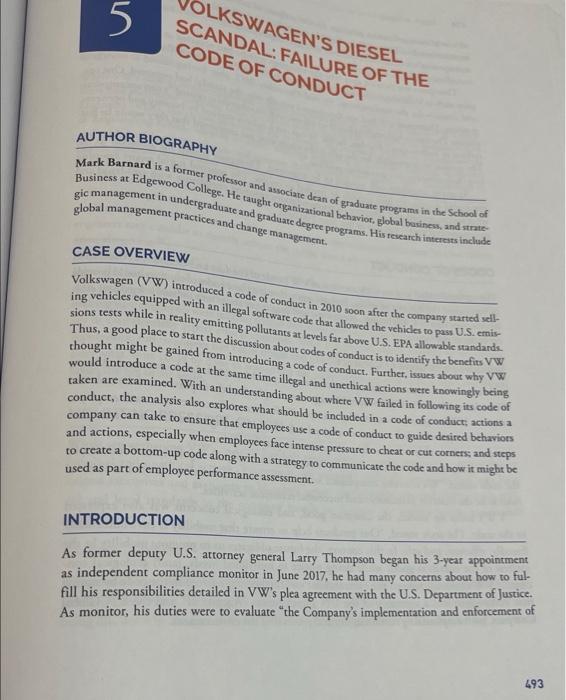
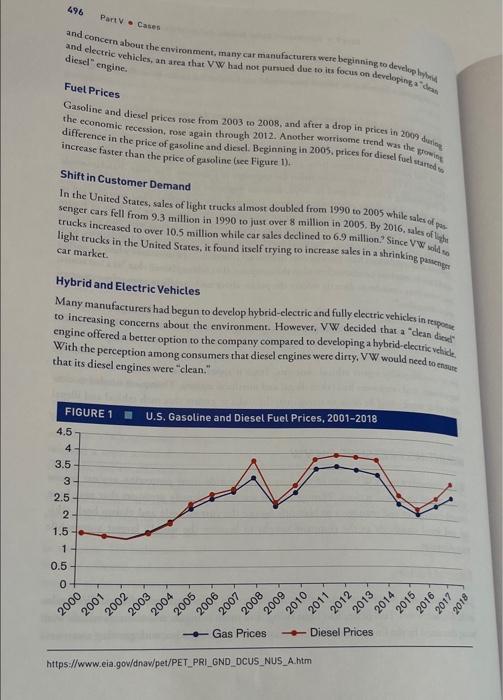
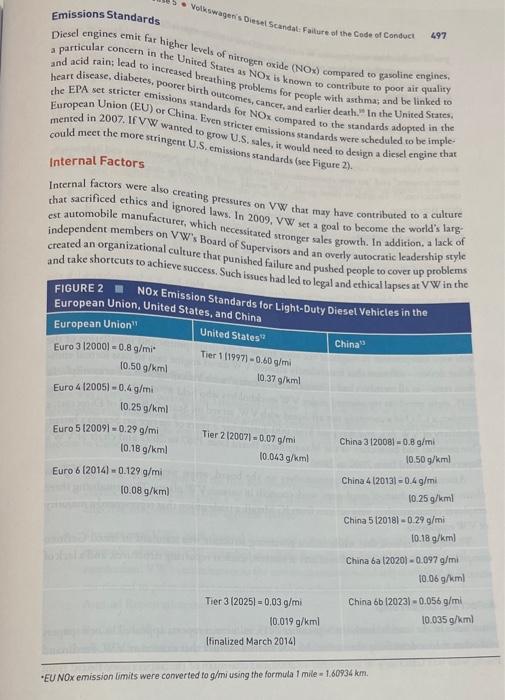
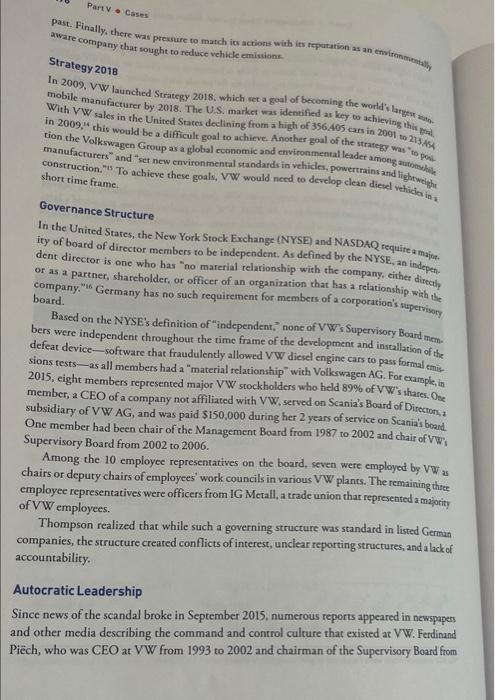
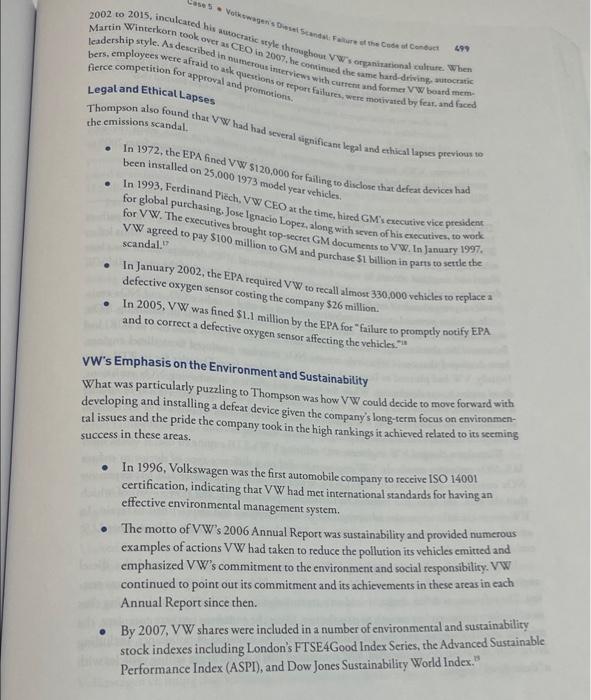
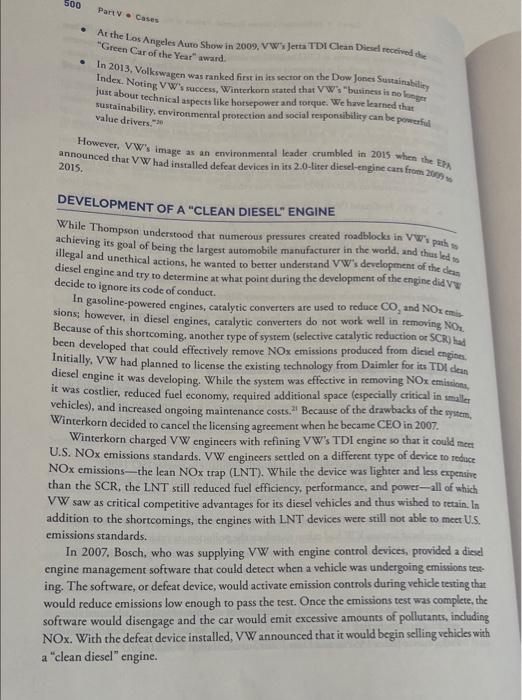
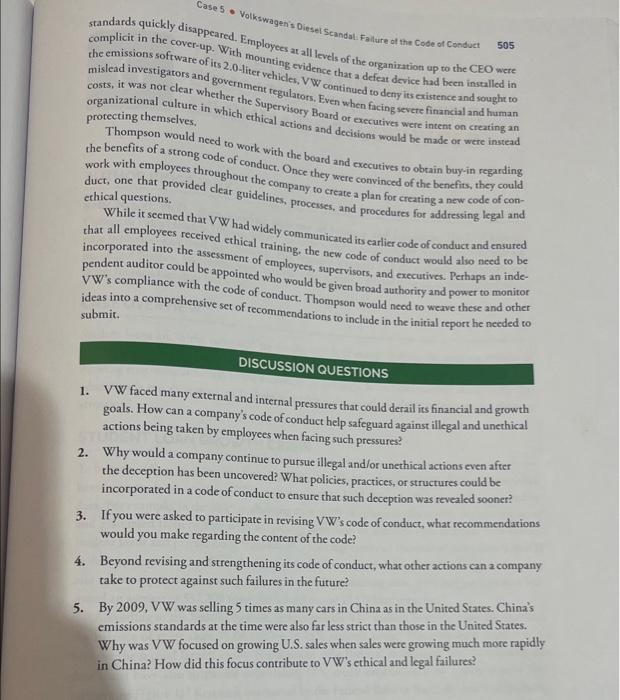
5 OLKSWAGEN'S DIESEL SCANDAL: FAILURE OF THE CODE OF CONDUCT AUTHOR BIOGRAPHY Business at Mark Barnard is a former professor and associate dean of graduate programs in the School of Edgewood College. He taught organizational behavior, global business, and strate- gic management in undergraduate and graduate degree programs. His research interests include global management practices and change management. CASE OVERVIEW Volkswagen (VW) introduced a code of conduct in 2010 soon after the company started sell- ing vehicles equipped with an illegal software code that allowed the vehicles to pass U.S. emis- sions tests while in reality emitting pollutants at levels far above U.S. EPA allowable standards. Thus, a good place to start the discussion about codes of conduct is to identify the benefits VW thought might be gained from introducing a code of conduct. Further, issues about why VW would introduce a code at the same time illegal and unethical actions were knowingly being taken are examined. With an understanding about where VW failed in following its code of conduct, the analysis also explores what should be included in a code of conduct; actions a company can take to ensure that employees use a code of conduct to guide desired behaviors and actions, especially when employees face intense pressure to cheat or cut corners; and steps to create a bottom-up code along with a strategy to communicate the code and how it might be used as part of employee performance assessment. INTRODUCTION As former deputy U.S. attorney general Larry Thompson began his 3-year appointment as independent compliance monitor in June 2017, he had many concerns about how to ful- fill his responsibilities detailed in VW's plea agreement with the U.S. Department of Justice. As monitor, his duties were to evaluate "the Company's implementation and enforcement of 493 494 Part V Cases its compliance and ethics program for the purpose of preventing future criminal fraud and environmental violations including "an assessment of the Board of Management's and seni management's commitment to, and effective implementation of, the Company's corporate compliance and ethics program." Thompson was puzzled as to why the emissions scandal had occurred at a successful com and concern for the environment. By mid-December 2017, after having served 6 months a pany such as Volkswagen that had a strong brand name, a reputation for well-designed vehicles, monitor, Thompson still had not determined exactly why the scandal had occurred. One con clusion Thompson had reached based on his research was that there existed "a corrupt corporate culture at Volkswagen. Further, he felt "it was not a culture marked by honesty and opennes The executives responsible for the affair obviously were not concerned that they would be put ting their company in a precarious position." remaining documents and records he needed to review. The required initial report assessing As many questions still needed to be answered, Thompson turned his attention to the what had happened and "making recommendations ensuring compliance with anti-fraud and environmental laws") was due in less than 100 days. CODES OF CONDUCT Thompson decided to start with a review of VW's code of conduct and Germany's Association of Engineers' (VDI) code of ethics. Perhaps strengthening these codes of conduct could provide clearer direction to VW's boards, executives, and employees about how to handle legal and ethi cal issues in the future. Volkswagen's Code of Conduct Volkswagen first released a formal code of conduct in May 2010. In the foreword, Martin Winterkorn, Chair of VW's Board of Management, emphasized the importance of the code and called on VW's supervisors to lead by example. To further reinforce the code, each employee received a copy, attended seminars, received information through internal communication channels, and was able to access the code on the company's website. The code placed an emphasis on compliance with laws and ethical principles. For example, the code stated. "We consider compliance with international conventions, laws, and internal rules to be the basis for sustainable and successful economic activities. VW's focus on justice, the common good, and ecological concerns was also expressed in the code. The code stated, "Our products help to ensure that mobility is environmentally friendly, efficient, and safe. In this context, the future obligates us to promote mobility in the interest of the common good, while doing justice to individual needs, [and] ecological con- cerns." VW's commitment to the environment was further emphasized in the code by noting that Volkswagen was a signatory of the UN Development "Agenda 21" and the UN Global Compact, both emphasizing sustainability and protecting the environment. Case 5 Volkswagen's Diesel Scandal: Failure of the Code of Conduct An anticorruption officer and two ombudsmen were available to employees to raise eth- ical or corruption issues. Information provided was "strictly confidential, and the name of an employee who raised an ethical issue would not be revealed unless he or she gave consent 495 to do so. Fundamentals of Engineering Ethics-German Association of Engineers (VDI) While VW's code of conduct provided guidance regarding legal and ethical issues, VW's engi- neers had additional guidance from a code of ethics adopted by the German Association of Engineers (VDI), the largest association for engineers in Germany. The code, Fundamentals of Engineering Ethics, adopted in 2002, directed engineers to consider "societal, economic and ecological feasibility of technical systems; their usability and safety, their contribution to health, personal development and welfare of the citizens; their impact on the lives of future generations. Priorities regarding national laws versus employee contracts were also addressed in VDI's code. The code stated, "National laws have priority over professional regulations, such professional regulations have priority over individual contracts." In situations where a conflict could not be resolved satisfactorily within the company, the code explained that "as a last resort, engineers may consider to directly inform the public about such conflicts or to refuse co-opet- ation altogether." After reviewing VW's and VDI's codes of conduct, it was apparent to Thompson that exist- ing codes had provided some basic guidance regarding ethical behaviors and actions. In addi- tion, employees had received training regarding VW's code, supervisors were responsible for making sure employees were making ethical decisions, and pathways were provided for employ- ees to confidentially report ethical concerns. Since it appeared that a number of executives. supervisors, and employees had taken illegal and unethical actions, Thompson needed to co- sider what more could be done to strengthen the codes to ensure that such ethical and illegal lapses did not occur again. MOUNTING PRESSURE ON VW While strengthening VW's code of conduct could provide some protection against future criminal and unethical actions. Thompson also wanted to identify pressures that may have caused executives and managers to blatantly ignore the current code and violate both ethi- cal and legal standards as the company sought to become the world's largest automobile manufacturer. External Factors Thompson found a number of external factors that could have negatively affected diesel sales in the United States. Fuel prices had been rising, and more stringent emissions standards were being discussed by the Environmental Protection Agency (EPA). Also, with growing awareness 496 Part V Cases and concern about the environment, many car manufacturers were beginning to develop hybrid and electric vehicles, an area that VW had not pursued due to its focus on developing a dea diesel engine. Fuel Prices the economic recession, rose again through 2012. Another worrisome trend was the growing Gasoline and diesel prices rose from 2003 to 2008, and after a drop in prices in 2009 during difference in the price of gasoline and diesel. Beginning in 2005, prices for diesel fuel started to increase faster than the price of gasoline (see Figure 1). Shift in Customer Demand In the United States, sales of light trucks almost doubled from 1990 to 2005 while sales of pas senger cars fell from 9.3 million in 1990 to just over 8 million in 2005. By 2016, sales of light trucks increased to over 10.5 million while car sales declined to 6.9 million. Since VW sold o light trucks in the United States, it found itself trying to increase sales in a shrinking passenger car market. Hybrid and Electric Vehicles Many manufacturers had begun to develop hybrid-electric and fully electric vehicles in response to increasing concerns about the environment. However, VW decided that a "dean die engine offered a better option to the company compared to developing a hybrid-electric vehicle With the perception among consumers that diesel engines were dirty, VW would need to en that its diesel engines were "clean." FIGURE 1 U.S. Gasoline and Diesel Fuel Prices, 2001-2018 4.5 4 3.5 3- 2.5 2 1.5 1 0.5 0 2000 2001 2002 2003 2004 2005 2006 2007 2008 2009 2010 2011 Gas Prices https://www.eia.gov/dnav/pet/PET_PRI_GND_DCUS_NUS_A.htm 2012 Diesel Prices 2013 2014 2015 2016 2017 2018 Emissions Standards Volkswagen's Diesel Scandal: Failure of the Code of Conduct 497 Diesel engines emit far higher levels of nitrogen oxide (NOx) compared to gasoline engines, concern in the United States as NOx is known to contribute to poor air quality a particular and acid rain; lead to increased breathing problems for people with asthma; and be linked to heart disease, diabetes, poorer birth outcomes, cancer, and earlier death." In the United States, the EPA set stricter emissions standards for NOx compared to the standards adopted in the European Union (EU) or China. Even stricter emissions standards were scheduled to be imple- mented in 2007. If VW wanted to grow U.S. sales, it would need to design a diesel engine that could meet the more stringent U.S. emissions standards (see Figure 2). Internal Factors Internal factors were also creating pressures on VW that may have contributed to a culture that sacrificed ethics and ignored laws. In 2009, VW set a goal to become the world's larg est automobile manufacturer, which necessitated stronger sales growth. In addition, a lack of independent members on VW's Board of Supervisors and an overly autocratic leadership style created an organizational culture that punished failure and pushed people to cover up problems and take shortcuts to achieve success. Such issues had led to legal and ethical lapses at VW in the FIGURE 2 NOX Emission Standards for Light-Duty Diesel Vehicles in the European Union, United States, and China European Union" United States" China" Euro 3 120001 0.8 g/mi Tier 1 (1997)-0.60 g/mi 10.37 g/kml Euro 4 (2005)-0.4 g/mi 10.25 g/kml Euro 5 (2009)-0.29 g/mi Tier 2 (2007)-0.07 g/mi China 3 120081-0.8 g/mi (0.18 g/kml 10.043 g/km) Euro 6 (2014)-0.129 g/mi China 4 (2013)-0.4 g/mi (0.08 g/km) 10.25 g/kml China 5 (2018)-0.29 g/mi 10.18 g/km) China 6a (2020)-0.097 g/mi 10.06 g/km) Tier 3 (2025) 0.03 g/mi China 6b (2023)-0.056 g/mi 10.035 g/km) 10.019 g/kml (finalized March 2014) *EU NOx emission limits were converted to g/mi using the formula 1 mile-1.60934 km. (0.50 g/km) 10.50 g/km) Part V Cases environmentally past. Finally, there was pressure to match its actions with its reputation as an e aware company that sought to reduce vehicle emissions. Strategy 2018 In 2009, VW launched Strategy 2018, which set a goal of becoming the world's largest auto mobile manufacturer by 2018. The U.S. market was identified as key to achieving this goal With VW sales in the United States declining from a high of 356,405 cars in 2001 to 213454 in 2009," this would be a difficult goal to achieve. Another goal of the strategy was to pos tion the Volkswagen Group as a global economic and environmental leader among automobil manufacturers" and "set new environmental standards in vehicles, powertrains and lightweight construction." To achieve these goals, VW would need to develop clean diesel vehicles in a short time frame. Governance Structure In the United States, the New York Stock Exchange (NYSE) and NASDAQ require a mai ity of board of director members to be independent. As defined by the NYSE, an indepen dent director is one who has "no material relationship with the company, either directly or as a partner, shareholder, or officer of an organization that has a relationship with the company." Germany has no such requirement for members of a corporation's supervisory board. Based on the NYSE's definition of "independent, none of VW's Supervisory Board mem bers were independent throughout the time frame of the development and installation of the defeat device software that fraudulently allowed VW diesel engine cars to pass formal emis sions tests as all members had a "material relationship with Volkswagen AG. For example, in 2015, eight members represented major VW stockholders who held 89% of VW's shares. One member, a CEO of a company not affiliated with VW, served on Scania's Board of Directors, a subsidiary of VW AG, and was paid $150,000 during her 2 years of service on Scania's board. One member had been chair of the Management Board from 1987 to 2002 and chair of VW', Supervisory Board from 2002 to 2006. Among the 10 employee representatives on the board, seven were employed by VW as chairs or deputy chairs of employees' work councils in various VW plants. The remaining three employee representatives were officers from IG Metall, a trade union that represented a majority of VW employees. Thompson realized that while such a governing structure was standard in listed German companies, the structure created conflicts of interest, unclear reporting structures, and a lack of accountability. Autocratic Leadership Since news of the scandal broke in September 2015, numerous reports appeared in newspapers and other media describing the command and control culture that existed at VW. Ferdinand Pich, who was CEO at VW from 1993 to 2002 and chairman of the Supervisory Board from 499 2002 to 2015, inculcared his autocratic style throughout VW's organizational culture. When Case 5 Volkswagen's Diesel Scandal Failure of the Code of Conduct Martin Winterkorn took over as CEO in 2007, he continued the same hard-driving, autocratic leadership style. As described in numerous interviews with current and former VW board mem fierce competition for approval and promotions. were afraid to ask questions or report failures, were motivated by fear, and faced bers, employees w Legal and Ethical Lapses Thompson also found that VW had had several significant legal and ethical lapses previous to the emissions scandal. In 1972, the EPA fined VW $120,000 for failing to disclose that defeat devices had been installed on 25,000 1973 model year vehicles. . In 1993, Ferdinand Piech, VW CEO at the time, hired GM's executive vice president for global purchasing, Jose Ignacio Lopez, along with seven of his executives, to work for VW. The executives brought top-secret GM documents to VW. In January 1997. VW agreed to pay $100 million to GM and purchase $1 billion in parts to settle the scandal. In January 2002, the EPA required VW to recall almost 330,000 vehicles to replace a defective oxygen sensor costing the company $26 million. In 2005, VW was fined $1.1 million by the EPA for "failure to promptly notify EPA and to correct a defective oxygen sensor affecting the vehicles. VW's Emphasis on the Environment and Sustainability What was particularly puzzling to Thompson was how VW could decide to move forward with developing and installing a defeat device given the company's long-term focus on environmen tal issues and the pride the company took in the high rankings it achieved related to its seeming success in these areas . In 1996, Volkswagen was the first automobile company to receive ISO 14001 certification, indicating that VW had met international standards for having an effective environmental management system. The motto of VW's 2006 Annual Report was sustainability and provided numerous examples of actions VW had taken to reduce the pollution its vehicles emitted and emphasized VW's commitment to the environment and social responsibility. VW continued to point out its commitment and its achievements in these areas in each Annual Report since then. By 2007, VW shares were included in a number of environmental and sustainability stock indexes including London's FTSE4Good Index Series, the Advanced Sustainable Performance Index (ASPI), and Dow Jones Sustainability World Index." 500 Part V Cases At the Los Angeles Auto Show in 2009, VW's Jetta TDI Clean Diesel received the "Green Car of the Year" award. . In 2013, Volkswagen was ranked first in its sector on the Dow Jones Sustainability Index. Noting VW's success, Winterkorn stated that VW's "business is no longer just about technical aspects like horsepower and torque. We have learned that sustainability, environmental protection and social responsibility can be powerful value drivers." However, VW's image as an environmental leader crumbled in 2015 when the EPA announced that VW had installed defeat devices in its 2.0-liter diesel-engine cars from 2009 2015. DEVELOPMENT OF A "CLEAN DIESEL ENGINE While Thompson understood that numerous pressures created roadblocks in VW's path to achieving its goal of being the largest automobile manufacturer in the world, and thus led to illegal and unethical actions, he wanted to better understand VW's development of the clean diesel engine and try to determine at what point during the development of the engine did V decide to ignore its code of conduct. engines. In gasoline-powered engines, catalytic converters are used to reduce CO, and NOx emis sions; however, in diesel engines, catalytic converters do not work well in removing NO Because of this shortcoming, another type of system (selective catalytic reduction or SCR) had been developed that could effectively remove NOx emissions produced from diesel Initially, VW had planned to license the existing technology from Daimler for its TDI clean diesel engine it was developing. While the system was effective in removing NOx emissions it was costlier, reduced fuel economy, required additional space (especially critical in smaller vehicles), and increased ongoing maintenance costs." Because of the drawbacks of the system, Winterkorn decided to cancel the licensing agreement when he became CEO in 2007. Winterkorn charged VW engineers with refining VW's TDI engine so that it could meet U.S. NOx emissions standards. VW engineers settled on a different type of device to reduce NOx emissions the lean NOx trap (LNT). While the device was lighter and less expensive than the SCR, the LNT still reduced fuel efficiency, performance, and power-all of which VW saw as critical competitive advantages for its diesel vehicles and thus wished to retain. In addition to the shortcomings, the engines with LNT devices were still not able to meet U.S. emissions standards. In 2007, Bosch, who was supplying VW with engine control devices, provided a diesel engine management software that could detect when a vehicle was undergoing emissions test- ing. The software, or defeat device, would activate emission controls during vehicle testing that would reduce emissions low enough to pass the test. Once the emissions test was complete, the software would disengage and the car would emit excessive amounts of pollutants, including NOx. With the defeat device installed, VW announced that it would begin selling vehicles with a "clean diesel engine. States. Initial sales results were encouraging, After a decline in U.S. VW sales from 356405 VW cars with new clean diesel engines started to be sold in model year 2009 in the United Cases Volkswagen's Diesel Scandal: Failure of the Code of Conduct in 2002 to 213,454 in 2009, sales quickly grew, almost doubling by 2012 when cales reached a record high of 407,704. Unfortunately for VW, its success ultimately led to its deception being 501 uncovered. TESTING THE "CLEAN DIESEL ENGINE In 2013, the International Council on Clean Transportation (ICCT), an independent nonprofit organization that provides research, technical, and scientific analysis related to environmental performance, noticed that emissions of diesel vehicles sold in the United States were lower com- U.S. diesel vehicles to determine the reason for the better performance. pared to emissions of diesel vehicles sold in Europe. The ICCT decided to undertake a study of Partnering with West Virginia University's Center for Alternative Fuels, Engines, and Emissions (CAFEE) and the California Air Resources Board (CARB), a research study was undertaken to compare emissions in lab and on-road driving environments. Three diesel vehi- cles were tested: a 2012 VW Jetta, a 2013 VW Passat, and a BMW X5. While the emissions results from the VW vehicles tested in the lab met U.S. NOx emissions standards, the emissions during on-road tests were significantly higher for both VW vehicles. Depending on the driving environment, the NOx emissions for the Jetta ranged from almost 14 to over 34 times the EPA's NOx emissions standard of 0.07 g/mi (0.043 g/km). For the Passat, NOx emissions ranged from almost 7 to more than 18 times the EPA NOx emissions standard. The NOx emission results for the BMW X5, which had an SCR installed, were basically the same in the lab and on the road, 24 After a second set of tests confirmed the initial test results, the results were submitted to the EPA and CARB in May 2014. When questioned about the discrepancies in the lab and on-road test results, VW denied it did anything wrong and attempted to discount the disparate results. After failing numerous times to provide an acceptable explanation of the results, VW agreed to voluntarily recall 500,000 vehicles in December 2014 to "fix" the problem by upgrading the engine software. However, testing done after the software upgrade revealed that the NOx emis- sions levels of the diesel engines were basically unchanged. The EPA and CARB continued to pressure VW to explain the discrepancy. After continu- ing to stonewall and provide no reasonable explanation for the anomaly, VW was notified in July 2015 that the EPA would not certify sales for VW model year 2016 diesel vehicles in the United States. Faced with the threat of being unable to sell vehicles in the United States, VW representa- tives met with the EPA and CARB officials several times in August 2015 trying to convince officials to certify the vehicles. Unexpectedly, on August 19, 2015, a VW engineer admitted to the EPA and CARB that VW had installed a defeat device in its 2.0-liter diesel engines. Two weeks later, a second engineer provided written confirmation that defeat devices had been used. On September 18, 2015, the EPA issued a Notice of Violation of the Clean Air Act to Volkswagen claiming that Volkswagen installed defeat device software in almost 500,000 of its 502 Part V Cases model year 2009-2015 2.0-liter diesel cars sold in the United States. On September 22, 2015. Volkswagen publicly admitted to installing defeat devices. KNOWLEDGE ABOUT THE DEFEAT DEVICE After reviewing the actions that led to the installation of the defeat device and the attempted cover-up, Thompson wanted to determine to what extent senior executives had known abou and/or participated in the actions and decisions as this would help guide him in developing rec ommendations to reduce the risk of a future recurrence of such misconduct. Thompson already knew that six employees had been charged by the U.S. Department of Justice with crimes including conspiracy to defraud the United States, violating the Clean Air Act, and/or wire fraud based on their involvement in the cover-up of the defeat device. All were senior supervisors serving as heads of various VW divisions. One of the six served on the Management Board for the VW brand. even more at the time, While the involvement of such high-ranking employees was troublesome, concern was the direct involvement of Martin Winterkorn, CEO of Volkswagen and Matthias Mller, who replaced Winterkorn and was still VW's CEO. While both denied involvement in decisions about the defeat device, an increasing number of internal memos, e-mails, and documents had been released that indicated the company's decision to use the defeat device software involved many people at different levels of the company, including Winterkorn and Mller. Zaccheo Giovanni Pamio, former head of thermodynamics in Audi's engine development department, provided German prosecutors e-mails and other documents showing that top Audi managers were aware as early as 2006 that vehicles made by the division could not meet U.S. emissions standards. In 2006, Martin Winterkorn was CEO of Audi and chairman of Audi's Management Board while Matthias Mller was head of product management at Audi.26 In November 2007, a meeting was held with Winterkorn, Mller, and other executives to discuss emissions issues. Evidence had been uncovered that a presentation prepared for the meeting included information explaining how a defeat device could be used to ensure that a vehicle passed emissions tests. While acknowledging the meeting and existence of the presentation, Volkswagen said there was no evidence that either Winterkorn or Mller saw the presentation." Winterkorn was sent a memo in May 2014 about the ICCT research study and noted that the United States would likely open an investigation about whether the defeat device was installed. VW claimed that "whether and to which extent Mr. Winterkorn took notice of this memo at that time is not documented."28 Ferdinand Piech, former CEO and chair of the Board of Supervisors told German prosecutors that in February 2015 he had informed senior VW executives and directors, including Winterkorn, about the emissions cheating.29 Case 5 Volkswagen's Diesel Scandal Failure of the Code of Conduct 503 In his sentencing document, Oliver Schmidt acknowledged meeting with senior VW management in July 2015 to explain in detail the technical issues about the defeat device. Schmidt further claimed he was directed to use his connections with U.S. regulators to persuade them to provide the approvals needed to sell 2016 model year VWs in the United States. While acknowledging that Winterkorn attended the meeting, VW claimed "it is not clear whether (the meetingl participants understood already at this point in time that the change in the software violated U.S. environmental regulations." In a lawsuit filed in 2016, New York attorney general Eric Schneiderman stated that it was clear that current Volkswagen CEO Mller knew about emissions issues in July 2006. In addition, Schneiderman declared that other top VW executives, including Winterkorn, knew about the deception and participated in efforts to cover it up." On January 27, 2017, prosecutors in Germany indicated they had Winterkorn may have known of the cheating earlier than he had claimed." lence that . On May 17, 2017, German prosecutors announced they had sufficient evidence to move forward with a formal investigation of Mller noting that he was aware of the emissions scandal but did not warn shareholders. Prosecutors conducted a search of Mller's office as well as those of other senior VW executives." With all the evidence available by December 2017, and the promise of more to come, it was clear to Thompson that top-level managers had known about the cover-up and had possibly been involved in approving the installation of the defeat device. Thompson's recommendations would need to take into account how far-reaching the illegal and unethical activities had been when determining how to reduce the risk of such activities in the future. PENALTIES Thompson knew he was facing an extremely challenging task if he was to fulfill his charge to "address and reduce the risk of any recurrence of the Company's misconduct"" One strong motivational factor he could possibly use to convince VW's Supervisory Board that change was necessary was to highlight the tremendous financial, reputational, and human cost of the deception. Stock Price VW's stock price on the Frankfurt Stock Exchange fell from a high of 249.79 on March 16, 2015, to a low of 161.17 just before Volkswagen publicly admitted to the deception. Within 2 weeks of VW admitting that a defeat device had been installed, its stock price fell to 102.50. For the remainder of 2015 and through 2017, VW's stock price fluctuated from a low of 110.47 to a high of 152.88 before falling to 128.93 on August 6, 2017. VW's stock price then climbed steadily to close at 142.50 on December 30, 2017, still more than 100 below its high. 504 Part V Cases Financial Costs VW also suffered enormous financial costs related to the scandal. In VW's plea agreement, the company agreed to set aside $10 billion to buy back affected vehicles, pay $2.8 billion as part of the criminal penalty and $1.5 billion for civil claims, and commit $2 billion for investment in green energy and electric cars and new public charging stations. Also in January 2017, the court approved VW's payment of $1.2 billion to VW car dealers in the United States." VW also agreed to provide up to $2.7 billion over 3 years to government and tribal agencies to replace diesel trucks, buses, and other heavy duty diesel vehicles." Credit Ratings Due to the uncertainty associated with the lawsuits and legal charges, all three rating agencies downgraded VW's long-term credit ratings in 2015. S&P downgraded VW's credit rating two times, first on October 15, 2015, from A to A." and a second time on December 1, 2015, from A-to BBB+." Both Moody's and Fitch cut VW's credit rating once-Moody's on November 4, 2015, from A2 to A3" and Fitch on November 9, 2015, from A to BBB+." By the end of 2017, both S&P and Fitch's S&P reaffirmed their ratings of BBB.. Car Sales In 2016 in the EU, VW's car sales decreased 0.5% compared to sales in 2015 while car sales in the EU rose 6.8% overall." In 2017, overall car sales increased 3.4% in the EU while VW's sales fell 0.3%. In the United States, VW's sales continued a downward trend in 2015 and 2016 that had started in 2012. After sales of only 322,948 vehicles in 2016, down from 366,970 in 2014, VW sales rebounded slightly in 2017 with sales of 339,676 vehicles." Prison Sentences super- Finally, Thompson could also point to the criminal charges and prison sentences handed down to VW's employees involved in the scandal. Two employees received prison sentences for their involvement. Oliver Schmidt received a 7-year prison term and a $400,000 fine," and James Liang received a 40-month prison term and a $200,000 fine." Five other high-level VW visors were charged with conspiring to defraud the United States, committing wire fraud, and violating the Clean Air Act, including VW's current CEO, former CEO, and former executive chair of the board of directors. WRITING THE INITIAL REPORT Thompson recognized that a significant transformation would need to take place if VW was to implement a strong compliance and ethics culture. While VW had a code of conduct with which executives, supervisors, and employees were familiar, when pressure mounted to develop a "clean diesel" engine to launch by 2009, the commitment to following the code and legal Case 5 Volkswagen's Diesel Scandal: Failure of the Code of Conduct 505 standards quickly disappeared. Employees at all levels of the organization up to the CEO were complicit in the cover-up. With mounting evidence that a defeat device had been installed in the emissions software of its 2.0-liter vehicles, VW continued to deny its existence and sought to mislead investigators and government regulators. Even when facing severe financial and human costs, it was not clear whether the Supervisory Board or executives were intent on creating an organizational culture in which ethical actions and decisions would be made or were instead protecting themselves. Thompson would need to work with the board and executives to obtain buy-in regarding the benefits of a strong code of conduct. Once they were convinced of the benefits, they could work with employees throughout the company to create a plan for creating a new code of con- duct, one that provided clear guidelines, processes, and procedures for addressing legal and ethical questions. While it seemed that VW had widely communicated its earlier code of conduct and ensured that all employees received ethical training, the new code of conduct would also need to be incorporated into the assessment of employees, supervisors, and executives. Perhaps an inde- pendent auditor could be appointed who would be given broad authority and power to monitor VW's compliance with the code of conduct. Thompson would need to weave these and other ideas into a comprehensive set of recommendations to include in the initial report he needed to submit. DISCUSSION QUESTIONS 1. VW faced many external and internal pressures that could derail its financial and growth goals. How can a company's code of conduct help safeguard against illegal and unethical actions being taken by employees when facing such pressures? 2. Why would a company continue to pursue illegal and/or unethical actions even after the deception has been uncovered? What policies, practices, or structures could be incorporated in a code of conduct to ensure that such deception was revealed sooner? 3. If you were asked to participate in revising VW's code of conduct, what recommendations would you make regarding the content of the code? 4. Beyond revising and strengthening its code of conduct, what other actions can a company take to protect against such failures in the future? 5. By 2009, VW was selling 5 times as many cars in China as in the United States. China's emissions standards at the time were also far less strict than those in the United States. Why was VW focused on growing U.S. sales when sales were growing much more rapidly in China? How did this focus contribute to VW's ethical and legal failures









 Study Help