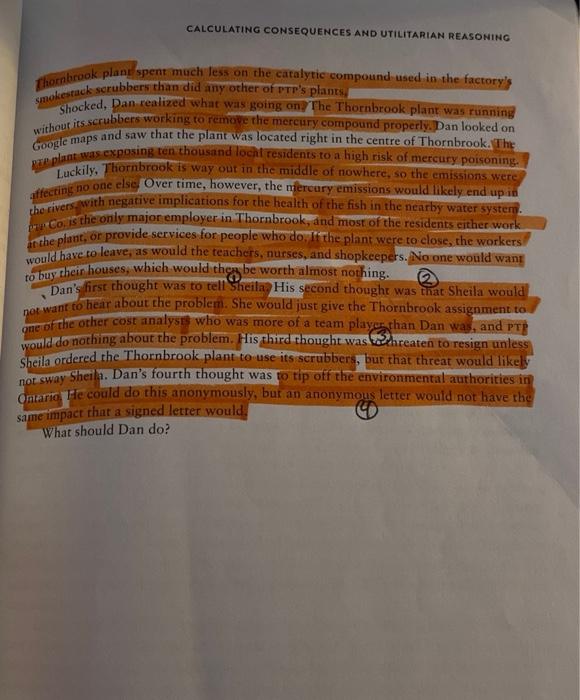
Question: A) Analyze the case study with a positive cost-benefit analysis. Note the three or four scenarios listed in the last paragraph of the case study.
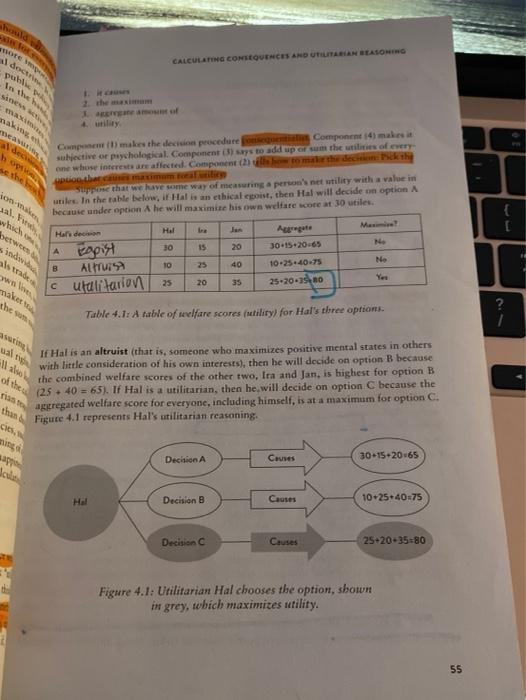
A) Analyze the case study with a positive cost-benefit analysis. Note the three or four scenarios listed in the last paragraph of the case study. Describe or actually create a table similar to Table 4.1 (p. 55) that contains a column for each alternative scenario and a row for each person with moral standing (you can create a column for "Thornbrook" but just remember that it represents many people). Designate the units of utility that you think each person will experience in each scenario. As with the payoff matrices that we review in class last week, these numbers are ultimately arbitrary... Just try to be consistent with whatever method you use to come up with the numbers and make sure that you pay attention their relative values. Lastly, aggregate all the numbers in each column and state the total utility for each scenario in the last row (as it does in Table 4.1).
B) Finish your analysis with a normative cost-benefit analysis using the info you presented in (A) above. Among the scenarios, which would Dan select if he was a Utilitarian? Which do you think he should select? Explain your reasoning using at least one technical term from Ch. 4 to demonstrate your understanding of the material. If you disagree with the Utilitarian approach, make sure you draw from the chapter to explain your reasoning.
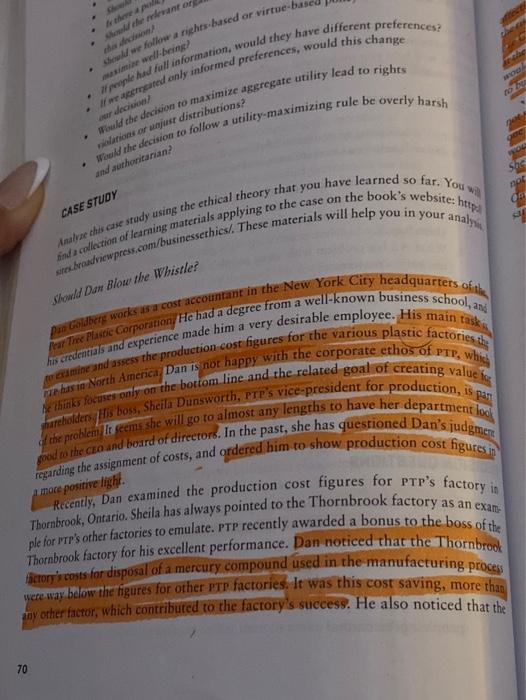
CALCULATING CONSEQUENCES AND UTTALIAN REASONINO wote doc puble che In the Sen MEN akh dece of utility Component makes the decision procedures Componen 14 makes subjective or psychological Component says to add up or sum the utilities of one whose interests are affected. Component to make the decekte Suppose that we have some way of measuring a person's net utility with a value in utiles. In the table below, if Hal is an ethical out, then Hal will decide on option A because under option & he will maximize his own welfare score at 30 utiles on maken al. which between Hal Halden 30 15 20 30.15.20.65 indi als wwnvot No B 10 25 40 Alhuis utalitarian 10.25.40-75 25-20-350 Yes 20 25 35 tycom Table 4.1: A table of welfare scores (utility) for Hal's three options ? 1 I also of the If Hal is an altruist (that is, someone who maximizes positive mental states in others with little consideration of his own interests), then he will decide on option B because the combined welfare scores of the other two, fra and Jan, is highest for option B (25. 40 = 65). If Hal is a utilitarian, then he will decide on option C because the agregated welfare score for everyone, including himself, is at a maximum for option C. Figure 4.1 represents Hal's utilitarian reasoning. than app Decision A Ceuses 30+15+2065 ! Decision B Causes 10 25.40.75 Decision Causes 25-20-35-80 Figure 4.1: Utilitarian Hal chooses the option, shown in grey, which maximizes utility. 55 how the mentor nh Show Followa nights based or virtue-bas . me well-being IT and only informed preferences, would this change imple had full information, would they have different preferences? the decision to maximize aggregate utility lead to rights ur decision lations or just distributions? the decision to follow a utility-maximizing rule be overly harsh and authoritanian CASE STUDY Showld Dan Blow the Whistler srebrand viewpress.com/businessethics/. These materials will help you in your analys find a collection of learning materials applying to the case on the book's website: http Analyze this case study using the ethical theory that you have learned so far. You his credentials and experience made him a very desirable employee. His main tasks Fear The Plastic Corporation. He had a degree from a well-known business school, an Pun Gouberg works as a cost accountant in the New York City headquarters of the mine and assess the production cost figures for the various plastic factories the in North America Dan is not happy with the corporate ethos of PTP, which shareholders His boss, Sheila Dunsworth, PTP's vice-president for production, is par e thinks focuses only on the bottom line and the related goal of creating value to the problem It seems she will go to almost any lengths to have her department loc food to the CEO and board of directors. In the past, she has questioned Dan's judgment regarding the assignment of costs, and ordered him to show production cost figurer u more positive light Recently, Dan examined the production cost figures for PTP's factory in Thornbrook, Ontario, Sheila has always pointed to the Thornbrook factory as an exam ple for Pr's other factories to emulate. PTP recently awarded a bonus to the boss of the Thornbrook factory for his excellent performance. Dan noticed that the Thornbrook factory's costs for disposal of a mercury compound used in the manufacturing process were way below the figures for other per factories. It was this cost saving, more than any other factor, which contributed to the factory's success. He also noticed that the 70 CALCULATING CONSEQUENCES AND UTILITARIAN REASONING Thornbrook plan spent much less on the catalytic compound used in the factory's smokestack scrubbers than did any other of Pep's plants, Shocked, Dan realized what was going on The Thornbrook plant was running without its scrubbers working to remove the mercury compound properly. Dan looked on Google maps and saw that the plant was located right in the centre of Thornbrook. The PT plant was exposing ten thousand local residents to a high risk of mercury poisoning affecting no one else Over time, however, the mercury emissions would likely end up in the rivers with negative implications for the health of the fish in the nearby water system Luckily. Thornbrook is way out in the middle of nowhere, so the emissions were une co is the only major employer in Thornbrook, and most of the residents either work er the plant, or provide services for people who do. If the plant were to close, the workers would have to leave, as would the teachers, nurses, and shopkeepers. No one would wang to buy their houses, which would they be worth almost nothing. Dan's first thought was to tell Sheila His second thought was that Sheila would not want to hear about the problem. She would just give the Thornbrook assignment to one of the other cost analyses who was more of a team player than Dan was, and ptg pould do nothing about the problem. His third thought was threaten to resign unless Sheila ordered the Thornbrook plant to use its scrubbers, but that threat would likely not sway Sheila. Dan's fourth thought was to tip off the environmental authorities in Ontario He could do this anonymously, but an anonymous letter would not have the same impact that a signed letter would What should Dan do









 Study Help