







Question: (a) (b) (C) (d) The supply function is the inverse of the marginal cost function. If the supply function is g = 43;), then we
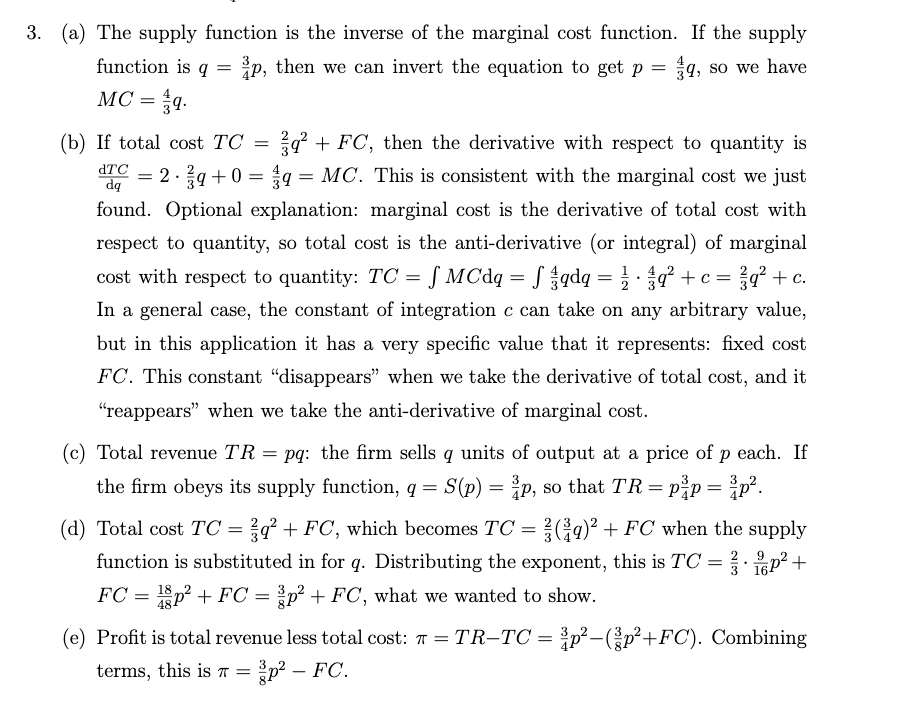
(a) (b) (C) (d) The supply function is the inverse of the marginal cost function. If the supply function is g = 43;), then we can invert the equation to get 33 = go, so we have M0 = 3:}. If total cost TC = ng + F C, then the derivative with respect to quantity is % = 2 - g + 0 = go = MC. This is consistent with the marginal cost we just found. Optional explanation: marginal cost is the derivative of total cost with respect to quantity, so total cost is the antiderivative (or integral) of marginal cost with respect to quantity: TC = fMqu = f quq = g - 2192 + c = ng + c. In a general case, the constant of integration 0 can take on any arbitrary value, but in this application it has a very specic value that it represents: xed cost F0. This constant \"disappears\" when we take the derivative of total cost, and it \"reappears\" when we take the antiderivative of marginal cost. Total revenue TR = pq: the rm sells 9 units of output at a price of p each. If the rm obeys its supply function, g = 3(1)) = 3p, so that TR = pip = 3,112. Total cost T0 = ng + F0, which becomes T0 = Egg)2 + F0 when the supply function is substituted in for q. Distributing the exponent, this is T0 = - 1361.512 + PC = pz + F0 = 3102 + F0, what we wanted to show. Prot is total revenue less total cost: a = TR TC = E gap(3132 +FC'). Combining terms, this is 1r =31)? FC
Step by Step Solution
There are 3 Steps involved in it

Get step-by-step solutions from verified subject matter experts
 Study Help