







Question: AP #1: A. B. C. D Use this function: f(X) = (1/3) X* + X*=3X +1 Find the derivative (a.k.a. first derivative) f'(X) = Solve
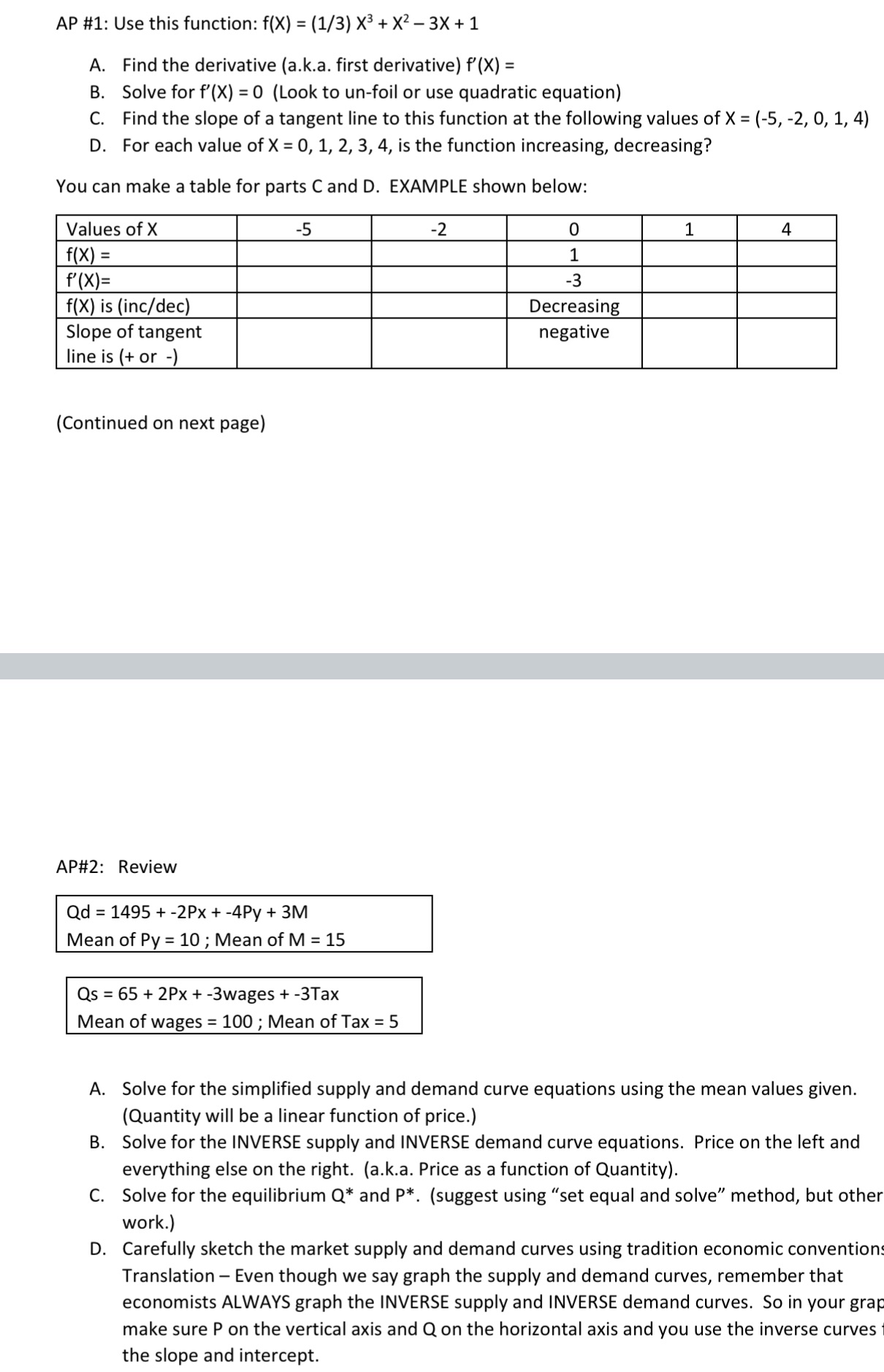
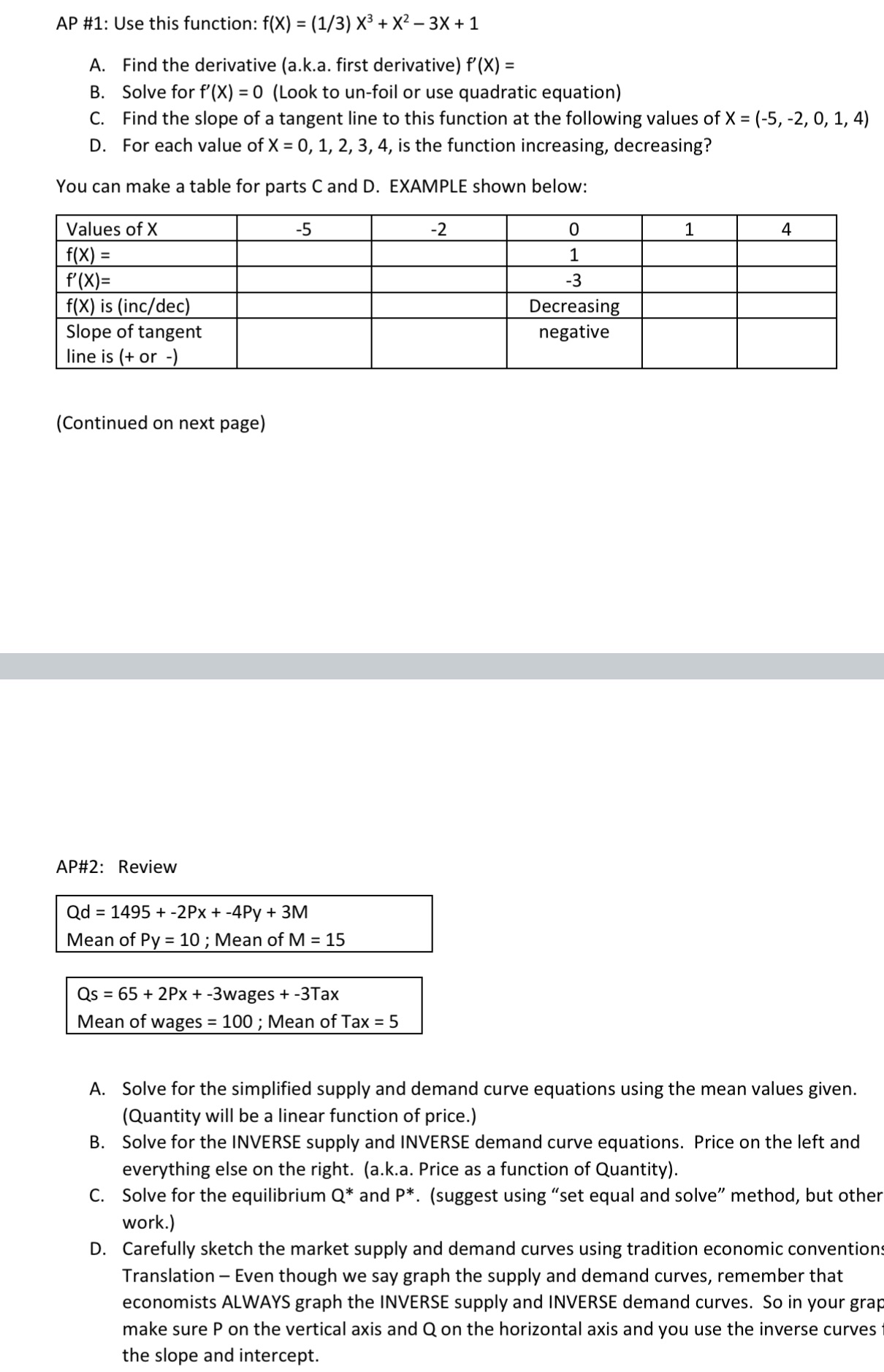
AP #1: A. B. C. D Use this function: f(X) = (1/3) X* + X*=3X +1 Find the derivative (a.k.a. first derivative) f'(X) = Solve for f'(X) =0 (Look to un-foil or use quadratic equation) Find the slope of a tangent line to this function at the following values of X = (-5, -2, 0, 1, 4) For each value of X =0, 1, 2, 3, 4, is the function increasing, decreasing? You can make a table for parts C and D. EXAMPLE shown below: Valuesofx | -5 | 2 | o | 1 | 4 0= o x =0y 3 ] fQistnc/ded | | | Decreasg | | | Slope of tangent negative lineis (+ or -) (Continued on next page) AP#2: Review Qd = 1495 + -2Px + -4Py + 3M Mean of Py = 10 ; Mean of M = 15 Qs =65 + 2Px + -3wages + -3Tax Mean of wages = 100 ; Mean of Tax =5 A. Solve for the simplified supply and demand curve equations using the mean values given. (Quantity will be a linear function of price.) Solve for the INVERSE supply and INVERSE demand curve equations. Price on the left and everything else on the right. (a.k.a. Price as a function of Quantity). Solve for the equilibrium Q* and P*. (suggest using \"set equal and solve\" method, but other work.) Carefully sketch the market supply and demand curves using tradition economic convention: Translation Even though we say graph the supply and demand curves, remember that economists ALWAYS graph the INVERSE supply and INVERSE demand curves. So in your grag make sure P on the vertical axis and Q on the horizontal axis and you use the inverse curves the slope and intercept
Step by Step Solution
There are 3 Steps involved in it

Get step-by-step solutions from verified subject matter experts
 Study Help