







Question: a b It can be shown that the Hill cipher with the matrix requires that (ad - bc) is relatively cd prime to 26; that
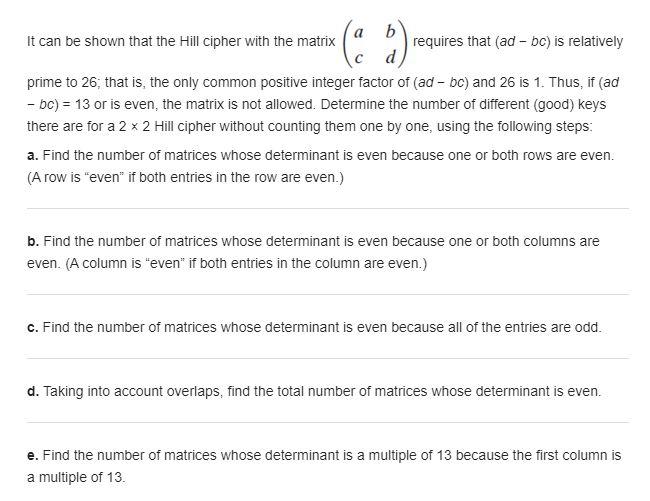
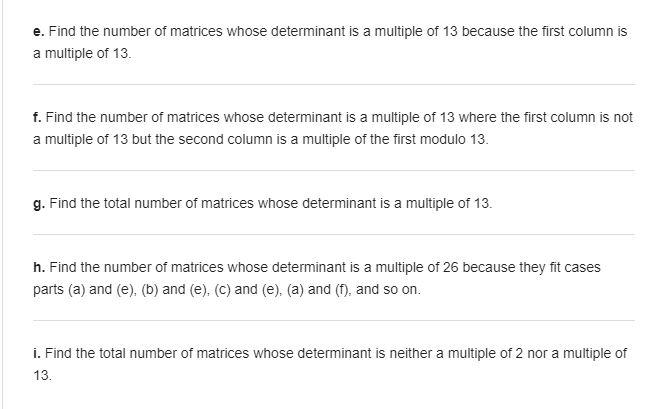
a b It can be shown that the Hill cipher with the matrix requires that (ad - bc) is relatively cd prime to 26; that is, the only common positive integer factor of (ad - bc) and 26 is 1. Thus, if (ad - bc) = 13 or is even the matrix is not allowed. Determine the number of different (good) keys there are for a 2 x 2 Hill cipher without counting them one by one, using the following steps: a. Find the number of matrices whose determinant is even because one or both rows are even. (A row is "even" if both entries in the row are even.) b. Find the number of matrices whose determinant is even because one or both columns are even. (A column is "even" if both entries in the column are even.) C. Find the number of matrices whose determinant is even because all of the entries are odd. d. Taking into account overlaps, find the total number of matrices whose determinant is even. e. Find the number of matrices whose determinant is a multiple of 13 because the first column is a multiple of 13. e. Find the number of matrices whose determinant is a multiple of 13 because the first column is a multiple of 13. f. Find the number of matrices whose determinant is a multiple of 13 where the first column is not a multiple of 13 but the second column is a multiple of the first modulo 13. g. Find the total number of matrices whose determinant is a multiple of 13. h. Find the number of matrices whose determinant is a multiple of 26 because they fit cases parts (a) and (e), (b) and (e), (C) and (e), (a) and (1), and so on. i. Find the total number of matrices whose determinant is neither a multiple of 2 nor a multiple of 13. a b It can be shown that the Hill cipher with the matrix requires that (ad - bc) is relatively cd prime to 26; that is, the only common positive integer factor of (ad - bc) and 26 is 1. Thus, if (ad - bc) = 13 or is even the matrix is not allowed. Determine the number of different (good) keys there are for a 2 x 2 Hill cipher without counting them one by one, using the following steps: a. Find the number of matrices whose determinant is even because one or both rows are even. (A row is "even" if both entries in the row are even.) b. Find the number of matrices whose determinant is even because one or both columns are even. (A column is "even" if both entries in the column are even.) C. Find the number of matrices whose determinant is even because all of the entries are odd. d. Taking into account overlaps, find the total number of matrices whose determinant is even. e. Find the number of matrices whose determinant is a multiple of 13 because the first column is a multiple of 13. e. Find the number of matrices whose determinant is a multiple of 13 because the first column is a multiple of 13. f. Find the number of matrices whose determinant is a multiple of 13 where the first column is not a multiple of 13 but the second column is a multiple of the first modulo 13. g. Find the total number of matrices whose determinant is a multiple of 13. h. Find the number of matrices whose determinant is a multiple of 26 because they fit cases parts (a) and (e), (b) and (e), (C) and (e), (a) and (1), and so on. i. Find the total number of matrices whose determinant is neither a multiple of 2 nor a multiple of 13
Step by Step Solution
There are 3 Steps involved in it

Get step-by-step solutions from verified subject matter experts
 Study Help