







Question: a Background Information In a crystalline solid, the unit cell is the smallest repeating unit in a much larger three-dimensional structure. Because of this comers,
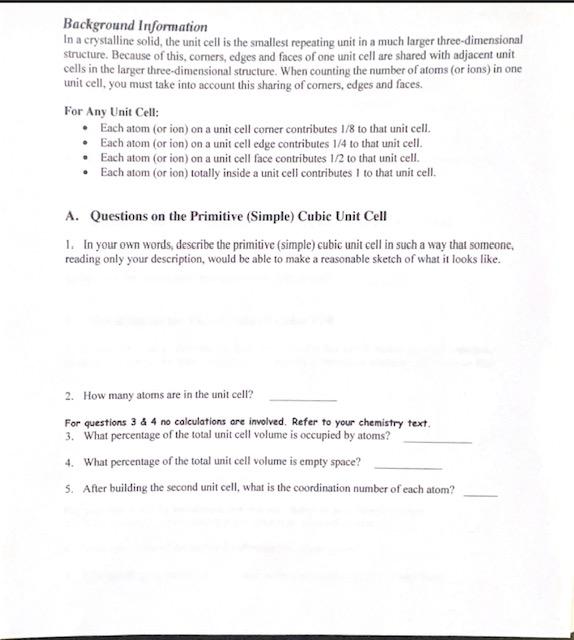
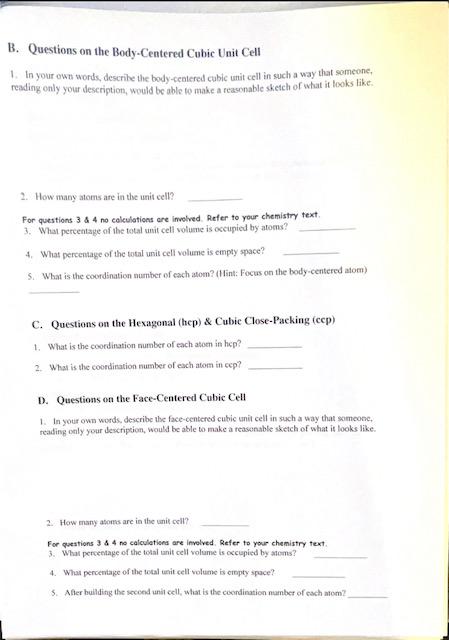
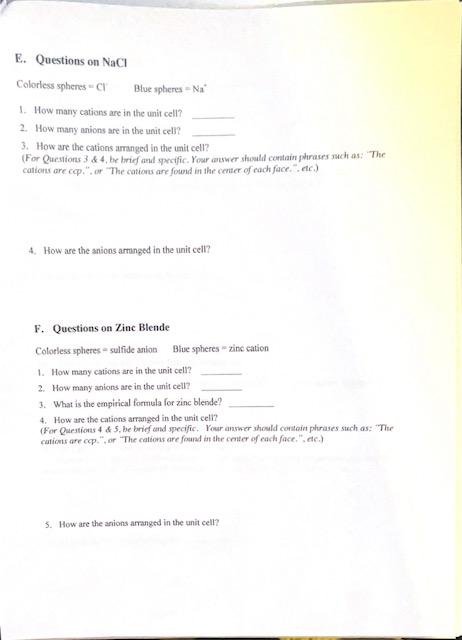
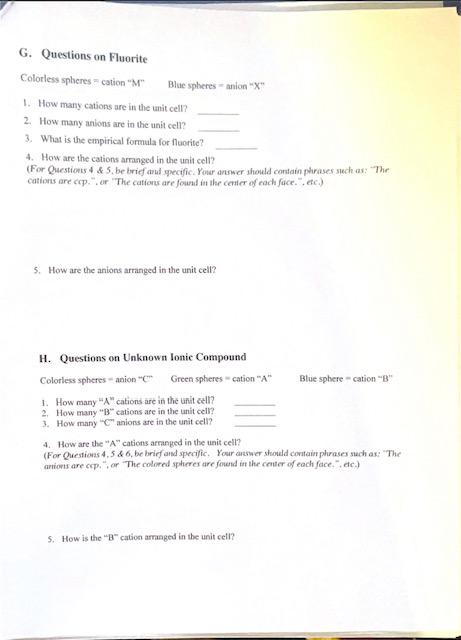
a Background Information In a crystalline solid, the unit cell is the smallest repeating unit in a much larger three-dimensional structure. Because of this comers, edges and faces of one unit cell are shared with adjacent unit cells in the larger three-dimensional structure. When counting the number of atoms (or ions) in one unit cell, you must take into account this sharing of comers, edges and faces. For Any Unit Cell: Each atom (or ion) on a unit cell corner contributes 1/8 to that unit cell. Each atom (or ion) on a unit cell edge contributes 1/4 to that unit cell Each atom (or ion) on a unit cell face contributes 1/2 to that unit cell Each atom (or ion) totally inside a unit cell contributes to that unit cell. A. Questions on the Primitive (Simple) Cubic Unit Cell 1. In your own words, describe the primitive (simple) cubic unit cell in such a way that someone, reading only your description, would be able to make a reasonable sketch of what it looks like. 2. How many atoms are in the unit cell? For questions 3 & 4 no calculations are involved. Refer to your chemistry text. 3. What percentage of the total unit cell volume is occupied by atoms? 4. What percentage of the total unit cell volume is empty space? 5. After building the second unit cell, what is the coordination number of each atom? B. Questions on the Body-Centered Cubic Unit Cell In your own words, describe the body-centered cubic unit cell in such a way that someone reading only your description, would be able to make a reasonable sketch of what it looks like. 2. How many atoms are in the unit cell? For questions 3 & 4 no calculations are involved. Refer to your chemistry text 3. What percentage of the total unit cell volume is occupied by atoms? 4. What percentage of the total unit cell volume is empty space? 5. What is the coordination number of each asom? (Ilint: Focus on the body-centered atom) C. Questions on the Hexagonal (hep) & Cubic Close-Packing (ccp) 1. What is the coordination number of each atoen in hcp? 2. What is the coordination number of cach atom in cep? D. Questions on the Face-Centered Cubic Cell 1. In your own words, describe the face-centered cubic unit cell in such a way that someone reading only your description, would be able to make a reasonable sketch of what it looks like. 2. How many atoms are in the unit cell? For questions 3 & 4 ne calculations are involved. Refer to your chemistry text 3. What percentage of the total unit cell volume is occupied by atoms? 4. What percentage of the total unit cell volume is eropty space? 5. Aber building the second unit cell, what is the ceerdination mamber of cach mom? E. Questions on NaCI Colorless spheresa Blue spheres - Na 1. How many cations are in the unit cell? 2. How many anions are in the unit cell? 3. How are the cations amonged in the unit cell? (For Questions 3 & 4 be brief and fic. Your answer should contain phrases such as: The cations are cop." or "The cations are found in the center of each face...) 4. How are the anions aminged in the unit cell? F. Questions on Zinc Blende Colorless spheres-sulfide anion Blue spheres zinc cation 1. How many cations are in the unit cell? 2. How many anions are in the unit cell? 3. What is the empirical formula for zinc blende? 4. How are the cations arranged in the unit cell? (For Questions 4 & 5. he brief and specific. Your answer should constant phrases such as: "The cations are cop." or "The cations are found in the center of each face...) 5. How are the anions arranged in the unit cell? G. Questions on Fluorite Colorless spheres - cation" Blue spheres anion"X" 1. How many cations are in the unit cell? 2. How many anions are in the unit celt? 3. What is the empirical formula for fluorite? 4. How are the cations arranged in the unit cell? (For Questions & S.be brief cu specific. Your answer should contain phrases such as: The cations are cop.", or "The cations are found in the center of each face.".ee) 5. How are the anions arranged in the unit cell? H. Questions on Unknown Tonic Compound Colorless spheres anion Green spheres cation "A" Blue sphere - cation "B" 1. How many "Acations are in the unit cell? 2. How many "B"cations are in the unit cell? 3. How many "Canions are in the unit cell? 4. How are the "A"cations arranged in the unit cell? (For Questions 4.5&6 be brief and specific. Your answer should contain phrases such as: "The antions are cop.", or "The colored spheres are found in the center of each face.ec.) 5. How is the cation anged in the unit cell? 6. How are the "C" anions arranged in the unit cell? 7. What is the empirical formula of this unknown ionic compound? (Write your answer as A,B,C, where you determine the subscripts, X. y, and 2.)
Step by Step Solution
There are 3 Steps involved in it

Get step-by-step solutions from verified subject matter experts
 Study Help