







Question: Two equal mass blocks are initially at rest and sitting on a frictionless surface. A hand exerts a force of magnitude F on block A,
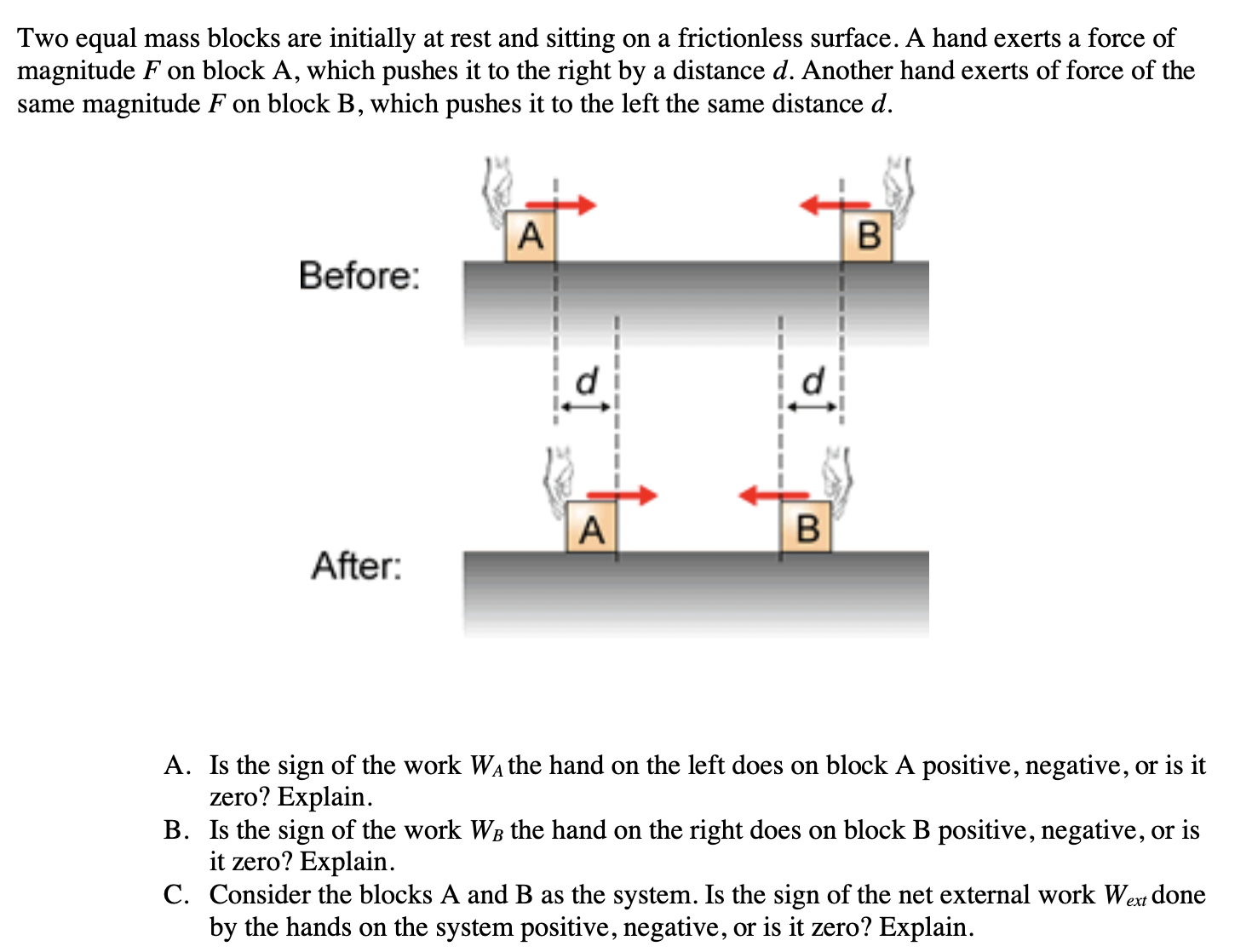
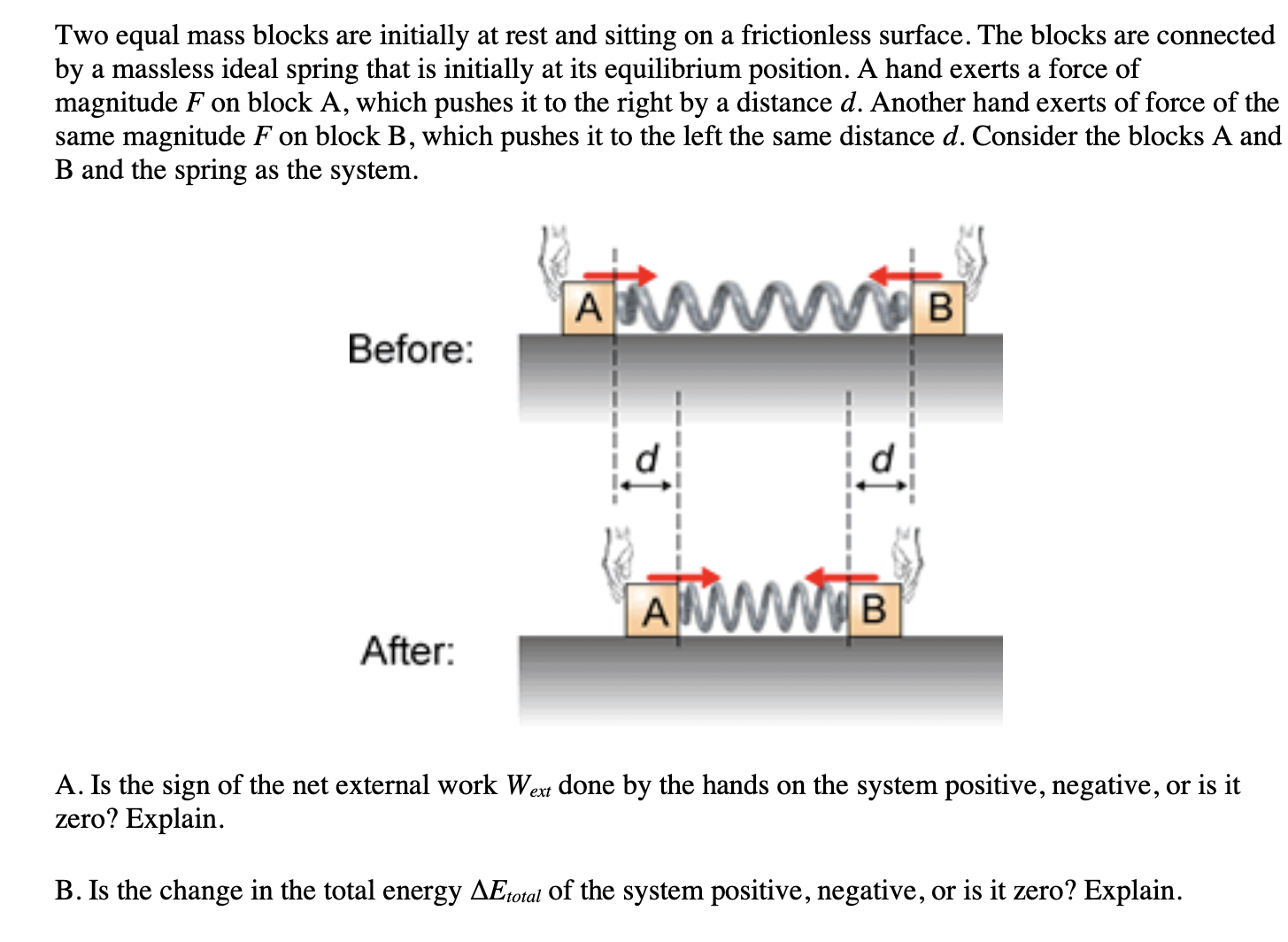
Two equal mass blocks are initially at rest and sitting on a frictionless surface. A hand exerts a force of magnitude F on block A, which pushes it to the right by a distance d. Another hand exerts of force of the same magnitude F on block B, which pushes it to the left the same distance d. A. Is the sign of the work WA the hand on the left does on block A positive, negative, or is it zero? Explain. B. Is the sign of the work W3 the hand on the right does on block B positive, negative, or is it zero? Explain. C. Consider the blocks A and B as the system. Is the sign of the net external work We,\" done by the hands on the system positive, negative, or is it zero? Explain. Two equal mass blocks are initially at rest and sitting on a frictionless surface. The blocks are connected by a massless ideal spring that is initially at its equilibrium position. A hand exerts a force of magnitude F on block A, which pushes it to the right by a distance d . Another hand exerts of force of the same magnitude F on block B, which pushes it to the left the same distance d. Consider the blocks A and B and the spring as the system. A. Is the sign of the net external work Wax! done by the hands on the system positive, negative, or is it zero? Explain. B. Is the change in the total energy AEromf of the system positive, negative, or is it zero? Explain
Step by Step Solution
There are 3 Steps involved in it

Get step-by-step solutions from verified subject matter experts
 Study Help