







Question: A binary information source generates 0 and 1 with unknown probability p = P[X = 1] which can be any number between 0 and 1.
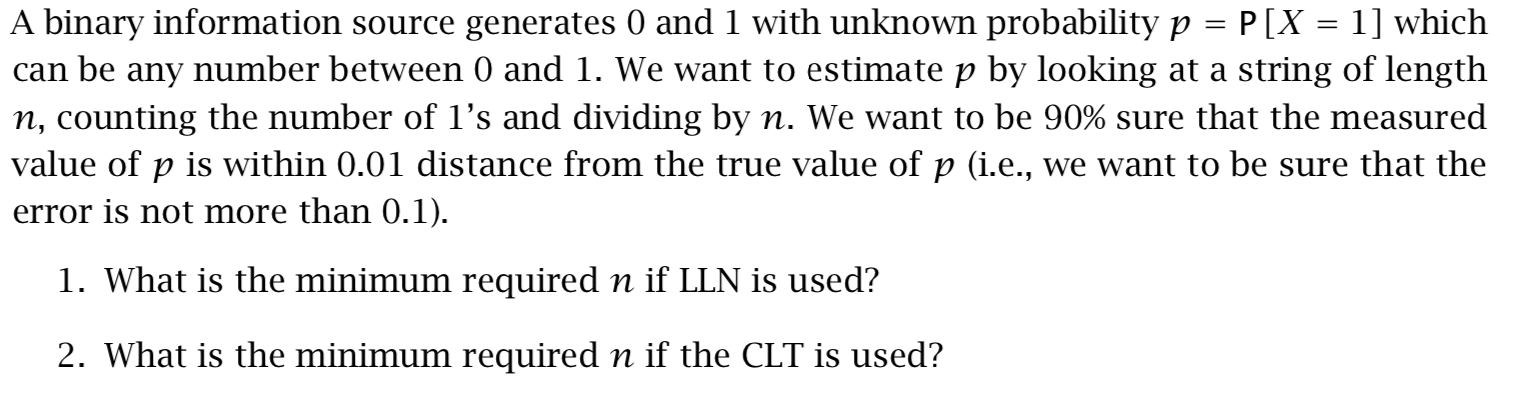
A binary information source generates 0 and 1 with unknown probability p = P[X = 1] which can be any number between 0 and 1. We want to estimate p by looking at a string of length n, counting the number of ls and dividing by n. We want to be 90% sure that the measured value of p is within 0.01 distance from the true value of p (i.e., we want to be sure that the error is not more than 0.1). 1. What is the minimum required n if LLN is used? 2. What is the minimum required n if the CLT is used? A binary information source generates 0 and 1 with unknown probability p = P[X = 1] which can be any number between 0 and 1. We want to estimate p by looking at a string of length n, counting the number of ls and dividing by n. We want to be 90% sure that the measured value of p is within 0.01 distance from the true value of p (i.e., we want to be sure that the error is not more than 0.1). 1. What is the minimum required n if LLN is used? 2. What is the minimum required n if the CLT is used
Step by Step Solution
There are 3 Steps involved in it

Get step-by-step solutions from verified subject matter experts
 Study Help