Question: - A Case Study Nissan.pdf - Adobe Acrobat Reader DC File Edit View Sign Window Help Home Tools Case Study Nissan... X Sign In 1
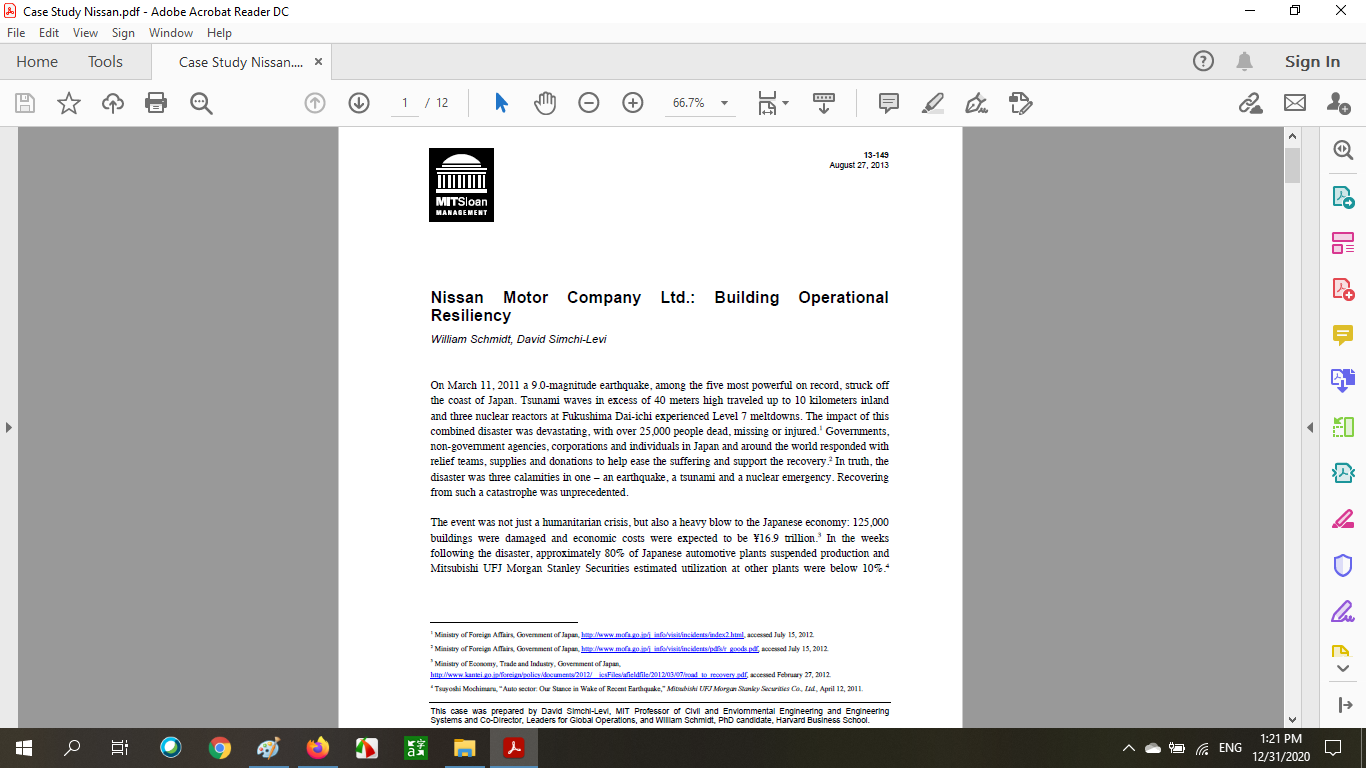
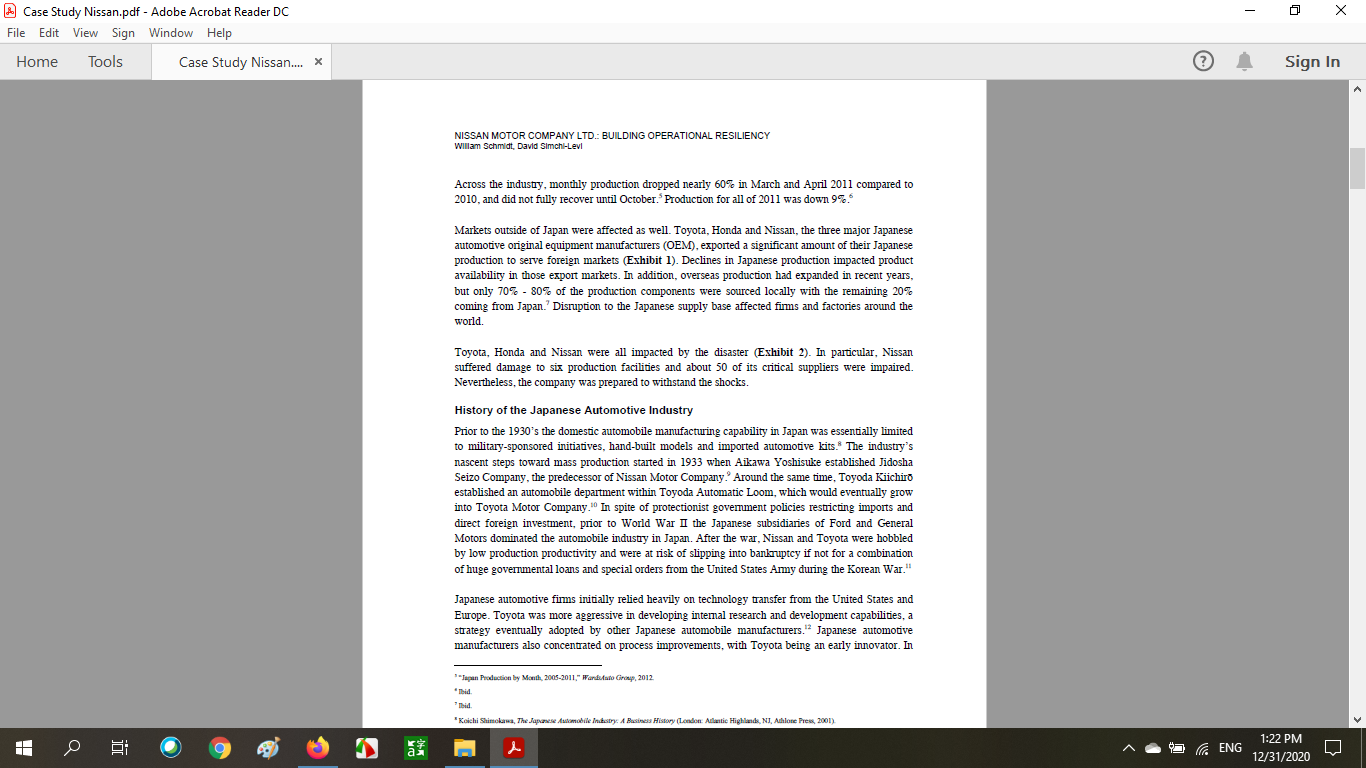
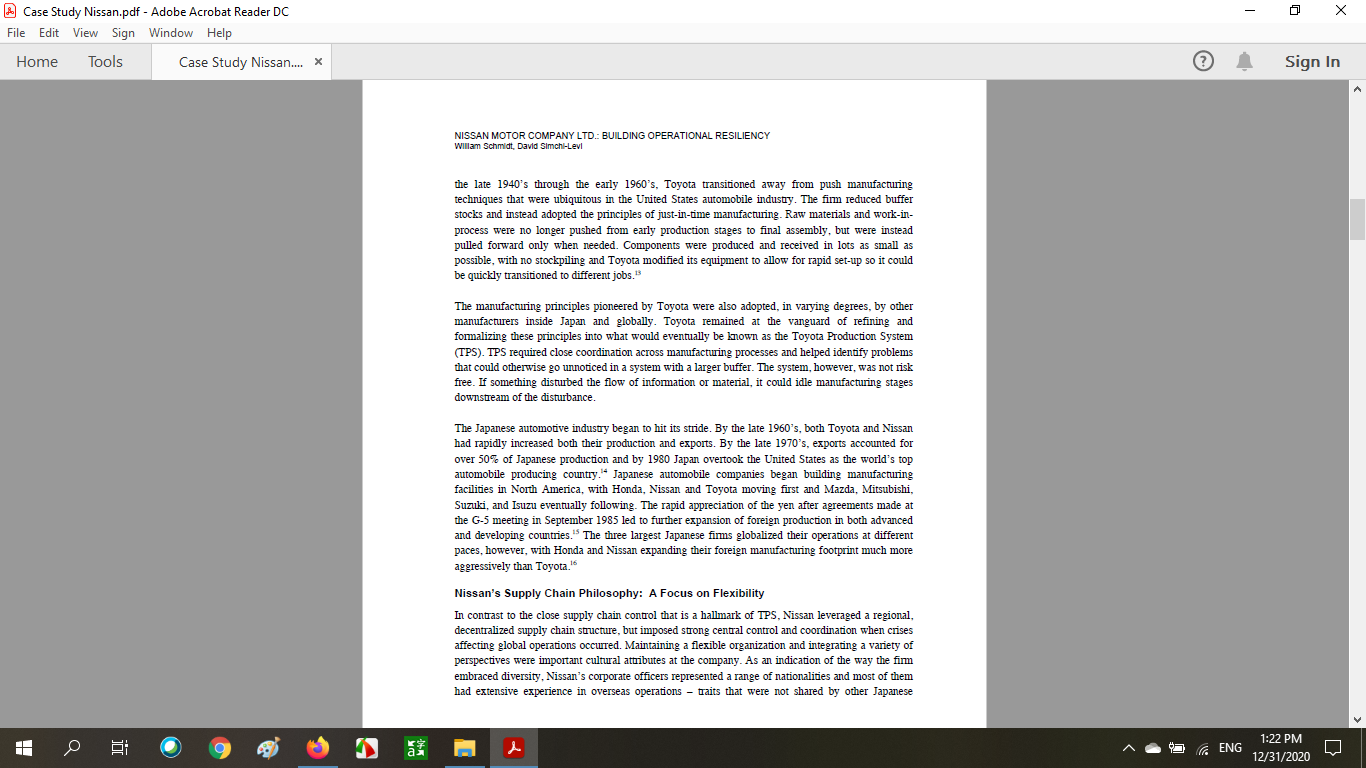
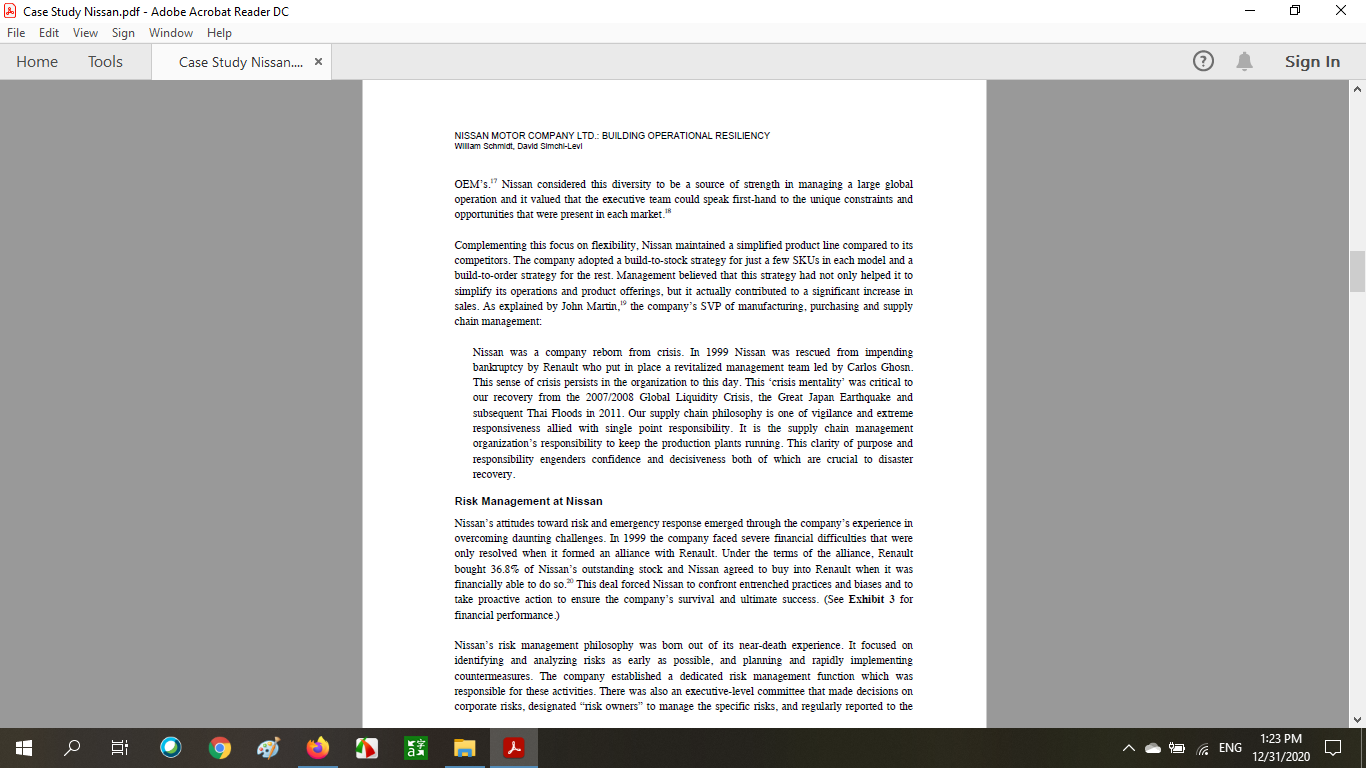
- A Case Study Nissan.pdf - Adobe Acrobat Reader DC File Edit View Sign Window Help Home Tools Case Study Nissan... X Sign In 1 1 / 12 + 66.7% 2 13-149 August 27, 2013 MITSloan MANAGEMENT Nissan Motor Company Ltd.: Building Operational Resiliency William Schmidt, David Simchi-Levi EL On March 11, 2011 a 9.0-magnitude earthquake, among the five most powerful on record, struck off the coast of Japan. Tsunami waves in excess of 40 meters high traveled up to 10 kilometers inland and three nuclear reactors at Fukushima Dai-ichi experienced Level 7 meltdowns. The impact of this combined disaster was devastating, with over 25,000 people dead, missing or injured.' Governments, non-goverment agencies, corporations and individuals in Japan and around the world responded with relief teams, supplies and donations to help ease the suffering and support the recovery. In truth, the disaster was three calamities in one - an earthquake, a tsunami and a nuclear emergency. Recovering from such a catastrophe was unprecedented. The event was not just a humanitarian crisis, but also a heavy blow to the Japanese economy: 125,000 buildings were damaged and economic costs were expected to be 16.9 trillion. In the weeks following the disaster, approximately 80% of Japanese automotive plants suspended production and Mitsubishi UFJ Morgan Stanley Securities estimated utilization at other plants were below 10%- Ministry of Foreign Affairs, Government of lapan, hmp://www.mof. 20.info/Visi incidents/index2.html accessed July 15, 2012 Ministry of Foreign Affairs, Government of lapan, himp://www.mofa.2017 info Visit incidents par good presso July 15, 2012 Ministry of Economy Trade and Industry, Government of lapan http://www.kantigo.jp foreign policy documents/2012/Filesfieldfile/2012/03/07/cal to recovery dr acessed February 27, 2012 Tsuyoshi Mochiman. "Auto sector Our Sunce in Wake of Recent Earthquake," Mimbishi UFJ Morgan Stanky Securities Co. Ind. April 12, 2011. 1 This case was prepared by David Simchi-Levi, MIT Professor of Civil and Enviommental Engineering and Engineering Systems and Co-Director, Leaders for Global Operations, and William Schmidt, PhD candidate, Harvard Business School 1 K as IT ENG 1:21 PM 12/31/2020 - A Case Study Nissan.pdf - Adobe Acrobat Reader DC File Edit View Sign Window Help Home Tools Case Study Nissan... X Sign In NISSAN MOTOR COMPANY LTD.: BUILDING OPERATIONAL RESILIENCY Across the industry, monthly production dropped nearly 60% in March and April 2011 compared to 2010, and did not fully recover until October. Production for all of 2011 was down 9%. Markets outside of Japan were affected as well. Toyota, Honda and Nissan, the three major Japanese automotive original equipment manufacturers (OEM), exported a significant amount of their Japanese production to serve foreign markets (Exhibit 1). Declines in Japanese production impacted product availability in those export markets. In addition, overseas production had expanded in recent years, but only 70% - 80% of the production components were sourced locally with the remaining 20% coming from Japan. Disruption to the Japanese supply base affected fimms and factories around the world. Toyota, Honda and Nissan were all impacted by the disaster (Exhibit 2). In particular, Nissan suffered damage to six production facilities and about 50 of its critical suppliers were impaired. Nevertheless, the company was prepared to withstand the shocks. in History of the Japanese Automotive Industry Prior to the 1930's the domestic automobile manufacturing capability in Japan was essentially limited to military-sponsored initiatives, hand-built models and imported automotive kits.* The industry's nascent steps toward mass production when Yoshisuke established Jidosha Seizo Company, the predecessor of Nissan Motor Company Around the same time, Toyoda Kiichiro established automobile department within Toyoda Automatic Loom, which would eventual grow into Toyota Motor Company. In spite of protectionist goverment policies resticting imports and direct foreign investment, prior to World War I the Japanese subsidiaries of Ford and General Motors dominated the automobile industy in Japan. After the war, Nissan and Toyota were hobbled by low production productivity and were at risk of slipping into bankruptcy if not for a combination of huge governmental loans and special orders from the United States Army during the Korean War." Japanese automotive firms initially relied heavily on technology transfer from the United States and Europe. Toyota was more aggressive in developing internal research and development capabilities, a strategy eventually adopted by other Japanese automobile manufacturers.Japanese automotive manufacturers also concentrated on process improvements, with Toyota being an early innovator. In Japan Production by Month, 2005-2011." Warburto Group, 2012 thid thid Koichi Shimokawa, The Japanese tomobile Inbestry. A Business History (London: Atlantic Highlan, NI Athlone Press, 2001) K ( ENG 1:22 PM 12/31/2020 D - Sign In NISSAN MOTOR CO.LTD.: BUILDING OPERATIONAL RESILIENCY A Case Study Nissan.pdf - Adobe Acrobat Reader DC File Edit View Sign Window Help Home Tools Case Study Nissan... X David the late 1940's through the early 1960's, Toyota transitioned away from push manufacturing techniques that were ubiquitous in the United States automobile indusay. The fim reduced buffer stocks and instead adopted the principles of just-in-time manufacturing Raw materials and work-in- process were no longer pushed from early production stages to final assembly, but were instead pulled forward only when needed. Components were produced and received in lots as small as possible, with no stockpiling and Toyota modified equipment to allow for rapid set-up so it could be quickly transitioned different jobs. The manufacturing principles pioneered by Toyota were also adopted, in varying degrees, by other manufacturers inside Japan and globally. Toyota remained at the vanguard of refining and formalizing these principles into what would eventually known as the Toyota Production System (TPS). TPS required close coordination across manufacturing processes and helped identify problems that could otherwise go unnoticed in a system with a larger buffer. The system, however, was not risk free. If something disturbed the flow of information or material, it could idle manufacturing stages downstream of the disturbance. The Japanese automotive industry began to hit its stride. By the late 1960's, both Toyota and Nissan rapidly increased both their production and exports. By the late 1970's, exports accounted for over 50% of Japanese production and by 1980 Japan overtook the United States as the world's top automobile producing country.** Japanese automobile companies began building manufacturing facilities in North America, with Honda, Nissan and Toyota moving first and Mazda, Mitsubishi, Suzuki, and Isuzu eventually following. The rapid appreciation of the yen after agreements made at the G-5 meeting in September 1985 led to further expansion of foreign production in both advanced and developing countries. The three largest Japanese fims globalized their operations at different paces, however, with Honda and Nissan expanding their foreign manufacturing footprint much more aggressively than Toyota.16 Nissan's Supply Chain Philosophy: A Focus on Flexibility In contrast to the close supply chain control that is a hallmark of TPS, Nissan leveraged a regional, decentralized supply chain structure, but imposed strong central control and coordination when crises affecting global operations occured. Maintaining a flexible organization and integrating a variety of perspectives were important cultural attributes at the company. As an indication of the way the fimm embraced diversity, Nissan's corporate officers represented a range of nationalities and most of them extensive experience in overseas operations - traits that were not shared by other Japanese K ce ENG 1:22 PM 12/31/2020 D - A Case Study Nissan.pdf - Adobe Acrobat Reader DC File Edit View Sign Window Help Home Tools Case Study Nissan... X Sign In NISSAN MOTOR COMPANY LTD.: BUILDING OPERATIONAL RESILIENCY OEM's." Nissan considered this diversity to be a source of strength in managing a large global operation and it valued that the executive team could speak first-hand to the unique constraints and opportunities that were present in each market.is Complementing this focus on flexibility, Nissan maintained a simplified product line compared to its competitors. The company adopted a build-to-stock strategy for just a few SKUs in each model and a build-to-order strategy for the rest. Management believed that this strategy had not only helped it to simplify its operations and product offerings, but it actually contributed to a significant increase in sales. As explained by John Martin," the company's SVP of manufacturing, purchasing and supply chain management: Nissan a company rebom from crisis. In 1999 Nissan was rescued from impending bankruptcy by Renault who put in place a revitalized management team led by Carlos Ghosn. This sense of crisis persists in the organization to this day. This "crisis mentality' was critical to our recovery from the 2007/2008 Global Liquidity Crisis, the Great Japan Earthquake and subsequent Thai Floods in 2011. Our supply chain philosophy is one of vigilance and extreme responsiveness allied with single point responsibility. It is the supply chain management organization's responsibility to keep the production plants running. This clarity of purpose and responsibility engenders confidence and decisiveness both of which are crucial to disaster recovery Risk Management at Nissan Nissan's attitudes toward risk and emergency response emerged through the company's experience in overcoming daunting challenges. In 1999 the company faced severe financial difficulties that were only resolved when it formed an alliance with Renault. Under the terms of the alliance, Renault bought 36.8% of Nissan's outstanding stock and Nissan agreed to buy into Renault when it was financially able to do so. This deal forced Nissan to confront entrenched practices and biases and to take proactive action to ensure the company's survival and ultimate success. (See Exhibit 3 for financial performance.) Nissan's risk management philosophy was bom out of its near-death experience. It focused on identifying and analyzing risks as early as possible, and planning and rapidly implementing countermeasures. The company established a dedicated risk management function which was responsible for these activities. There was also an executive-level committee that made decisions on corporate risks, designated "risk owners" to manage the specific risks, and regularly reported to the K as ce ENG 1:23 PM 12/31/2020 - NISSAN MOTOR CYLTD.: BUILDING OPERATIONAL RESILIENCY A Case Study Nissan.pdf - Adobe Acrobat Reader DC File Edit View Sign Window Help Home Tools Case Study Nissan... X Sign In Board of Directors on progress. Each division was empowered and expected to take preventive measures to minimize the realization and impact of risks that did not require corporate coordination. Nissan's continuous readiness process included activities such as ongoing seismic reinforcement of facilities, improvement to its business continuity planning (BCP), and disaster simulation training." Nissan had an earthquake emergency-response plan in place well in advance of the 2011 earthquake, which was described in its 2010 annual report (Exhibit 4). The principles of Nissan's emergency- response plan included a priority on human life, prevention of follow-on disasters, rapid disaster recovery and business continuity, and support for the neighboring community, companies, and government. It designated a Global Disaster Headquarters that, in the aftermath of a disaster, was responsible for gathering and distributing information concerning employee safety, facility damage, and business continuity planning for Nissan's operations and those of its suppliers. In addition, the plan required that Nissan conduct earthquake simulation training to test and improve upon the effectiveness of the organization and its contingency plan. Nissan's Response to the Disaster Nissan's actions after the earthquake and tsunami adhered to the principles detailed in its earthquake emergency-response plan. Immediately after the disaster, Nissan's Global Disaster Control Headquarters ded up by the chief operating officer, was convened to evaluate the impact on operations and to oversee the restoration of activities. A Recovery Committee was established to coordinate the global recovery actions, in particular the work of optimizing the entire supply chain. As Nissan's Chief Recovery Officer Colin Dodge wrote in the company's 2011 Annual Report, The impact on our business (of the disaster] was felt in all regions. Nissan's manufacturing operations are thoroughly global in nature, and disruption to the supply structure in Japan spreads quickly through our supply chain all around the world. In the past months Nissan has been implementing countermeasures in every region where it does business. In Europe, for example, where we maintain production bases in the United Kingdom, Spain and Russia, we took steps immediately after the quake to ensure supplies of needed parts. The European regional team worked closely with the Japan side to share information about the status of the Japan-sourced parts supply, swiftly reflecting these updates in the regional supply side. The level of depth and accuracy of this information sharing has been truly amazing. It has allowed us to constantly update our regional production forecast, so that we can align our production calendar with conditions in production sites in Japan. K ce ENG 1:23 PM 12/31/2020 - A Case Study Nissan.pdf - Adobe Acrobat Reader DC File Edit View Sign Window Help Home Tools Case Study Nissan... X Sign In William Schmal, David Simon-Levi The Recovery Committee emphasized a few simple yet meaningful practices in coordinating the company's response to the disaster: 1. Sharing information - Nissan brought all of their global regions into the response process. Management recognized that the non-Japanese operations would want information, but the effort to provide it would be a distraction to those on the ground handling the crisis. They also recognized information might be used selfishly by dependent facilities optimizing against its own needs. To address these two concems, each region was asked to send two staff members to Japan to gather their own information and to help solve problems holistically Instead of becoming a drain on the local response effort, the other regions and plants contributed to solutions. In addition, the regions had complete visibility into what was happening in Japan and could help the organization improve response. Allocating supply - Given the capacity constraints in the weeks and months after the disaster, and the dependencies that existed across the Nissan operational network, allocation of component parts was critical. The sales, marketing, and the regional supply chain management functions were brought together to identify how to globally allocate supplies to focus on highest margin goods. For example the supply of integrated Global Positioning System (GPS) units was constrained by the disaster. Nissan identified which car models required integrated GPS to meet customer demands, and allocated resources accordingly. Low-end models did not receive the allocation of available GPS since they did not have commensurately high margins, and customers were willing to purchase those models without an integrated GPS. This process was completed within two weeks of the earthquake and continually updated as the supply situation became clearer. 3. Managing production - Nissan slowed their production lines in a targeted way. Management closely considered in-stock and in-transit inventory within their network and slowed production upstream and downstream of anticipated bottlenecks. For example, the company was able to ramp down production, and thereby decrease costly overtime, for operations that were expected to be bottlenecked. Management also pulled vacation time into April and May in order to free up capacity later in the summer when upstream bottlenecks were projected to have cleared. The company used the time bought by having in-transit inventory to identify and implement supply altematives. For example, the lead-time for ocean transport from Japan to the west coast of the United States was 15 days, plus five days to move material to plants in Tennessee and Mississippi. This meant that management had as many as 20 days to identify how to access altemative supplies of critical components. They were also able to secure air freight out of Japan so they could get critical parts out of the country faster and mitigate the reduction of in-transit stocks. K ( ENG 1:23 PM 12/31/2020 - A Case Study Nissan.pdf - Adobe Acrobat Reader DC File Edit View Sign Window Help Home Tools Case Study Nissan... X Sign In we second dulu umu uers. Development of a mole Tovust supply chant du complemerLSIVE TISK management are imperative in making our business more sustainable." Case Discussion Questions 1. The case identifies several aspects of the Nissan response that were particularly beneficial. Expand on the points made in the case to identify the potential costs and benefits these actions 2. What else could Nissan have done to prepare for and respond to the disaster? Try to articulate the costs and benefits of your suggestions 3. What could Nissan have done to assess the risk of disruption in their supply chain? How did Nissan's product line strategy help or hurt its ability to respond to and recover from the disaster? 4. **Chester Duw. "Nissan Aims to Boost North American Production, The Wall Streer Journal, Jamary 9, 2012 August 27, 2013 NISSAN MOTOR COMPANY LTD.: BUILDING OPERATIONAL RESILIENCY Willam Schmidt, David Simchi-Levi 5. How will the operational changes announced in 2012 affect Nissan's exposure to future disruptions? How will it affect its steady-state operations? What trade-offs is management making and why? K as d ENG 1:25 PM 12/31/2020 D









 Study Help