







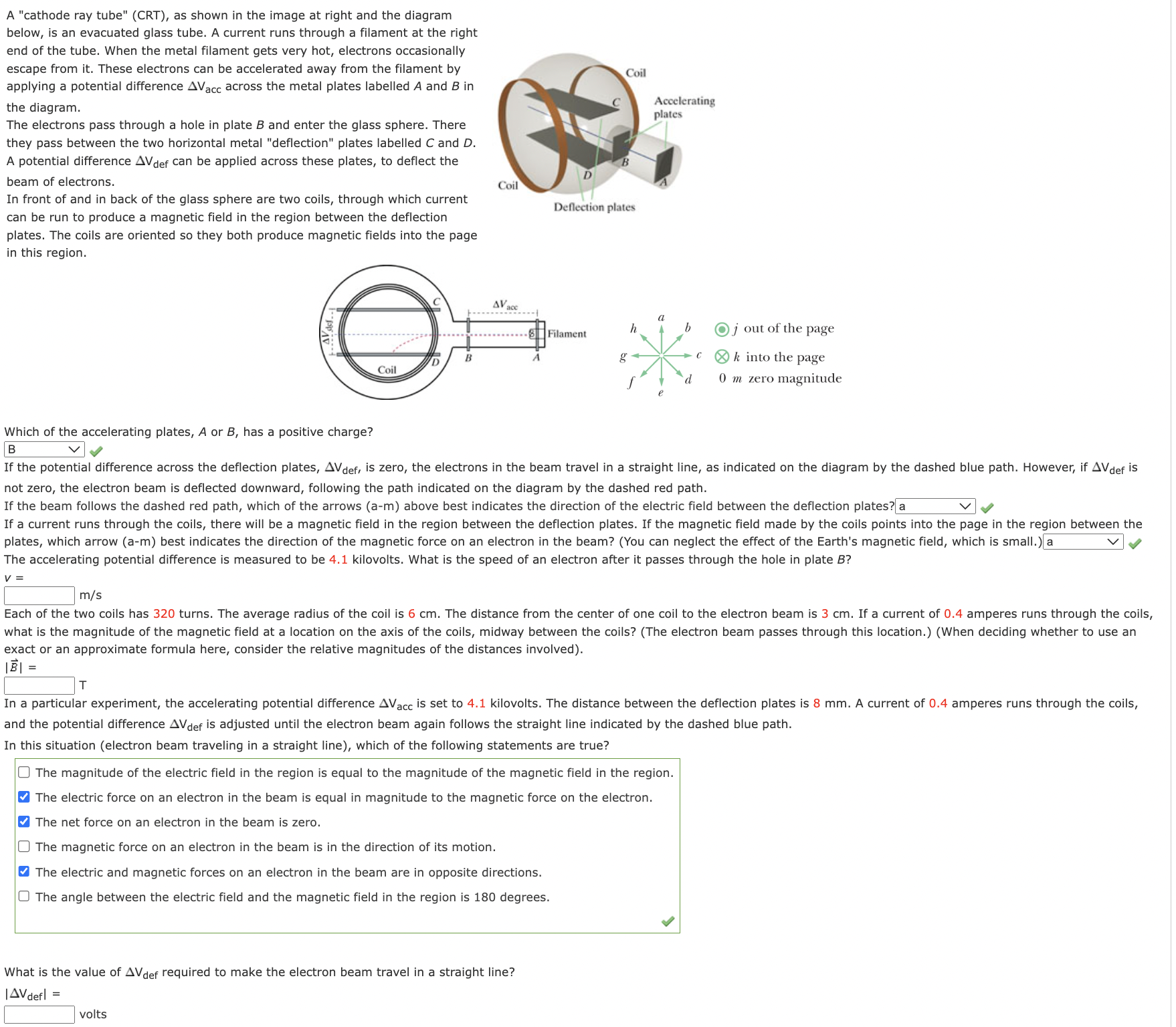
Question: A cathode ray tube ( CRT ) , as shown in the image at right and the diagram below, is an evacuated glass tube. A
A "cathode ray tube" CRT as shown in the image at right and the diagram below, is an evacuated glass tube. A current runs through a filament at the right end of the tube. When the metal filament gets very hot, electrons occasionally escape from it These electrons can be accelerated away from the filament by applying a potential difference Delta mathrmVmathrmacc across the metal plates labelled A and B in the diagram.
The electrons pass through a hole in plate B and enter the glass sphere. There they pass between the two horizontal metal "deflection" plates labelled C and D A potential difference Delta mathrmVtext def can be applied across these plates, to deflect the beam of electrons. In front of and in back of the glass sphere are two coils, through which current can be run to produce a magnetic field in the region between the deflection plates. The coils are oriented so they both produce magnetic fields into the page in this region.
of the page
s the page
o magnitude
Which of the accelerating plates, A or B has a positive charge?
If the potential difference across the deflection plates, Delta mathrmVtext def is zero, the electrons in the beam travel in a straight line, as indicated on the diagram by the dashed blue path. However, if Delta mathrmVtext def is not zero, the electron beam is deflected downward, following the path indicated on the diagram by the dashed red path.
If the beam follows the dashed red path, which of the arrows am above best indicates the direction of the electric field between the deflection plates
If a current runs through the coils, there will be a magnetic field in the region between the deflection plates. If the magnetic field made by the coils points into the page in the region between the plates, which arrow am best indicates the direction of the magnetic force on an electron in the beam? You can neglect the effect of the Earth's magnetic field, which is small. a The accelerating potential difference is measured to be kilovolts. What is the speed of an electron after it passes through the hole in plate B
vquad mathrmmmathrms
Each of the two coils has turns. The average radius of the coil is cm The distance from the center of one coil to the electron beam is cm If a current of amperes runs through the coils, what is the magnitude of the magnetic field at a location on the axis of the coils, midway between the coils? The electron beam passes through this location.When deciding whether to use an exact or an approximate formula here, consider the relative magnitudes of the distances involved
vecB
In a particular experiment, the accelerating potential difference Delta Vmathrmacc is set to kilovolts. The distance between the deflection plates is mm A current of amperes runs through the coils, and the potential difference Delta mathrmVtext def is adjusted until the electron beam again follows the straight line indicated by the dashed blue path.
In this situation electron beam traveling in a straight line which of the following statements are true?
The magnitude of the electric field in the region is equal to the magnitude of the magnetic field in the region.
The electric force on an electron in the beam is equal in magnitude to the magnetic force on the electron.
The net force on an electron in the beam is zero.
The magnetic force on an electron in the beam is in the direction of its motion.
The electric and magnetic forces on an electron in the beam are in opposite directions.
The angle between the electric field and the magnetic field in the region is degrees.
What is the value of Delta Vtext def required to make the electron beam travel in a straight line?
leftDelta Vtext def right
volts
Step by Step Solution
There are 3 Steps involved in it
1 Expert Approved Answer
Step: 1 Unlock

Question Has Been Solved by an Expert!
Get step-by-step solutions from verified subject matter experts
Step: 2 Unlock
Step: 3 Unlock
 Study Help