







Question: (a) // Code in Counter.cpp unsigned int counter_value; // Code in main.cpp unsigned int counter_value; int main() { counter_value = 1909; return 0; } (b)
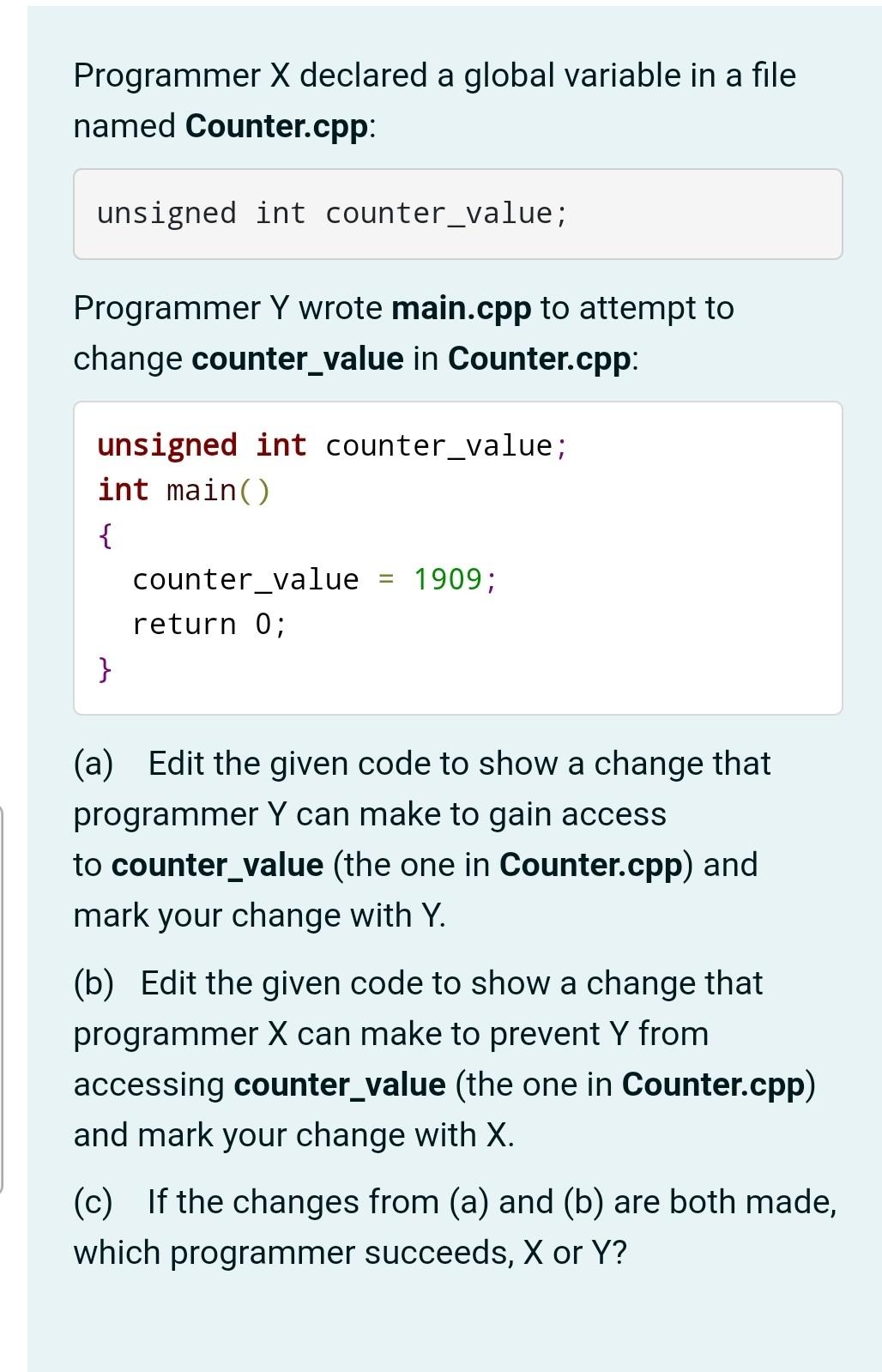
(a) // Code in Counter.cpp unsigned int counter_value; // Code in main.cpp unsigned int counter_value; int main() { counter_value = 1909; return 0; } (b) // Code in Counter.cpp unsigned int counter_value; // Code in main.cpp unsigned int counter_value; int main() { counter_value = 1909; return 0; }
(c)
/*please help me solve this in details */
Programmer X declared a global variable in a file named Counter.cpp: unsigned int counter_value; Programmer Y wrote main.cpp to attempt to change counter_value in Counter.cpp: unsigned int counter_value; int main() { counter_value 1909; return 0; } - (a) Edit the given code to show a change that programmer Y can make to gain access to counter_value (the one in Counter.cpp) and mark your change with Y. (b) Edit the given code to show a change that programmer X can make to prevent Y from accessing counter_value (the one in Counter.cpp) and mark your change with X. (c) If the changes from (a) and (b) are both made, which programmer succeeds, X or Y
Step by Step Solution
There are 3 Steps involved in it

Get step-by-step solutions from verified subject matter experts
 Study Help