







Question: A common approximation to the interatomic forces in a material is the Lennard-Jones potential between neighboring atoms in a solid: U(r) : A/r12 - B/r5
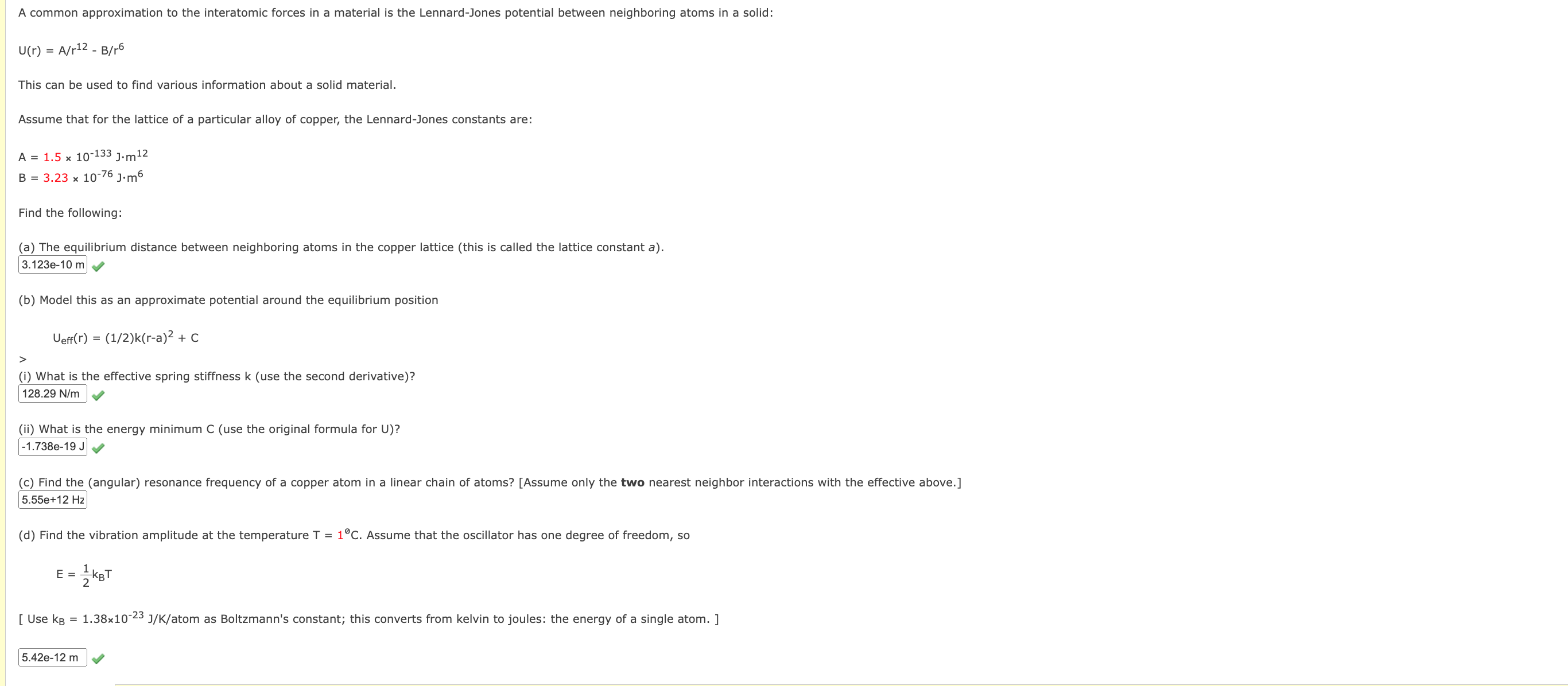
A common approximation to the interatomic forces in a material is the Lennard-Jones potential between neighboring atoms in a solid: U(r) : A/r12 - B/r5 This can be used to find Various information about a solid material. Assume that for the lattice of a particular alloy of copper, the Lennard-Jones constants are: A = 1.5 x 10'133 J-m12 B = 3.23 x 10'751>m5 Find the followmg: (a) The equilibrium distance between neighboring atoms in the copper lattice (this is called the lattice constant a). 3.123e-10 m v (b) Model this as an approximate potential around the equilibrium position Ueffm = (1/2)l (i) what is the effective spring stiffness k (use the secbnd derivative)? 128.29 N/m '/ (ii) What IS the energy minimum C (use the original formula for U)? -1.738e-19J ./ (c) Find the (angular) resonance frequency of a copper atom in a linear chain of atoms? [Assume only the two nearest neighbor interactions with the effective above.] 5.559912 H2 (o) Find the vibration amplitude at the temperature T = 1C, Assume that the oscillator has one degree of freedom, so 1 E=7kT ZB [ Use k3 = 1t38x10'23 J/K/atom as Boltzmann's constant; this converts from kelvln to joules: the energy ufa single atom. 1 5.42e12 m 9/
Step by Step Solution
There are 3 Steps involved in it

Get step-by-step solutions from verified subject matter experts
 Study Help