







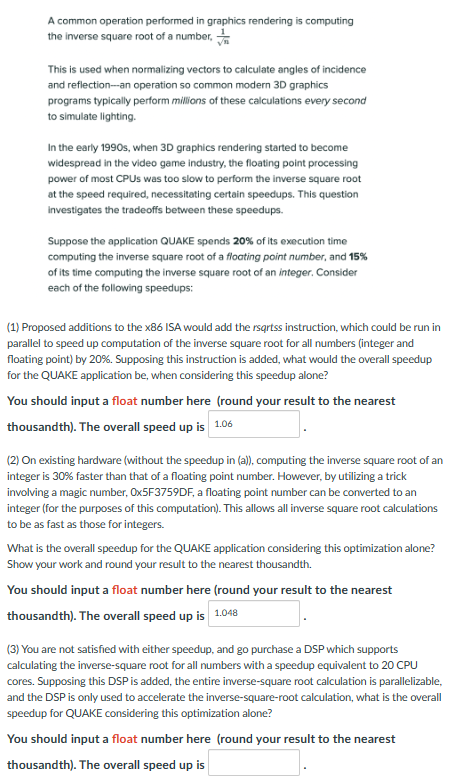
Question: A common operation performed in graphics rendering is computing the inverse square root of a number, 1 n 2 This is used when normalizing vectors
A common operation performed in graphics rendering is computing
the inverse square root of a number,
This is used when normalizing vectors to calculate angles of incidence
and reflectionan operation so common modern D graphics
programs typically perform millions of these calculations every second
to simulate lighting.
In the early s when D graphics rendering started to become
widespread in the video game industry, the floating point processing
power of most CPUs was too slow to perform the inverse square root
at the speed required, necessitating certain speedups. This question
investigates the tradeoffs between these speedups.
Suppose the application QUAKE spends of its execution time
computing the inverse square root of a flocting point number, and
of its time computing the inverse square root of an integer. Consider
each of the following speedups:
Proposed additions to the ISA would add the rsqrtss instruction, which could be run in
parallel to speed up computation of the inverse square root for all numbers integer and
floating point by Supposing this instruction is added, what would the overall speedup
for the QUAKE application be when considering this speedup alone?
You should input a float number here round your result to the nearest
thousandth The overall speed up is
On existing hardware without the speedup in a computing the inverse square root of an
integer is faster than that of a floating point number. However, by utilizing a trick
involving a magic number, xFDF a floating point number can be converted to an
integer for the purposes of this computation This allows all inverse square root calculations
to be as fast as those for integers.
What is the overall speedup for the QUAKE application considering this optimization alone?
Show your work and round your result to the nearest thousandth.
You should input a float number here round your result to the nearest
thousandth The overall speed up is
You are not satisfied with either speedup, and go purchase a DSP which supports
calculating the inversesquare root for all numbers with a speedup equivalent to CPU
cores. Supposing this DSP is added, the entire inversesquare root calculation is parallelizable,
and the DSP is only used to accelerate the inversesquareroot calculation, what is the overall
speedup for QUAKE considering this optimization alone?
You should input a float number here round your result to the nearest
thousandth The overall speed up is
Step by Step Solution
There are 3 Steps involved in it
1 Expert Approved Answer
Step: 1 Unlock

Question Has Been Solved by an Expert!
Get step-by-step solutions from verified subject matter experts
Step: 2 Unlock
Step: 3 Unlock
 Study Help