







Question: A) Computer security experts suggest that a strong password can be formed by randomly choosing characters from all the alphabets, numbers and 30 symbols listed
A) Computer security experts suggest that a strong password can be formed by randomly choosing characters from all the alphabets, numbers and 30 symbols listed below: `~!@#$%^&*()-=+_][{};:/.,?
If the advise is followed, about 5.13218873110 different passwords can be formed. Explain how this number is obtained. Then, considering that the length of the password of some systems cannot exceed 16 characters, explain why the number of different passwords formed by personal information hardly reaches this number.
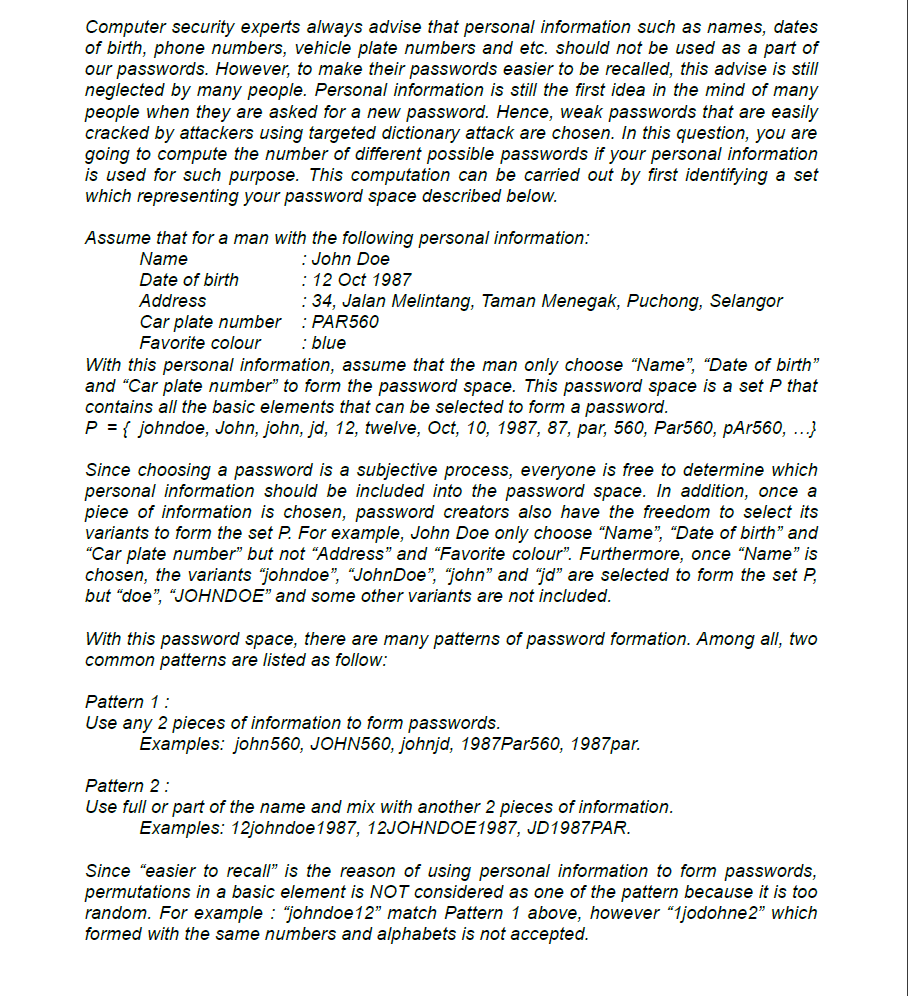
Computer security experts always advise that personal information such as names, dates of birth, phone numbers, vehicle plate numbers and etc. should not be used as a part of our passwords. However, to make their passwords easier to be recalled, this advise is still neglected by many people. Personal information is still the first idea in the mind of many people when they are asked for a new password. Hence, weak passwords that are easily cracked by attackers using targeted dictionary attack are chosen. In this question, you are going to compute the number of different possible passwords if your personal information is used for such purpose. This computation can be carried out by first identifying a set which representing your password space described below. Assume that for a man with the following personal information: Name : John Doe Date of birth : 12 Oct 1987 Address :34, Jalan Melintang, Taman Menegak, Puchong, Selangor Car plate number : PAR560 Favorite colour : blue With this personal information, assume that the man only choose "Name", "Date of birth" and "Car plate number" to form the password space. This password space is a set P that contains all the basic elements that can be selected to form a password. P = { johndoe, John, john, jd, 12, twelve, Oct, 10, 1987, 87, par, 560, Par560, pAr560, ...} Since choosing a password is a subjective process, everyone is free to determine which personal information should be included into the password space. In addition, once a piece of information is chosen, password creators also have the freedom to select its variants to form the set P. For example, John Doe only choose "Name", "Date of birth" and "Car plate number" but not "Address" and "Favorite colour". Furthermore, once "Name" is chosen, the variants johndoe", "John Doe", "john" and jd" are selected to form the set P, but "doe", "JOHNDOE" and some other variants are not included. With this password space, there are many patterns of password formation. Among all, two common patterns are listed as follow: Pattern 1 : Use any 2 pieces of information to form passwords. Examples: john560, JOHN560, johnjd, 1987Par560, 1987par. Pattern 2 : Use full or part of the name and mix with another 2 pieces of information. Examples: 12johndoe 1987, 12JOHNDOE 1987, JD1987PAR. Since "easier to recall is the reason of using personal information to form passwords, permutations in a basic element is NOT considered as one of the pattern because it is too random. For example : "johndoe 12" match Pattern 1 above, however "jodohne2" which formed with the same numbers and alphabets is not accepted
Step by Step Solution
There are 3 Steps involved in it

Get step-by-step solutions from verified subject matter experts
 Study Help