







Question: Securing Information Systems Are We Ready for Cyberwarfare? CASE STUDY or most of us, the Internet is a tool ewidespread and prolonged, succeeding in slowing
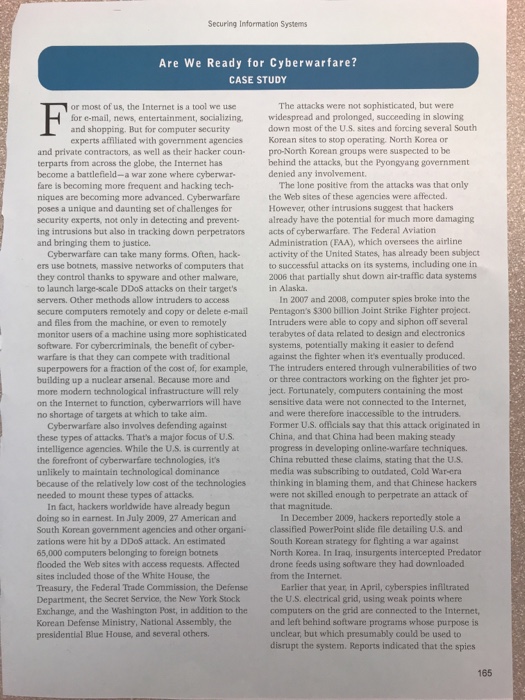
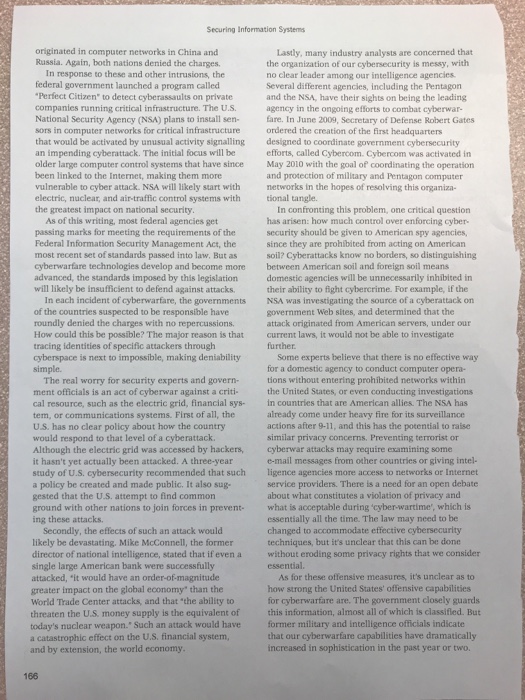
Securing Information Systems Are We Ready for Cyberwarfare? CASE STUDY or most of us, the Internet is a tool ewidespread and prolonged, succeeding in slowing The attacks were not sophisticated, but were inment, socializing. down most of the U.S sites and forcing several Soutih and shopping. But for computer security experts affiliated with government agencies Koean sites to stop operating. North Korea or and private contractors, as well as their hacker coun pro-North Korean groups were suspected to be terparts from across the globe, the Internet has become a battlefield-a war zone where cyberwar fare is becoming more frequent and hacking tech- niques are becoming more advanced. Cyberwarfarethe Web sites of these agencies were affected. poses a unique and daunting set of challenges for security experts, not only in detecting and prevent ardy have the potential for much more damaging ing intrusions but also in tracking down perpetrators acts of cyberwarfare. The Federal Aviation and bringing them to justice. behind the attacks, but the Pyongyang government denied any involvement The lone positive from the attacks was that only However, other intrusions suggest that hackers Administration (FAA), which oversees the airline activity of the United States, has already been subject Cyberwarfare can take many forms. Often, hack ers use botnets, massive networks of computers that they control thanks to spyware and other malware, to launch large-scale DDoS attacks on their target's servers. Other methods allow intruders to access to successfiul attacks on its systems, including one in 2006 that partially shut down air-traffic data systems In 2007 and 2008, computer spies broke into the secure computers remotely and copy or delete e-mail and files from the machine, or even to remotely monitor users of a machine using more sophisticated software. For cybercriminals, the benefit of cyber- Pentagon's $300 billtion Joint Strike Fighter project. Intruders were able to copy and siphon off several terabytes of data related to design and electronics systems, potentially making it easier to defend against the fighter when it's eventually produced. The intruders entered through vulnerabilities of two arfare is that they can compete with traditional superpowers for a fraction of the cost of, for example, building up a nuclear arsenal. Because more ar more modern technological infrastructure will rely on the Internet to function, cyberwarriors will have no shortage of targets at which to take alm. three contractors working on the fighter jet pro- ject. Fortunately, computers containing the most Cyberwarfare also involves defending a these types of attacks. That's a major focus of U.S intelligence agencies. While the U.S. is currently at the forefront of cyberwarfare technologies, it's unlikely to maintain technological dominan because of the relatively low cost of the technologies needed to mount these types of attacks nsitive data were not connected to the Internet, and were therefore inaccessible to the intruders Former U.S. officials say that this attack originated in China, and that China had been making steady progress in developing online-warfare techniques. China rebutted these claims, stating that the media was subscribing to outdated, Cold War-era thinking in blaming them, and that Chinese hackers were not skilled enough to perpetrate an attack of In fact, hackers worldwide have already begun doing so in earnest. In July 2009, 27 American and South Korean government agencies and other organi-classified PowerPoint slide file detailing U.S. and zations were hit by a DDoS attack. An estimated 65,000 computers belonging to foreign botnets flooded the Web sites with access requests. Affected sites included those of the White House, the Treasury, the Federal Trade Commission, the Defense Department, the Secret Service, the New York Stock Exchange, and the Washington Post, in addition to thecomputers on the grid are connected to the Internet, Korean Defense Ministry, National Assembly, the presidential Blue House, and several others In December 2009, hackers reportedly sto South Korean strategy for fighting a war against North Korea. In Iraq, insurgents intercepted Predator drone feeds using software they had downloaded from the Internet Earlier that year, in April, cyberspies infiltrated the U.S. electrical grid, using weak points where and left behind software programs whose purpose its unclear, but which presumably could be used to disrupt the system. Reports indicated that the spies
Step by Step Solution
There are 3 Steps involved in it

Get step-by-step solutions from verified subject matter experts
 Study Help