







Question: (a) Consider the weighted interval scheduling problem. In this problem, the input is a list of n intervals-with-weights, each of which is specified by (starti,
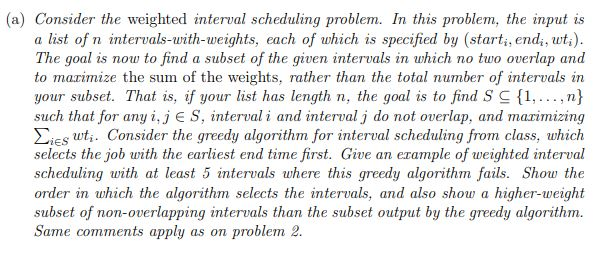
(a) Consider the weighted interval scheduling problem. In this problem, the input is a list of n intervals-with-weights, each of which is specified by (starti, endi, wt;). The goal is now to find a subset of the given intervals in which no two overlap and to marimize the sum of the weights, rather than the total number of intervals in your subset. That is, if your list has length n, the goal is to find S {1,...,n} such that for any i, je S, interval i and interval j do not overlap, and maximizing Lies wt;. Consider the greedy algorithm for interval scheduling from class, which selects the job with the earliest end time first. Give an example of weighted interval scheduling with at least 5 intervals where this greedy algorithm fails. Show the order in which the algorithm selects the intervals, and also show a higher-weight subset of non-overlapping intervals than the subset output by the greedy algorithm. Same comments apply as on problem 2. (a) Consider the weighted interval scheduling problem. In this problem, the input is a list of n intervals-with-weights, each of which is specified by (starti, endi, wt;). The goal is now to find a subset of the given intervals in which no two overlap and to marimize the sum of the weights, rather than the total number of intervals in your subset. That is, if your list has length n, the goal is to find S {1,...,n} such that for any i, je S, interval i and interval j do not overlap, and maximizing Lies wt;. Consider the greedy algorithm for interval scheduling from class, which selects the job with the earliest end time first. Give an example of weighted interval scheduling with at least 5 intervals where this greedy algorithm fails. Show the order in which the algorithm selects the intervals, and also show a higher-weight subset of non-overlapping intervals than the subset output by the greedy algorithm. Same comments apply as on problem 2
Step by Step Solution
There are 3 Steps involved in it

Get step-by-step solutions from verified subject matter experts
 Study Help