







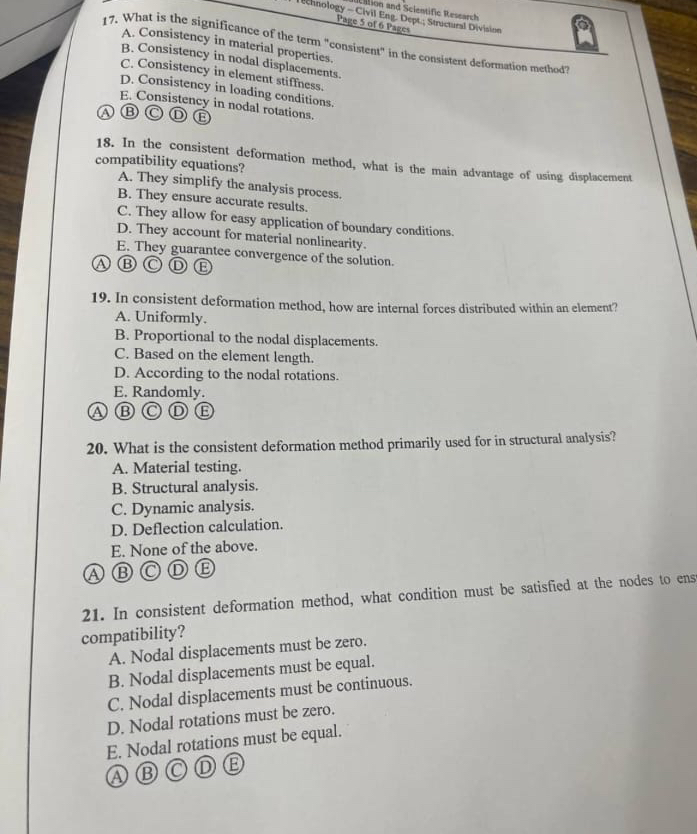
Question: A . Consistency in material properties. B . Consistency in nodal displacements. C . Consistency in element stiffness. D . Consistency in loading conditions. E
A Consistency in material properties.
B Consistency in nodal displacements.
C Consistency in element stiffness.
D Consistency in loading conditions.
E Consistency in nodal rotations.
ABCDE
In the consistent deformation method, what is the main advantage of using displacement compatibility equations?
A They simplify the analysis process.
B They ensure accurate results.
C They allow for easy application of boundary conditions.
D They account for material nonlinearity.
E They guarantee convergence of the solution.
A
B
C
DE
In consistent deformation method, how are internal forces distributed within an element?
A Uniformly.
B Proportional to the nodal displacements.
C Based on the element length.
D According to the nodal rotations.
E Randomly.
A
B
C
DE
What is the consistent deformation method primarily used for in structural analysis?
A Material testing.
B Structural analysis.
C Dynamic analysis.
D Deflection calculation.
E None of the above.
ABCDE
In consistent deformation method, what condition must be satisfied at the nodes to ens compatibility?
A Nodal displacements must be zero.
B Nodal displacements must be equal.
C Nodal displacements must be continuous.
D Nodal rotations must be zero.
E Nodal rotations must be equal.
ABCDE
Step by Step Solution
There are 3 Steps involved in it
1 Expert Approved Answer
Step: 1 Unlock

Question Has Been Solved by an Expert!
Get step-by-step solutions from verified subject matter experts
Step: 2 Unlock
Step: 3 Unlock
 Study Help