







Question: A consumer has preferences summarized by the utility function U(qX, qY ) = [q ? X + q ? Y ] 1/? . a. [5
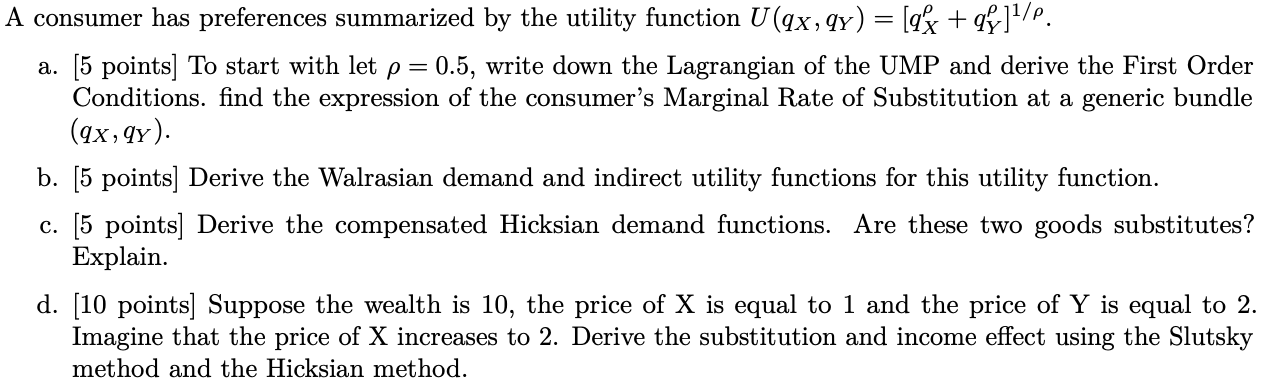
A consumer has preferences summarized by the utility function U(qX, qY ) = [q ? X + q ? Y ] 1/? . a. [5 points] To start with let ? = 0.5, write down the Lagrangian of the UMP and derive the First Order Conditions. find the expression of the consumer's Marginal Rate of Substitution at a generic bundle (qX, qY ). b. [5 points] Derive the Walrasian demand and indirect utility functions for this utility function. c. [5 points] Derive the compensated Hicksian demand functions. Are these two goods substitutes? Explain. d. [10 points] Suppose the wealth is 10, the price of X is equal to 1 and the price of Y is equal to 2. Imagine that the price of X increases to 2. Derive the substitution and income effect using the Slutsky method and the Hicksian method.
![) = [q ? X + q ? Y ] 1/? .](https://s3.amazonaws.com/si.experts.images/answers/2024/06/667543108cf07_912667543106ea2b.jpg)
A consumer has preferences summarized by the utility function U (9;, (1y) = [q + qf,]1/ 9. a. [5 points] To start with let p = 0.5, write down the Lagrangian of the UMP and derive the First Order Conditions. nd the expression of the consumer's Marginal Rate of Substitution at a generic bundle (ex. (13/)- b. [5 points] Derive the Walrasian demand and indirect utility functions for this utility function. c. [5 points] Derive the compensated Hicksian demand functions. Are these two goods substitutes? Explain. d. [10 points] Suppose the wealth is 10, the price of X is equal to 1 and the price of Y is equal to 2. Imagine that the price of X increases to 2. Derive the substitution and income effect using the Slutsky method and the Hicksian method
Step by Step Solution
There are 3 Steps involved in it

Get step-by-step solutions from verified subject matter experts
 Study Help