







Question: A consumer has the Cobb-Douglas utility function u(21, X2) = rfx2, where 0 0 and p2 > 0, and the exogenous target utility level is
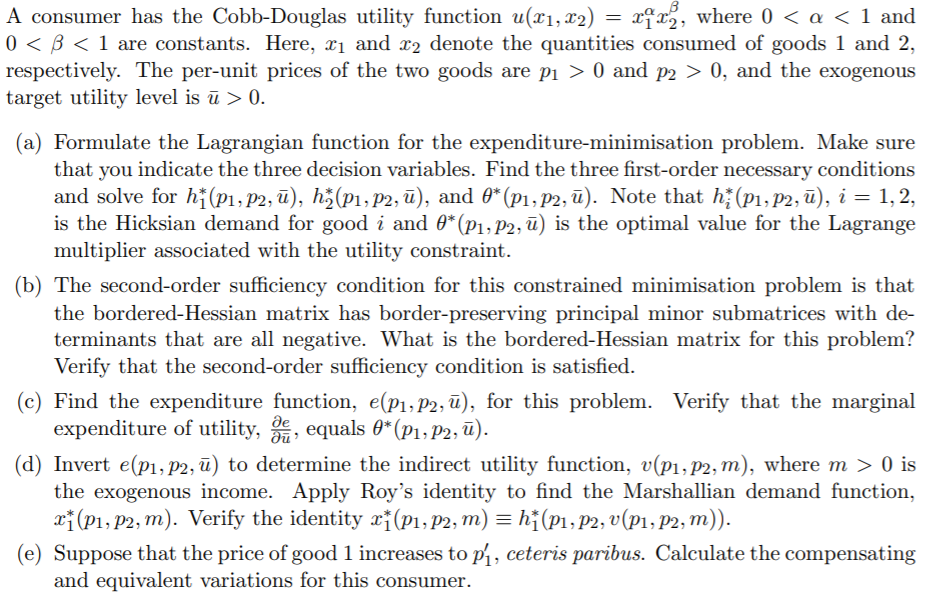
A consumer has the Cobb-Douglas utility function u(21, X2) = rfx2, where 0 0 and p2 > 0, and the exogenous target utility level is u > 0. (a) Formulate the Lagrangian function for the expenditure-minimisation problem. Make sure that you indicate the three decision variables. Find the three first-order necessary conditions and solve for hi(p1, p2, u), h2(p1, p2, u), and 0* (p1, p2, u). Note that hi (p1, p2, u), i = 1, 2, is the Hicksian demand for good i and 0*(P1, p2, u) is the optimal value for the Lagrange multiplier associated with the utility constraint. (b) The second-order sufficiency condition for this constrained minimisation problem is that the bordered-Hessian matrix has border-preserving principal minor submatrices with de- terminants that are all negative. What is the bordered-Hessian matrix for this problem? Verify that the second-order sufficiency condition is satisfied. (c) Find the expenditure function, e(P1, p2, u), for this problem. Verify that the marginal expenditure of utility, du: ge, equals 0*(P1, P2, u). (d) Invert e(p1, p2, u) to determine the indirect utility function, v(p1, p2, m), where m > 0 is the exogenous income. Apply Roy's identity to find the Marshallian demand function, xi (p1, p2, m). Verify the identity xi (p1, p2, m) = hi(p1, p2, v(p1, p2, m)). (e) Suppose that the price of good 1 increases to p', ceteris paribus. Calculate the compensating and equivalent variations for this consumer
Step by Step Solution
There are 3 Steps involved in it

Get step-by-step solutions from verified subject matter experts
 Study Help