







Question: A consumer with the utility function U (x;, x,) = xx, faces prices p, = $4,p, = $5 and has an income of $100. Suppose
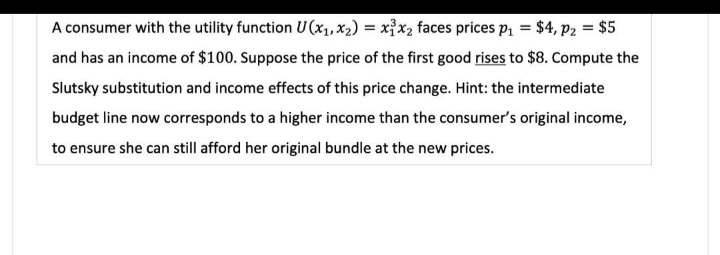
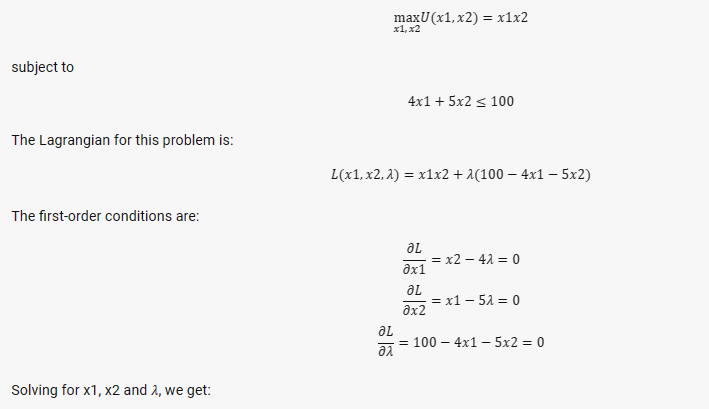
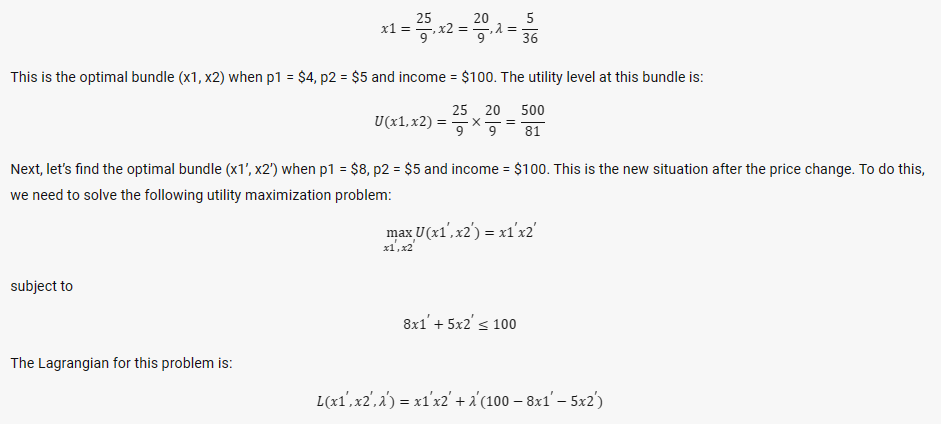
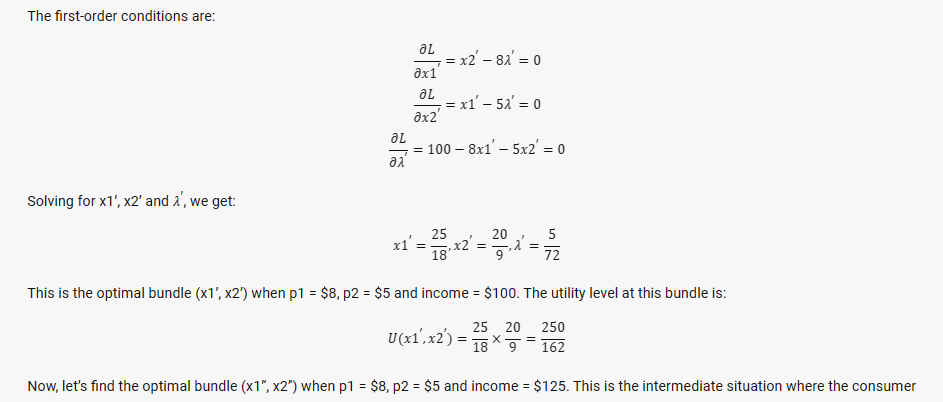
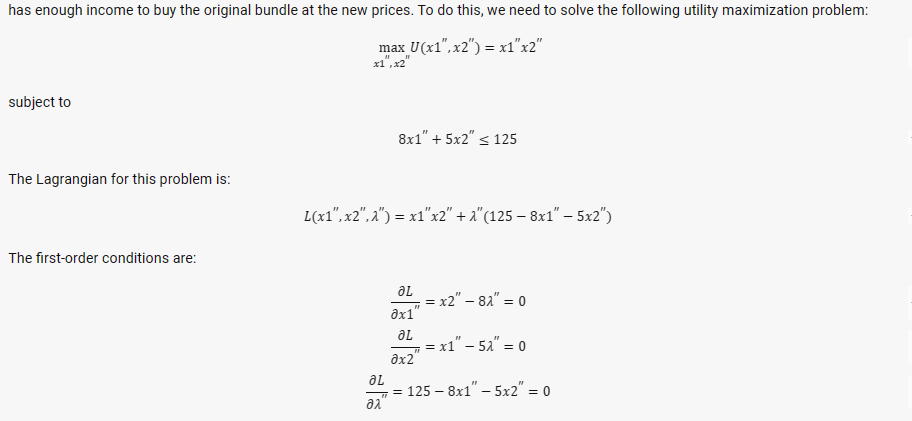
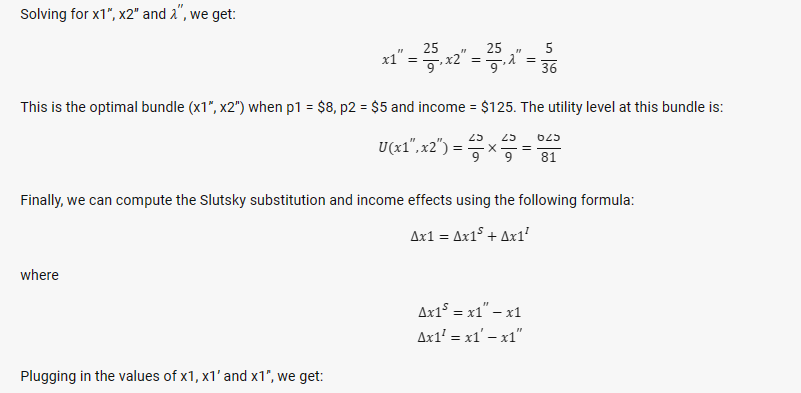
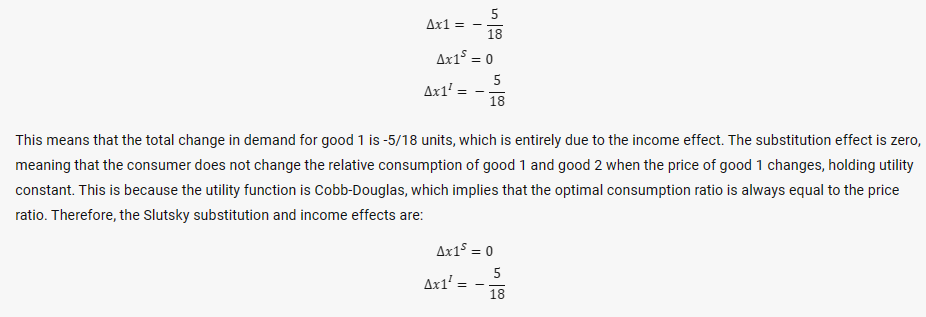
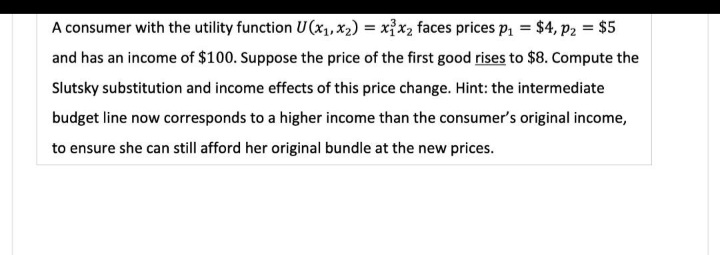
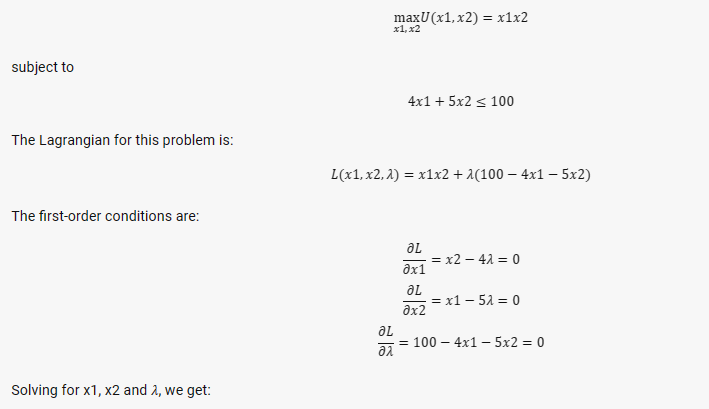
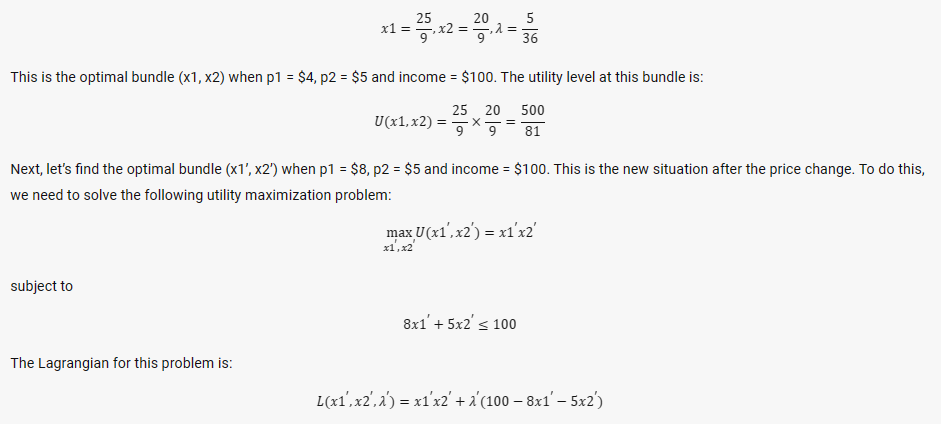
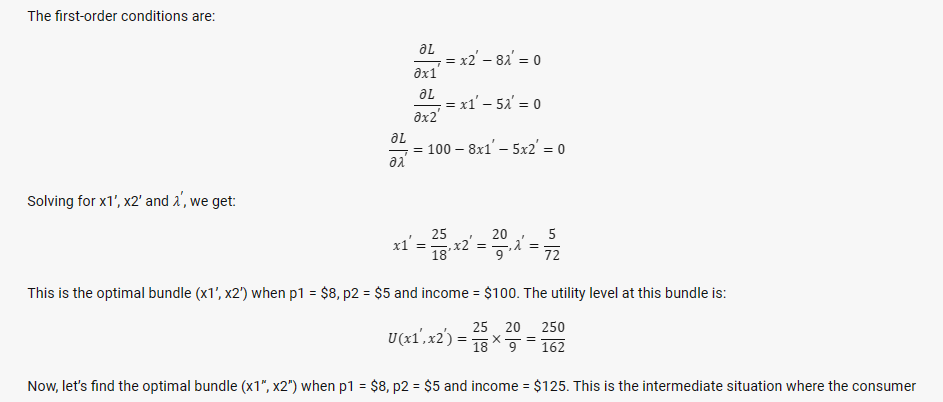
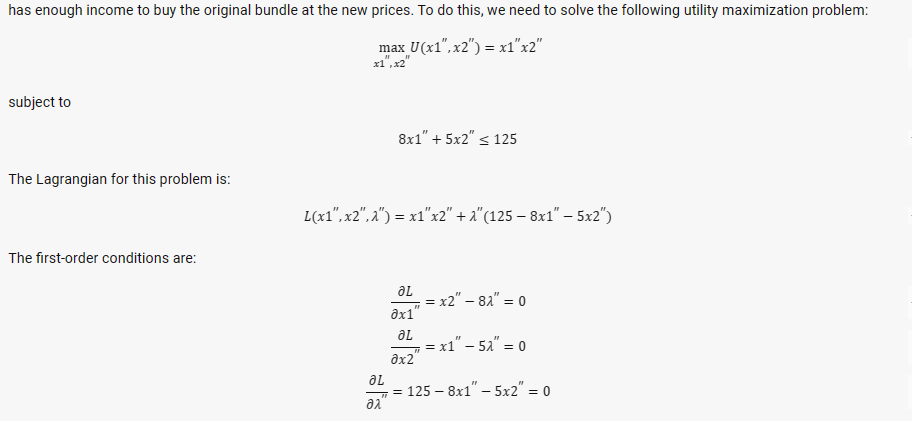
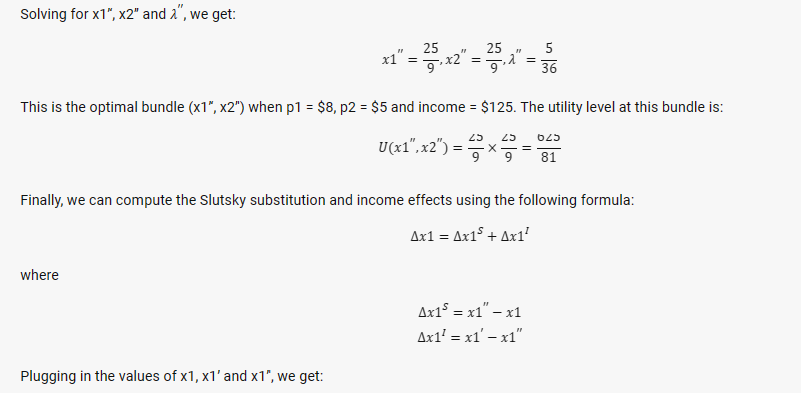
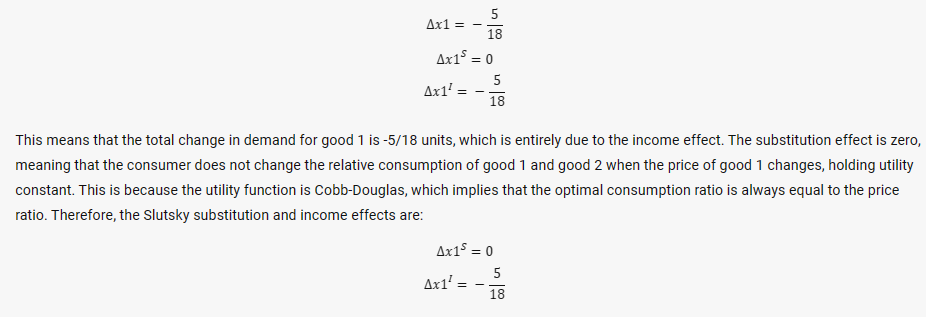
A consumer with the utility function U (x;, x,) = xx, faces prices p, = $4,p, = $5 and has an income of $100. Suppose the price of the first good rises to $8. Compute the Slutsky substitution and income effects of this price change. Hint: the intermediate budget line now corresponds to a higher income than the consumer's original income, to ensure she can still afford her original bundle at the new prices. maxU (x1, x2) = x1x2 x1, x2 subject to 4x1 + 5x2 = 100 The Lagrangian for this problem is: L(x1, x2,1) = x1x2 + A(100 - 4x1 - 5x2) The first-order conditions are: al = x2 - 41 = 0 dx1 al = x1 - 51 = 0 ax2 OL ax = 100 - 4x1 - 5x2 = 0 Solving for x1, x2 and 1, we get:25 20 5 x1 = 9 9 1 = 36 This is the optimal bundle (x1, x2) when p1 = $4, p2 = $5 and income = $100. The utility level at this bundle is: 25 20 500 U(x1, x2) = 81 Next, let's find the optimal bundle (x1', x2') when p1 = $8, p2 = $5 and income = $100. This is the new situation after the price change. To do this, we need to solve the following utility maximization problem: max U(x1 , x2 ) = x1'x2' x1,x2 subject to 8x1 + 5x2 = 100 The Lagrangian for this problem is: L(x1',x2, 2 ) = x1 x2 + a(100 - 8x1' - 5x2)The first-order conditions are: OL = x2 - 81 = 0 dx1 al = x1 - 51' = 0 dx2 OL = 100 - 8x1 - 5x2 = 0 Solving for x1', x2' and 2 , we get: 25 20 5 x1 = 18 .x2 = 9 -1 = 72 This is the optimal bundle (x1', x2') when p1 = $8, p2 = $5 and income = $100. The utility level at this bundle is: U(x1', x2 ) = 25 20 250 18 * 9 = 162 Now, let's find the optimal bundle (x1", x2") when p1 = $8, p2 = $5 and income = $125. This is the intermediate situation where the consumerhas enough income to buy the original bundle at the new prices. To do this, we need to solve the following utility maximization problem: max U(x1 , x2") = x1"x2" x1 , x2 subject to 8x1 + 5x2" = 125 The Lagrangian for this problem is: L(x1 ,x2 ,A") = x1 x2"+ A"(125 - 8x1" - 5x2") The first-order conditions are: aL = x2 - 81 = 0 Ox1 al = x1 - 51 = 0 ax2 al = 125 - 8x1 - 5x2 = 0 axSolving for x1", x2" and 1 , we get: 25 25 5 x1 = 9.*2 = 9 36 This is the optimal bundle (x1", x2") when p1 = $8, p2 = $5 and income = $125. The utility level at this bundle is: U(x1 ,x2" ) = 25 9 X = 9 81 Finally, we can compute the Slutsky substitution and income effects using the following formula: Axl = Ax15 + Ax1' where Ax1 = x1 - x1 Axl' = x1' - x1" Plugging in the values of x1, x1' and x1", we get:5 Axl= * 18 Ax15 =0 Ax1! > x1'= 18 This means that the total change in demand for good 1 is -5/18 units, which is entirely due to the income effect. The substitution effect is zero, meaning that the consumer does not change the relative consumption of good 1 and good 2 when the price of good 1 changes, holding utility constant. This is because the utility function is Cobb-Douglas, which implies that the optimal consumption ratio is always equal to the price ratio. Therefore, the Slutsky substitution and income effects are: Ax15 =0 5 Axti= - = * 18
Step by Step Solution
There are 3 Steps involved in it

Get step-by-step solutions from verified subject matter experts
 Study Help