







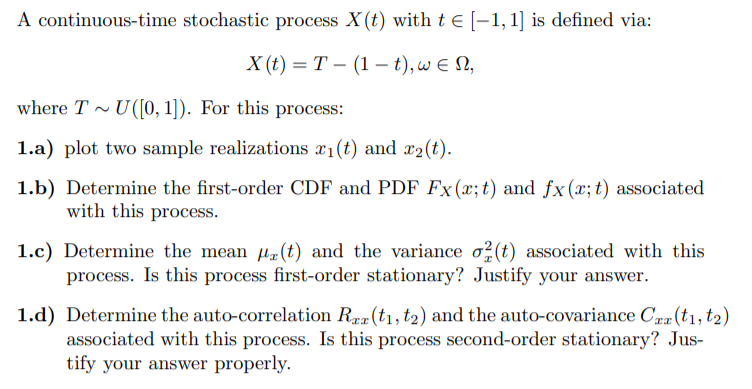
Question: A continuous-time stochastic process X(t) with t (-1,1) is defined via: X(t) = T - (1 t), well, where T ~ U([0,1]). For this process:
![X(t) = T - (1 t), well, where T ~ U([0,1]). For](https://s3.amazonaws.com/si.experts.images/answers/2024/07/6695ad403ddd4_2476695ad3fb7dfc.jpg)
A continuous-time stochastic process X(t) with t (-1,1) is defined via: X(t) = T - (1 t), well, where T ~ U([0,1]). For this process: 1.a) plot two sample realizations xi(t) and x2(t). 1.b) Determine the first-order CDF and PDF Fx (2;t) and fx (2;t) associated with this process. 1.c) Determine the mean po(t) and the variance of(t) associated with this process. Is this process first-order stationary? Justify your answer. 1.d) Determine the auto-correlation Rez(t1, t2) and the auto-covariance Czo(t1, t2) associated with this process. Is this process second-order stationary? Jus- tify your answer properly. A stochastic process X(t) is defined via: X(t,w) = A(w)t + Bw), te 1-1, 1], where Aw) ~ U([-1,1]) and B(w) ~ U((-1,1]) are statistically independent random variables. For this process: 2.a) plot two sample realizations x1(t) and x2(t). 2.b) Determine the first-order PDF fx(x;t) associated with it. 2.c) Determine the mean pz(t) and variance o(t). 2.d) Determine the autocorrelation Rex(ti, t2) and the auto-covariance Cxx(t1, t2) associated with it
Step by Step Solution
There are 3 Steps involved in it

Get step-by-step solutions from verified subject matter experts
 Study Help