







Question: A contractor has six jobs awaiting processing at a workstation that is also a bottleneck and therefore is only capable of processing one job at
A contractor has six jobs awaiting processing at a workstation that is also a bottleneck and therefore
is only capable of processing one job at a time. The day the job was received, its processing time
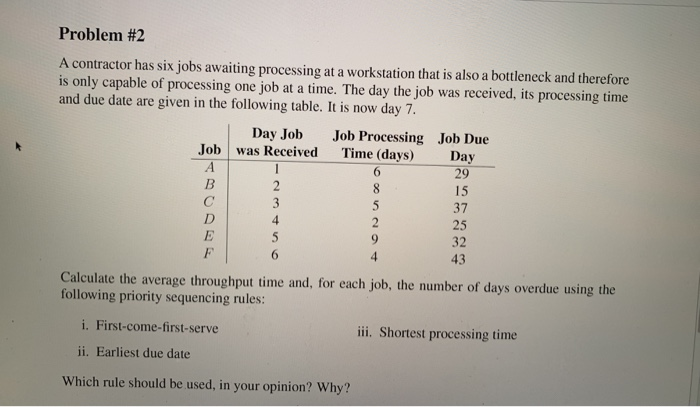
and due date are given in the following table. It is now day 7.
Day Job Job Processing Job Due
Job was Received Time (days) Day
A 1 6 29
B 2 8 15
C 3 5 37
D 4 2 25
E 5 9 32
F 6 4 43
Calculate the average throughput time and, for each job, the number of days overdue using the
following priority sequencing rules:
i. First-come-first-serve
ii. Earliest due date
iii. Shortest processing time
Which rule should be used, in your opinion? Why?
Step by Step Solution
There are 3 Steps involved in it
1 Expert Approved Answer
Step: 1 Unlock

Question Has Been Solved by an Expert!
Get step-by-step solutions from verified subject matter experts
Step: 2 Unlock
Step: 3 Unlock
 Study Help