







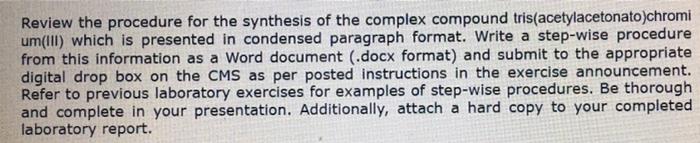
Question: A coordination complex, a neutral compound or a complex ion, a charged species, is defined as a chemical species composed of several parts, each of
A coordination complex, a neutral compound or a complex ion, a charged species, is defined as a chemical species composed of several parts, each of which is capable of independent existence in solution. The complex usually consists of a positive transition metal ion to which a number of ions or molecules are attached through coordinate covalent bonds. The number of electron-rich groups, the ligands, surrounding the central metal atoms depends on the size and charge of metal ion and on the ligand type. Ligands may be anions, such as CN- , Cl- , or OH- and/or molecules with lone pairs of electrons, including CO, H2O, and NH3. The positive metal ion, being electron-deficient, seeks a negative atmosphere. The central metal atom is said to be electrophilic (electron-loving), and is designated as Lewis Acids. The ligands, on the other hand, having lone pairs of electrons available, act as electron donors. Consequently, the ligands are said to be nucleophilic in that they seek the positive charge of the nucleus, and are designated as Lewis Bases. The association between the Lewis Acid and Base results in the formation of a coordinate covalent bond where the ligand supplies both electrons in this bonding characteristic. Ligands are not limited to simple molecules or anions which contain a single attachment site as in the examples above. Many organic molecules coordinate the metal ion by donating more than one electron pair to the central metal atom. These chelating ligands are capable of forming multiple coordinate covalent bonds with the transition metal. For example, the oxalate ion, C2O4 2-, and 2,4-pentadione, CH3COCH2COCH3, have two attachment sites (shown below) and are classified as bidentate ligands. Other ligands, such as ethylenediaminetetraacetic acid which has six sites for attachment is, therefore, a hexadentate ligand
Ligands can also be differentiated as either primary (inner) or secondary (outer). Primary ligands are thoseligands that are directly attached to the central metal atom through the formation of the coordinate covalent bond. The secondary, or outer ligands, are electrostatically associated with the complex ion and are located in the secondary ionic layer surrounding the complex thereby producing the neutral, isolatable compound. For example, in tetraammineplatinum(II) chloride, [Pt(NH3)4]Cl2, the ammonia would be classified as the primary ligand and is written next to the transition metal (platinum) with the secondary ligand, the chloride, associated with the complex ion to form the neutral salt. When added to water, this salt dissociates forming three ions, the tetraammineplatinum(II) ion, Pt(NH3)4 2+ and two chloride ions. If two of the ammonia ligands are exchanged for two chloride ion ligands, the resulting neutral coordinate complex, [PtCl 2(NH3)2], diamminedichloroplatinum(II), commonly known as cisplatin, is obtained.
In this exercise, a chromium coordination complex, tris(acetylacetonato)chromium(III), Cr(C5H7O2)3, a neutral coordination complex, will be synthesized by mixing an aqueous solution of chromium(III) chloride hexahydrate with 2,4-pentanedione (also known as acetylacetone, Hacac). Urea is added to the reaction mixture to produce a basic solution, via hydrolysis of the urea, to facilitate the loss of a proton, forming the acetylacetonate ion (acac )
The acetylacetonate ion (the 2,4-pentadionate ion) complexes with the chromium(III) ion, Cr 3+, to form the reaction product tris(acetylacetonato)chromium(III), a neutral coordination compound
As with any chemical synthesis, one of the objectives is to obtain the product in the highest yield possible and with the desired purity. The purity of the reaction product may be a function of the necessary procedures or treatments required to remove the unreacted starting materials or reaction by-products. The theoretical yield of the product, in this case the tris(acetylacetonato)chromium(III), is the maximum amount of product forming in the complete reaction and is calculated from the number of moles of the reagent identified as the limiting reagent. A limiting reagent is defined as the reactant that is completely consumed in the reaction, limiting the amount of product formed. The other reagent(s) is(are) said to be in excess since it(they) does(do) not limit the amount of product produced. The quantities of the reagents reacting are obtained by determining the number of moles of each used in the reaction. As the amount of reagent used in the reaction is known, either as a mass or a volume of known concentration, conversion of these quantities to moles and adjusting based on the stoichiometric relationship presented in the balanced chemical equation, will indicate which of the reagents limits the overall yield of product. The actual yield is the amount of product isolated from the reaction mass with the percent yield, a measure of the overall efficiency of the preparation, the ratio of the actual yield to the theoretical yield expressed as a percentage.
Review the procedure for the synthesis of the complex compound tris(acetylacetonato)chromi um(III) which is presented in condensed paragraph format. Write a step-wise procedure from this information as a Word document (.docx format) and submit to the appropriate digital drop box on the CMS as per posted instructions in the exercise announcement. Refer to previous laboratory exercises for examples of step-wise procedures. Be thorough and complete in your presentation. Additionally, attach a hard copy to your completed laboratory report
Step by Step Solution
There are 3 Steps involved in it

Get step-by-step solutions from verified subject matter experts
 Study Help