







Question: A Data Programming Project Now that you have had a chance to explore some techniques and tools in Python, it is time to start working
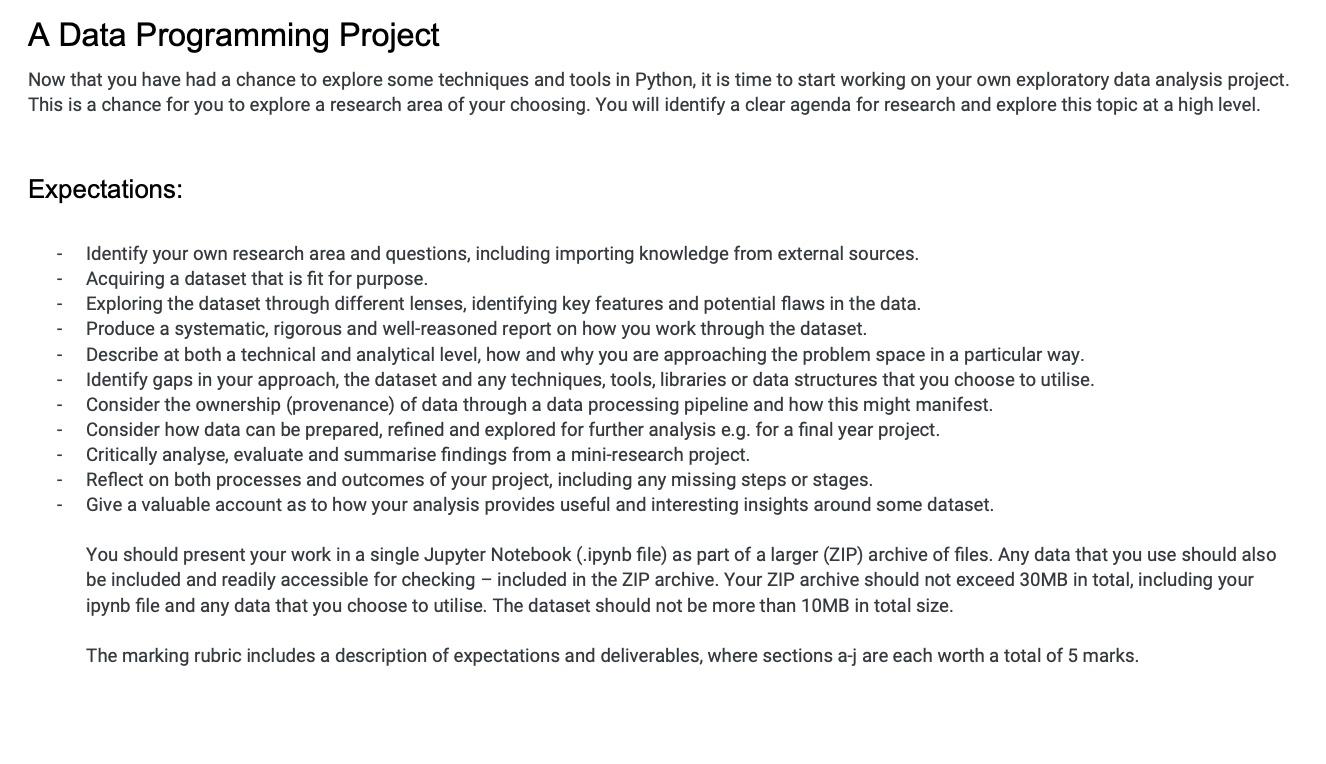
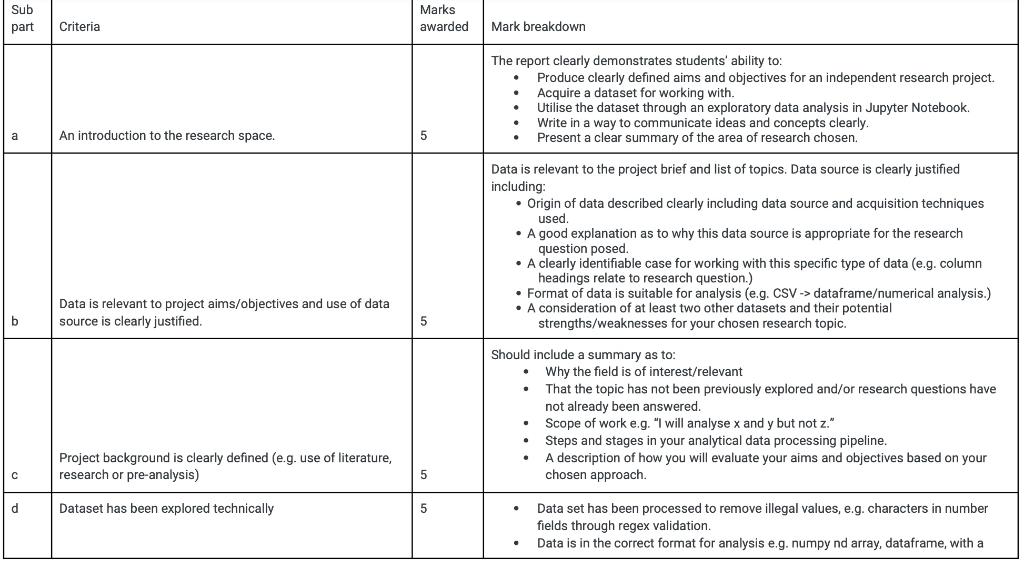
A Data Programming Project Now that you have had a chance to explore some techniques and tools in Python, it is time to start working on your own exploratory data analysis project. This is a chance for you to explore a research area of your choosing. You will identify a clear agenda for research and explore this topic at a high level. Expectations: Identify your own research area and questions, including importing knowledge from external sources. Acquiring a dataset that is fit for purpose. Exploring the dataset through different lenses, identifying key features and potential flaws in the data. Produce a systematic, rigorous and well-reasoned report on how you work through the dataset. Describe at both a technical and analytical level, how and why you are approaching the problem space in a particular way. Identify gaps in your approach, the dataset and any techniques, tools, libraries or data structures that you choose to utilise. Consider the ownership (provenance) of data through a data processing pipeline and how this might manifest. Consider how data can be prepared, refined and explored for further analysis e.g. for a final year project. Critically analyse, evaluate and summarise findings from a mini-research project. Reflect on both processes and outcomes of your project, including any missing steps or stages. Give a valuable account as to how your analysis provides useful and interesting insights around some dataset. You should present your work in a single Jupyter Notebook (.ipynb file) as part of a larger (ZIP) archive of files. Any data that you use should also be included and readily accessible for checking - included in the ZIP archive. Your ZIP archive should not exceed 30MB in total, including your ipynb file and any data that you choose to utilise. The dataset should not be more than 10MB in total size. The marking rubric includes a description of expectations and deliverables, where sections a-j are each worth a total of 5 marks. Sub part Marks awarded Criteria Mark breakdown The report clearly demonstrates students' ability to: Produce clearly defined aims and objectives for an independent research project. Acquire a dataset for working with. Utilise the dataset through an exploratory data analysis in Jupyter Notebook. Write in a way to communicate ideas and concepts clearly. Present a clear summary of the area of research chosen. a An introduction to the research space. 5 Data is relevant to the project brief and list of topics. Data source is clearly justified including: Origin of data described clearly including data source and acquisition techniques used. A good explanation as to why this data source is appropriate for the research question posed. A clearly identifiable case for working with this specific type of data (e.g. column headings relate to research question.) Format of data is suitable for analysis (e.g. CSV->dataframeumerical analysis.) A consideration of at least two other datasets and their potential strengths/weaknesses for your chosen research topic. Data is relevant to project aims/objectives and use of data source is clearly justified. b . Should include a summary as to: Why the field is of interest/relevant That the topic has not been previously explored and/or research questions have not already been answered. Scope of work e.g. "I will analyse x and y but not z." Steps and stages in your analytical data processing pipeline. A description of how you will evaluate your aims and objectives based on your chosen approach. Project background is clearly defined (e.g. use of literature, research or pre-analysis) 5 d Dataset has been explored technically Data set has been processed to remove illegal values, e.g. characters in number fields through regex validation. Data is in the correct format for analysis e.g. numpy nd array, dataframe, with a
Step by Step Solution
There are 3 Steps involved in it

Get step-by-step solutions from verified subject matter experts
 Study Help