







Question: A database has four transactions. Let min sup 60 % and min conf 80 % cust ID TID items.bought (in the form of brand-item.category)
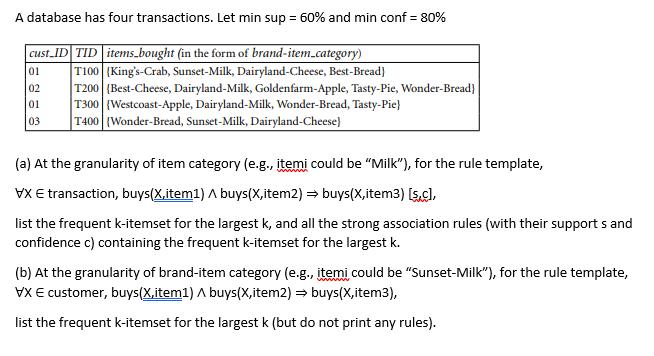
A database has four transactions. Let min sup 60 % and min conf 80 % cust ID TID items.bought (in the form of brand-item.category) T100 King's-Crab, Sunset-Milk, Dairyland-Cheese, Best-Bread T200 Best-Cheese, Dairyland-Milk, Goldenfarm-Apple, Tasty-Pie, Wonder-Bread T300 Westcoast-Apple, Dairyland-Milk, Wonder-Bread, Tasty-Pie T400 Wonder-Bread, Sunset-Milk, Dairyland-Cheese) 01 02 01 03 (a) At the granularity of item category (e.g., itemi could be "Milk"), for the rule template, buys (X,item3) scl, E transaction, buys(X,item1) A buys(X,item2) list the frequent k-itemset for the largest k, and all the strong association rules (with their support s and confidence c) containing the frequent k-itemset for the largest k. (b) At the granularity of brand-item category (e.g., itemi could be "Sunset-Milk"), for the rule template, E customer, buys(X.item1) A buys(X,item2) buys(X,item3), list the frequent k-itemset for the largest k (but do not print any rules)
Step by Step Solution
3.48 Rating (151 Votes )
There are 3 Steps involved in it
To solve this problem we need to find the frequent itemsets and strong association rules based on th... View full answer

Get step-by-step solutions from verified subject matter experts
 Study Help