







Question: A date ( e . g . , January 1 st , 2 0 1 1 ) marks a point in time in which an
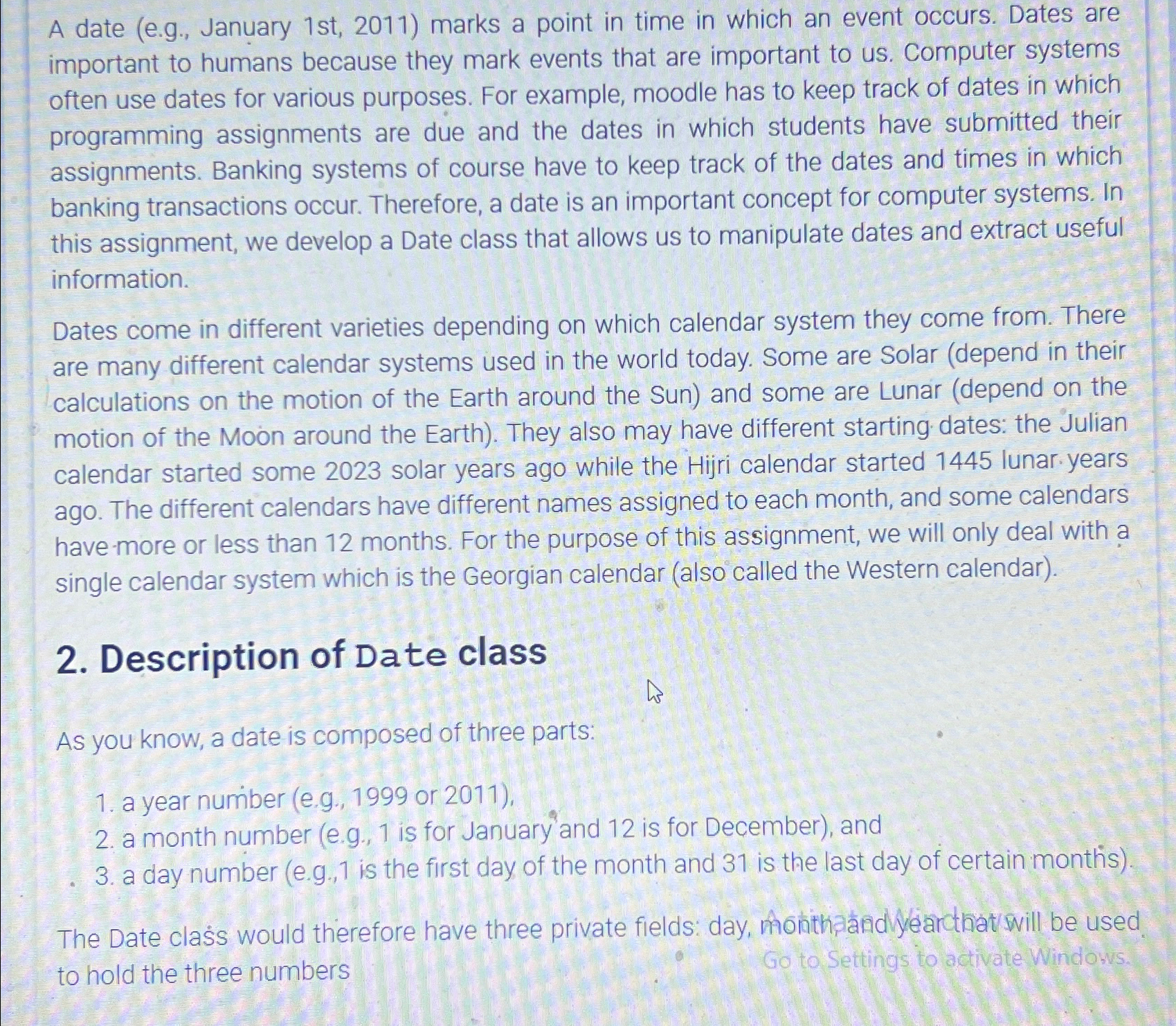
A date eg January st marks a point in time in which an event occurs. Dates are important to humans because they mark events that are important to us Computer systems often use dates for various purposes. For example, moodle has to keep track of dates in which programming assignments are due and the dates in which students have submitted their assignments. Banking systems of course have to keep track of the dates and times in which banking transactions occur. Therefore, a date is an important concept for computer systems. In this assignment, we develop a Date class that allows us to manipulate dates and extract useful information.
Dates come in different varieties depending on which calendar system they come from. There are many different calendar systems used in the world today. Some are Solar depend in their calculations on the motion of the Earth around the Sun and some are Lunar depend on the motion of the Moon around the Earth They also may have different starting dates: the Julian calendar started some solar years ago while the Hijri calendar started lunar years ago. The different calendars have different names assigned to each month, and some calendars havemore or less than months. For the purpose of this assignment, we will only deal with a single calendar system which is the Georgian calendar also called the Western calendar
Description of Date class
As you know, a date is composed of three parts:
a year number eg or
a month number eg is for January and is for December and
a day number eg is the first day of the month and is the last day of certain months
The Date clas would therefore have three private fields: day, mothndyearcthat will be used to hold the three numbers
Step by Step Solution
There are 3 Steps involved in it
1 Expert Approved Answer
Step: 1 Unlock

Question Has Been Solved by an Expert!
Get step-by-step solutions from verified subject matter experts
Step: 2 Unlock
Step: 3 Unlock
 Study Help