







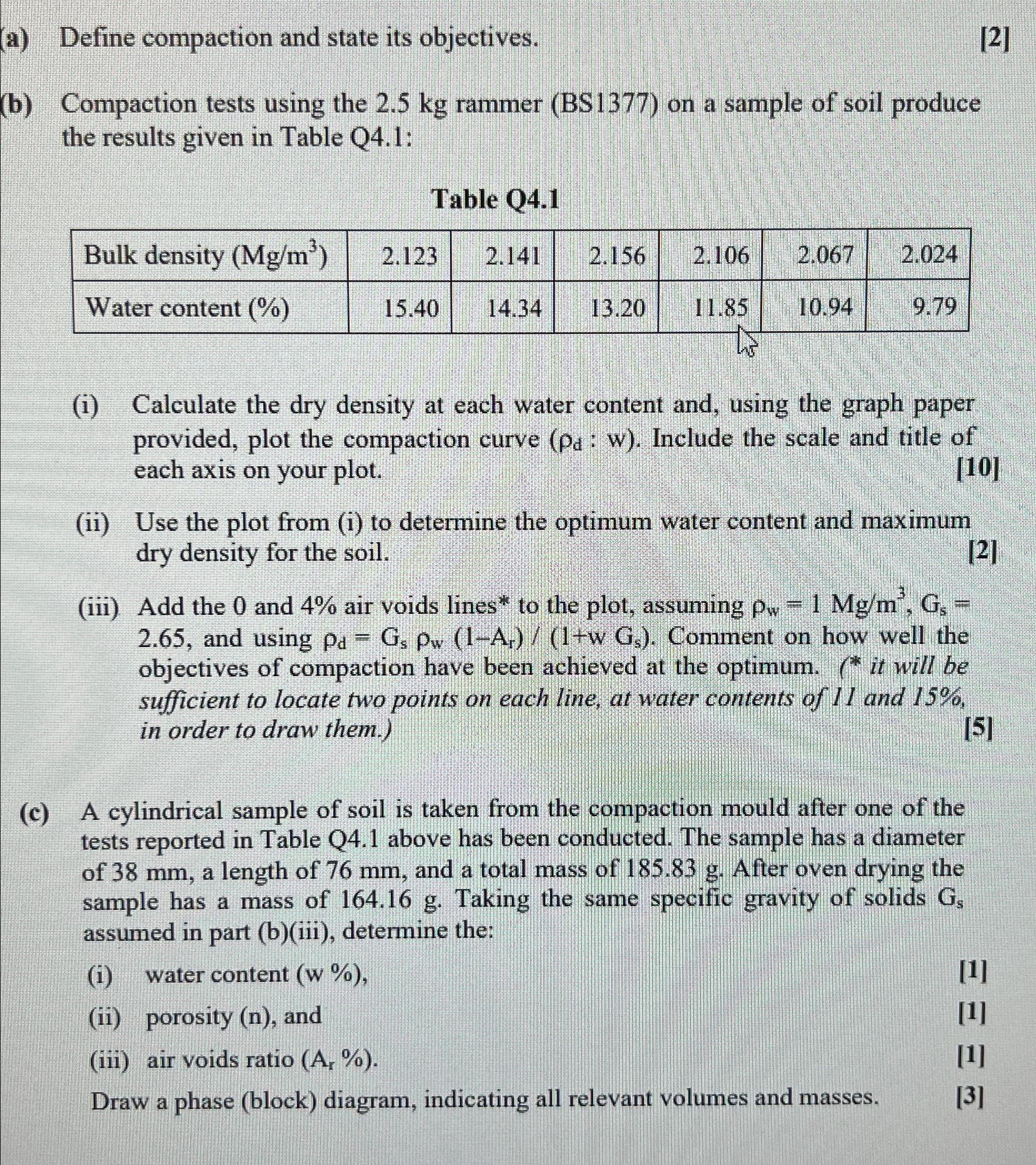
Question: ( a ) Define compaction and state its objectives. [ 2 ] ( b ) Compaction tests using the 2 . 5 k g rammer
a Define compaction and state its objectives.
b Compaction tests using the rammer BS on a sample of soil produce the results given in Table Q:
Table Q
tableBulk density Water content
i Calculate the dry density at each water content and, using the graph paper provided, plot the compaction curve : Include the scale and title of each axis on your plot.
ii Use the plot from i to determine the optimum water content and maximum dry density for the soil.
iii Add the and air voids lines to the plot, assuming and using Comment on how well the objectives of compaction have been achieved at the optimum. it will be sufficient to locate two points on each line, at water contents of II and in order to draw them.
c A cylindrical sample of soil is taken from the compaction mould after one of the tests reported in Table Q above has been conducted. The sample has a diameter of a length of and a total mass of After oven drying the sample has a mass of Taking the same specific gravity of solids assumed in part biii determine the:
i water content
ii porosity n and
iii air voids ratio
Draw a phase block diagram, indicating all relevant volumes and masses.
Step by Step Solution
There are 3 Steps involved in it
1 Expert Approved Answer
Step: 1 Unlock

Question Has Been Solved by an Expert!
Get step-by-step solutions from verified subject matter experts
Step: 2 Unlock
Step: 3 Unlock
 Study Help