







Question: a.) Define complexity in the context of the case study presented above. Extract: Nearly 200 chief executives, including the leaders of Apple, Pepsi and Walmart,
a.) Define complexity in the context of the case study presented above. 
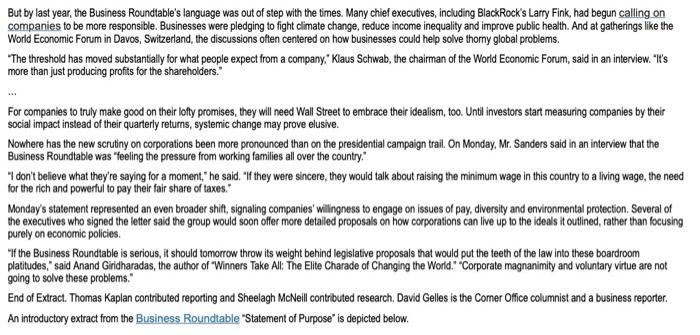
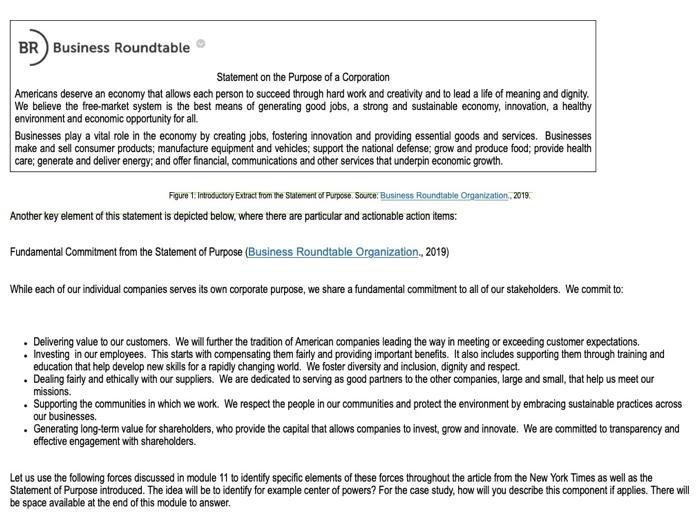
Extract: Nearly 200 chief executives, including the leaders of Apple, Pepsi and Walmart, tried on Monday to redefine the role of business in society and how companies are perceived by an increasingly skeptical public. Breaking with decades of long-held corporate orthodoxy, the Business Roundtable issued a statement on the purpose of a corporation," arguing that companies should no longer advance only the interests of shareholders. Instead, the group said, they must also invest in their employees, protect the environment and deal fairly and ethically with their suppliers. The statement is a PDF document that is also provided as part of this case study. This statement of purpose deserve attention, reflection and discussion as well. "While each of our individual companies serves its own corporate purpose, we share a fundamental commitment to all of our stakeholders," the group, a lobbying organization that represents many of America's largest companies, said in a statement. "We commit to deliver value to all of them, for the future success of our companies, our communities and our country." The shift comes at a moment of increasing distress in corporate America, as big companies face mounting global discontent over income inequality, harmful products and poor working conditions. On the Democratic presidential campaign trail, Senators Bernie Sanders and Elizabeth Warren have been vocal about the role of big business in perpetuating problems with economic mobility and climate change. Lawmakers are looking into the dominance of technology companies like Amazon and Facebook. There was no mention at the Roundtable of curbing executive compensation, a lightning-rod topic when the highest-paid 100 chief executives make 254 times the salary of an employee receiving the median pay at their company. And hardly a week goes by without a major company getting drawn into a contentious political debate. As consumers and employees hold companies to higher ethical standards, big brands increasingly have to defend their positions on worker pay, guns, immigration, President Trump and more. The Business Roundtable did not provide specifics on how it would carry out its newly stated ideals, offering more of a mission statement than a plan of action. But the companies pledged to compensate employees fairly and provide "important benefits, as well as training and education. They also vowed to "protect the environment by embracing sustainable practices across our businesses" and "foster diversity and inclusion, dignity and respect." It was an explicit rebuke of the notion that the role of the corporation is to maximize profits at all costs-the philosophy that has held sway on Wall Street and in the boardroom for 50 years. Milton Friedman, the University of Chicago economist who is the doctrine's most revered figure, famously wrote in The New York Times in 1970 that "the social responsibility of business is to increase its profits." This mind-set informed the corporate raiders of the 1980s and contributed to an unswerving focus on quarterly earnings reports. It found its way into pop culture, when in the 1987 movie "Wall Street," Gordon Gekko declared, Greed is good. More recently, it inspired a new generation of activist investors who pushed companies to slash jobs as a way to enrich themselves. "The ideology of shareholder primacy has contributed to the economic inequality we see today in America," Darren Walker, the president of the Ford Foundation and a Pepsi board member, said in an interview. "The Chicago school of economics is so embedded in the psyche of investors and legal theory and the C.E.O. mind-set. Overcoming that won't be easy." The Business Roundtable included its own articulation of the theory in an official doctrine in 1997, writing that "the paramount duty of management and of boards of directors is to the corporation's stockholders." Each version of its principles published over the last 20 years has stated that corporations exist principally to serve their shareholders. But by last year, the Business Roundtable's language was out of step with the times. Many chief executives, including BlackRock's Larry Fink, had begun calling on companies to be more responsible. Businesses were pledging to fight climate change, reduce income inequality and improve public health. And at gatherings like the World Economic Forum in Davos, Switzerland, the discussions often centered on how businesses could help solve thorny global problems. "The threshold has moved substantially for what people expect from a company," Klaus Schwab, the chairman of the World Economic Forum, said in an interview. "It's more than just producing profits for the shareholders." But by last year, the Business Roundtable's language was out of step with the times. Many chief executives, including BlackRock's Larry Fink, had begun calling on companies to be more responsible. Businesses were pledging to fight climate change, reduce income inequality and improve public health. And at gatherings like the World Economic Forum in Davos, Switzerland, the discussions often centered on how businesses could help solve thorny global problems. "The threshold has moved substantially for what people expect from a company," Klaus Schwab, the chairman of the World Economic Forum, said in an interview. "It's more than just producing profits for the shareholders." For companies to truly make good on their lofty promises, they will need Wall Street to embrace their idealism, too. Until investors start measuring companies by their social impact instead of their quarterly returns, systemic change may prove elusive. Nowhere has the new scrutiny on corporations been more pronounced than on the presidential campaign trail. On Monday, Mr. Sanders said in an interview that the Business Roundtable was "feeling the pressure from working families all over the country." "I don't believe what they're saying for a moment," he said. "If they were sincere, they would talk about raising the minimum wage in this country to a living wage, the need for the rich and powerful to pay their fair share of taxes." Monday's statement represented an even broader shift, signaling companies' willingness to engage on issues of pay, diversity and environmental protection. Several of the executives who signed the letter said the group would soon offer more detailed proposals on how corporations can live up to the ideals it outlined, rather than focusing purely on economic policies. "If the Business Roundtable is serious, it should tomorrow throw its weight behind legislative proposals that would put the teeth of the law into these boardroom platitudes," said Anand Giridharadas, the author of "Winners Take All: The Elite Charade of Changing the World." "Corporate magnanimity and voluntary virtue are not going to solve these problems." End of Extract. Thomas Kaplan contributed reporting and Sheelagh McNeill contributed research. David Gelles is the Corner Office columnist and a business reporter. An introductory extract from the Business Roundtable "Statement of Purpose" is depicted below. BR) Business Roundtable Statement on the Purpose of a Corporation Americans deserve an economy that allows each person to succeed through hard work and creativity and to lead a life of meaning and dignity. We believe the free-market system is the best means of generating good jobs, a strong and sustainable economy, innovation, a healthy environment and economic opportunity for all. Businesses play a vital role in the economy by creating jobs, fostering innovation and providing essential goods and services. Businesses make and sell consumer products; manufacture equipment and vehicles; support the national defense; grow and produce food; provide health care; generate and deliver energy; and offer financial, communications and other services that underpin economic growth. Figure 1: Introductory Extract from the Statement of Purpose. Source: Business Roundtable Organization, 2019 Another key element of this statement is depicted below, where there are particular and actionable action items: Fundamental Commitment from the Statement of Purpose (Business Roundtable Organization., 2019) While each of our individual companies serves its own corporate purpose, we share a fundamental commitment to all of our stakeholders. We commit to: Delivering value to our customers. We will further the tradition of American companies leading the way in meeting or exceeding customer expectations. Investing in our employees. This starts with compensating them fairly and providing important benefits. It also includes supporting them through training and education that help develop new skills for a rapidly changing world. We foster diversity and inclusion, dignity and respect. . Dealing fairly and ethically with our suppliers. We are dedicated to serving as good partners to the other companies, large and small, that help us meet our missions. Supporting the communities in which we work. We respect the people in our communities and protect the environment by embracing sustainable practices across our businesses. . Generating long-term value for shareholders, who provide the capital that allows companies to invest, grow and innovate. We are committed to transparency and effective engagement with shareholders. Let us use the following forces discussed in module 11 to identify specific elements of these forces throughout the article from the New York Times as well as the Statement of Purpose introduced. The idea will be to identify for example center of powers? For the case study, how will you describe this component if applies. There will be space available at the end of this module to
Step by Step Solution
There are 3 Steps involved in it
1 Expert Approved Answer
Step: 1 Unlock

Question Has Been Solved by an Expert!
Get step-by-step solutions from verified subject matter experts
Step: 2 Unlock
Step: 3 Unlock
 Study Help