







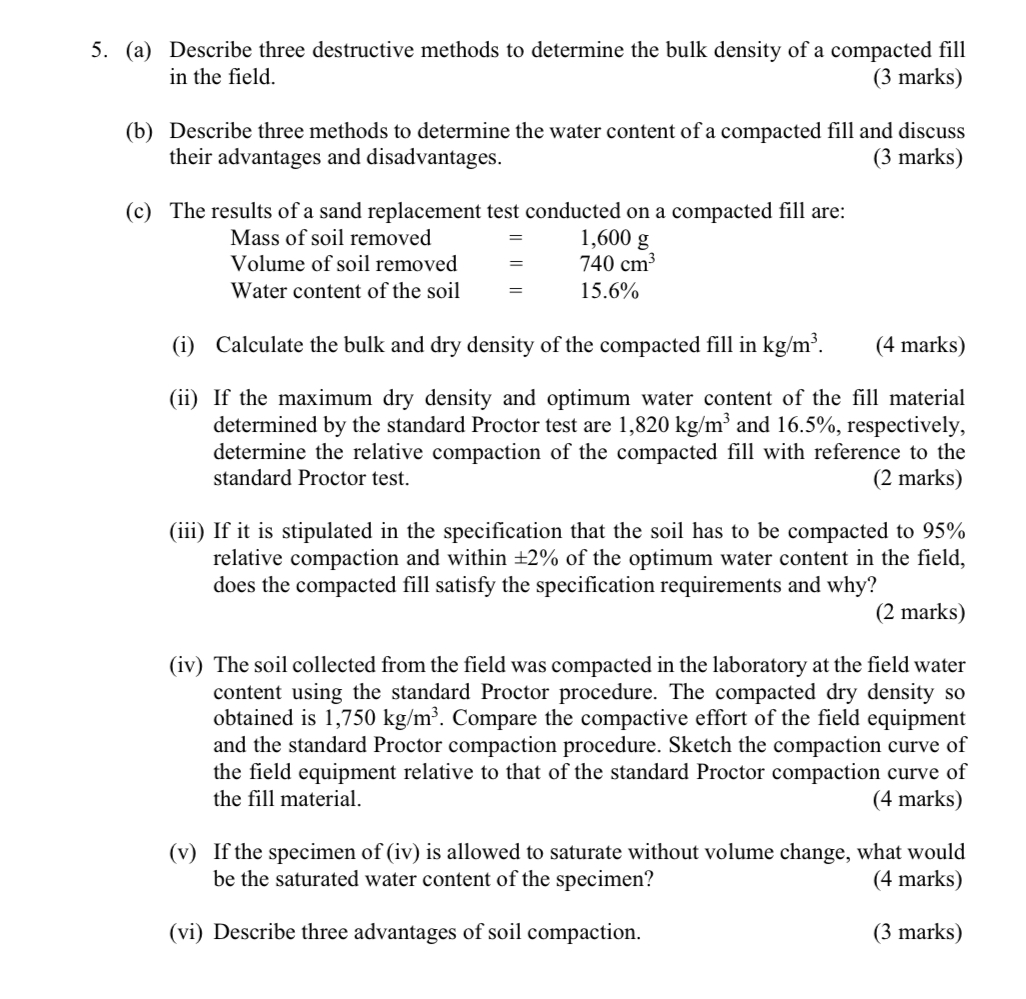
Question: ( a ) Describe three destructive methods to determine the bulk density of a compacted fill in the field. ( 3 marks ) ( b
a Describe three destructive methods to determine the bulk density of a compacted fill in the field.
marks
b Describe three methods to determine the water content of a compacted fill and discuss their advantages and disadvantages.
marks
c The results of a sand replacement test conducted on a compacted fill are:
Mass of soil removed
Volume of soil removed
Water content of the soil
i Calculate the bulk and dry density of the compacted fill in
marks
ii If the maximum dry density and optimum water content of the fill material determined by the standard Proctor test are and respectively, determine the relative compaction of the compacted fill with reference to the standard Proctor test.
marks
iii If it is stipulated in the specification that the soil has to be compacted to relative compaction and within of the optimum water content in the field, does the compacted fill satisfy the specification requirements and why?
marks
iv The soil collected from the field was compacted in the laboratory at the field water content using the standard Proctor procedure. The compacted dry density so obtained is Compare the compactive effort of the field equipment and the standard Proctor compaction procedure. Sketch the compaction curve of the field equipment relative to that of the standard Proctor compaction curve of the fill material.
marks
v If the specimen of iv is allowed to saturate without volume change, what would be the saturated water content of the specimen?
marks
vi Describe three advantages of soil compaction.
marks
Step by Step Solution
There are 3 Steps involved in it
1 Expert Approved Answer
Step: 1 Unlock

Question Has Been Solved by an Expert!
Get step-by-step solutions from verified subject matter experts
Step: 2 Unlock
Step: 3 Unlock
 Study Help