







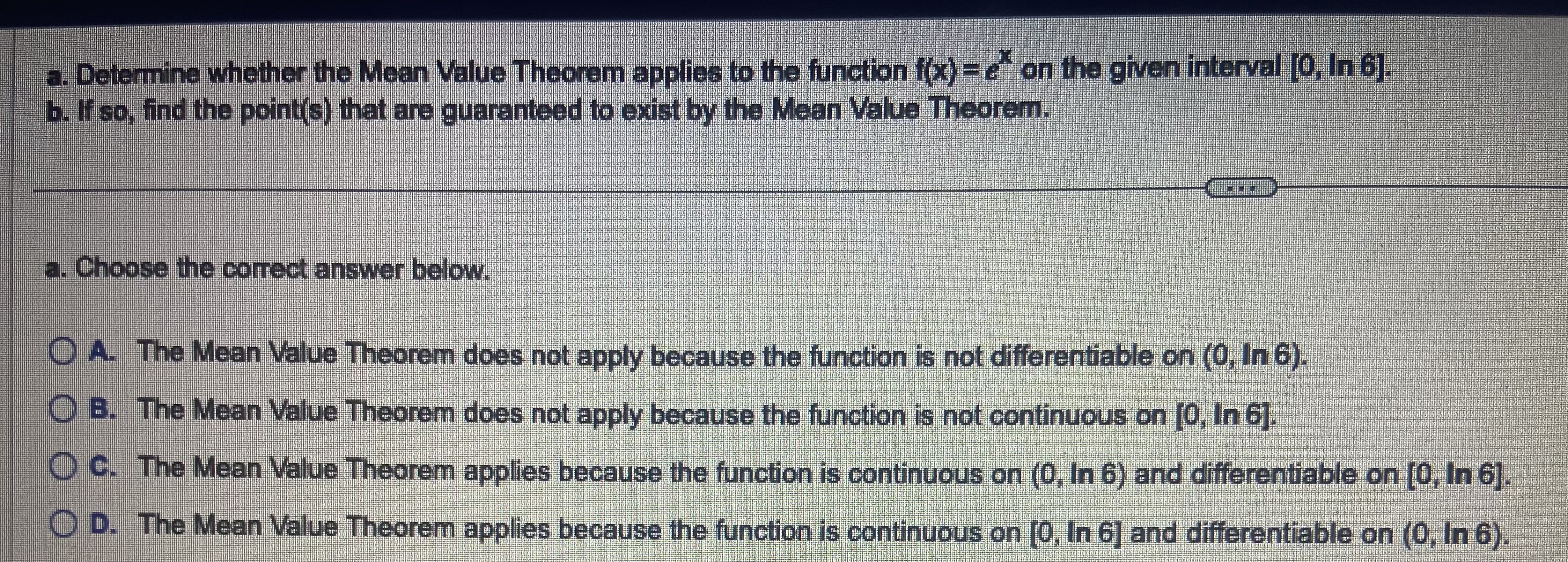
Question: a. Determine whether the Mean Value Theorem applies to the function f(x) = e on the given interval [0, In 6]. b. If so, find
![f(x) = e" on the given interval [0, In 6]. b. If](https://s3.amazonaws.com/si.experts.images/answers/2024/06/66644ad21b940_78566644ad1e1583.jpg)
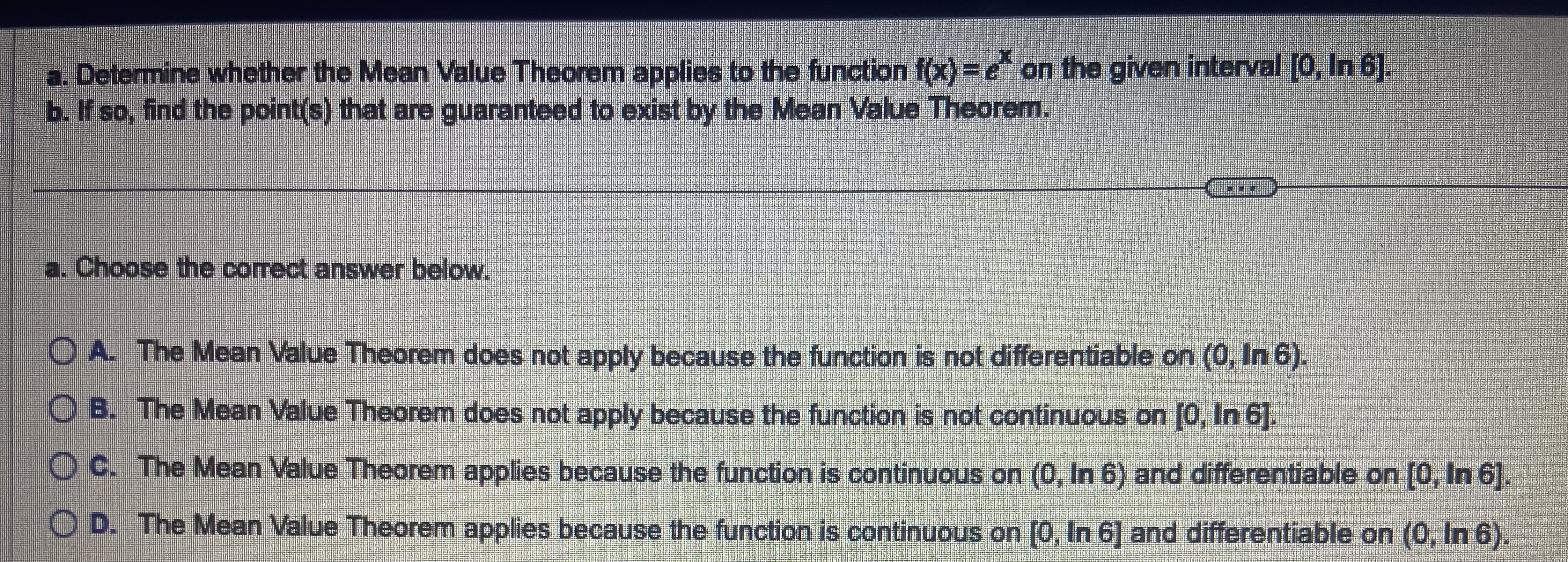
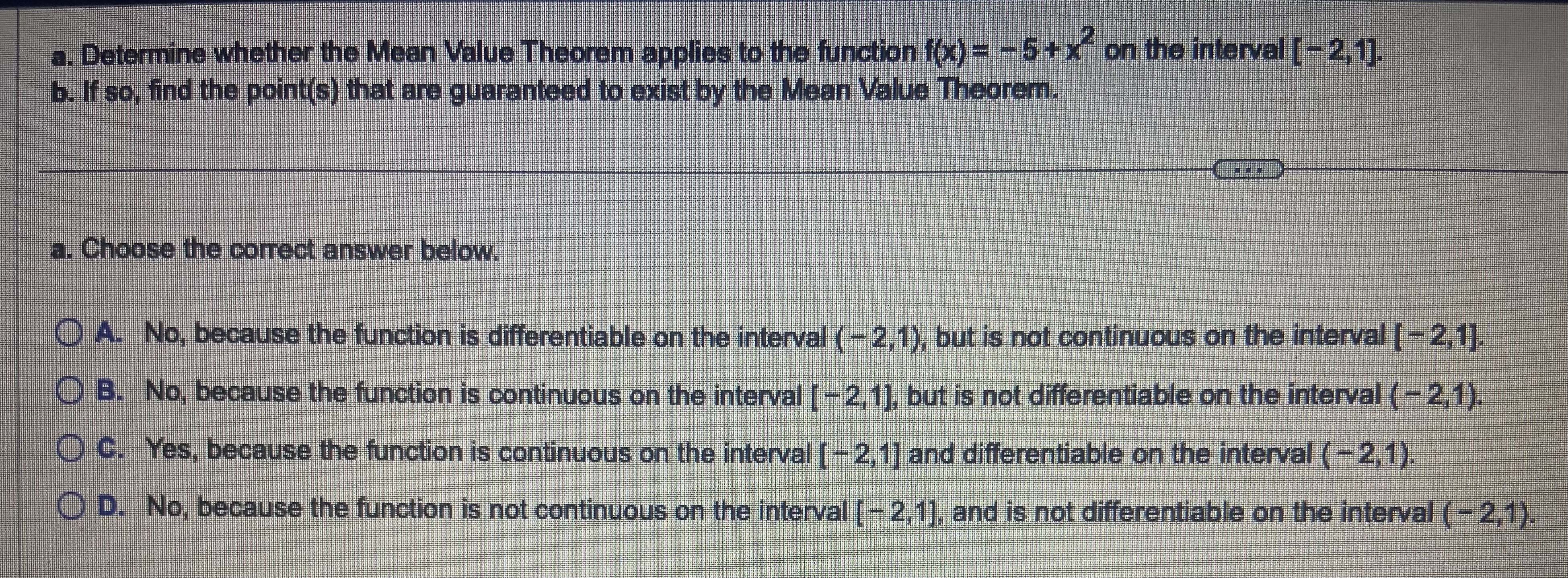
a. Determine whether the Mean Value Theorem applies to the function f(x) = e" on the given interval [0, In 6]. b. If so, find the point(s) that are guaranteed to exist by the Mean Value Theorem. a. Choose the correct answer below. A. The Mean Value Theorem does not apply because the function is not differentiable on (0, In 6). O B. The Mean Value Theorem does not apply because the function is not continuous on [0, In 6]. O C. The Mean Value Theorem applies because the function is continuous on (0, In 6) and differentiable on [0, In 6]. O D. The Mean Value Theorem applies because the function is continuous on [0, In 6] and differentiable on (0, In 6)a. Determine whether the Mean Value Theorem applies to the function f(x) = -5 +x* on the interval [ - 2,1]. b. If so, find the point(s) that are guaranteed to exist by the Mean Value Theorem. a. Choose the correct answer below. O A. No, because the function is differentiable on the interval ( - 2,1), but is not continuous on the interval [ - 2.1]. O B. No, because the function is continuous on the interval [ -2,1], but is not differentiable on the interval ( - 2,1). O C. Yes, because the function is continuous on the interval [ - 2,1] and differentiable on the interval ( - 2,1). O D. No, because the function is not continuous on the interval [ - 2,1), and is not differentiable on the interval ( - 2,1)
Step by Step Solution
There are 3 Steps involved in it

Get step-by-step solutions from verified subject matter experts
 Study Help