







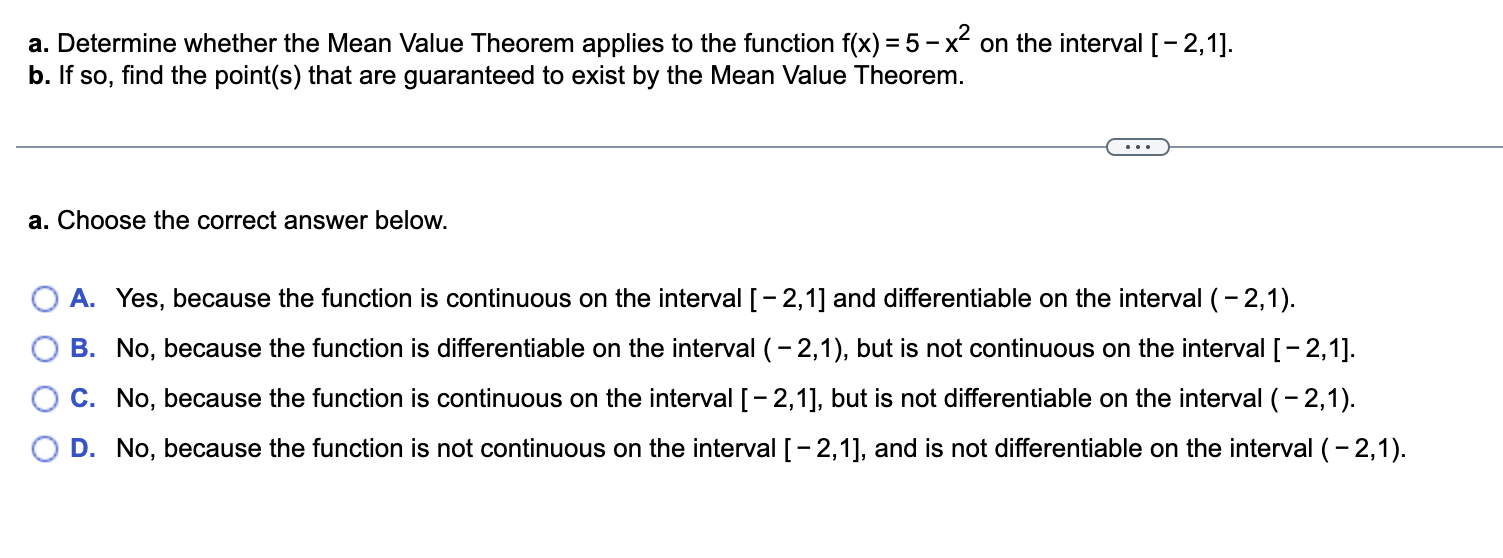
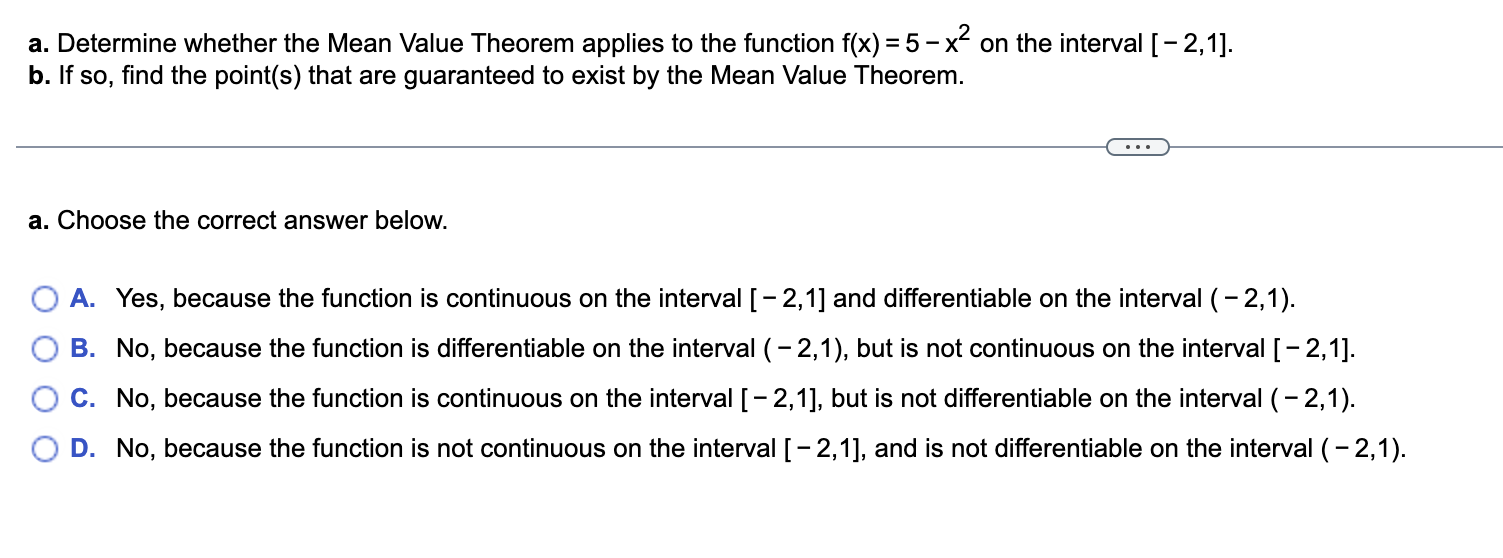
Question: 3. Determine whether the Mean Value Theorem applies to the function f(x) = 5 - x2 on the interval [ 2,1]. b. If so, find
![f(x) = 5 - x2 on the interval [ 2,1]. b. If](https://s3.amazonaws.com/si.experts.images/answers/2024/06/66643107c6cef_18366643107ab386.jpg)
![the function is continuous on the interval [- 2,1] and differentiable on](https://s3.amazonaws.com/si.experts.images/answers/2024/06/66643108cc0cc_18466643108acb49.jpg)
![interval [- 2,1]. {I} C. No, because the function is continuous on](https://s3.amazonaws.com/si.experts.images/answers/2024/06/66643109cfd97_18566643109b53ec.jpg)
![the interval [2,1], but is not differentiable on the interval (- 2,1).](https://s3.amazonaws.com/si.experts.images/answers/2024/06/6664310a453bb_1866664310a2f322.jpg)
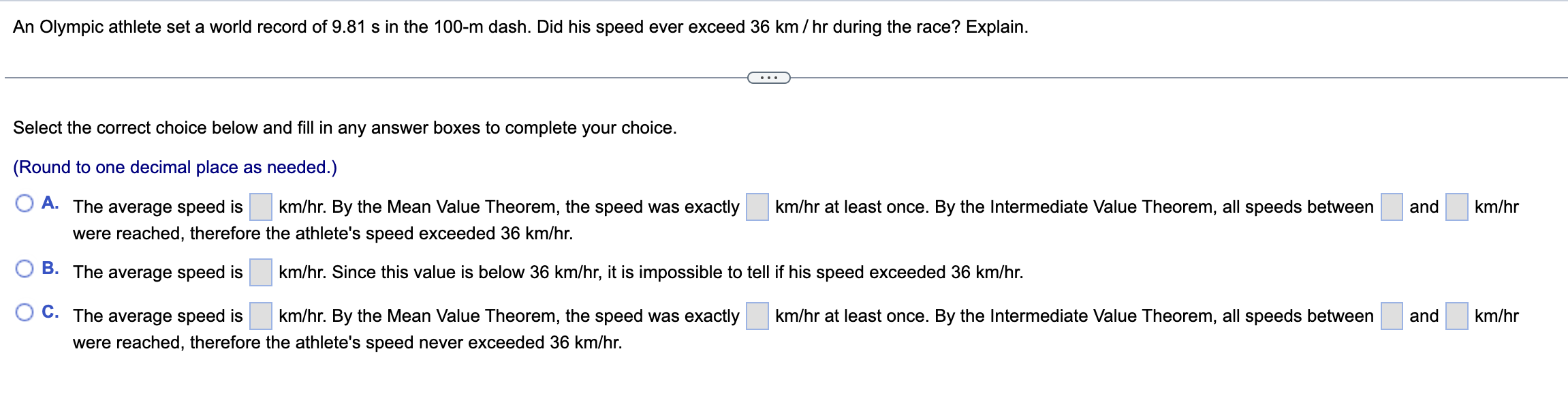
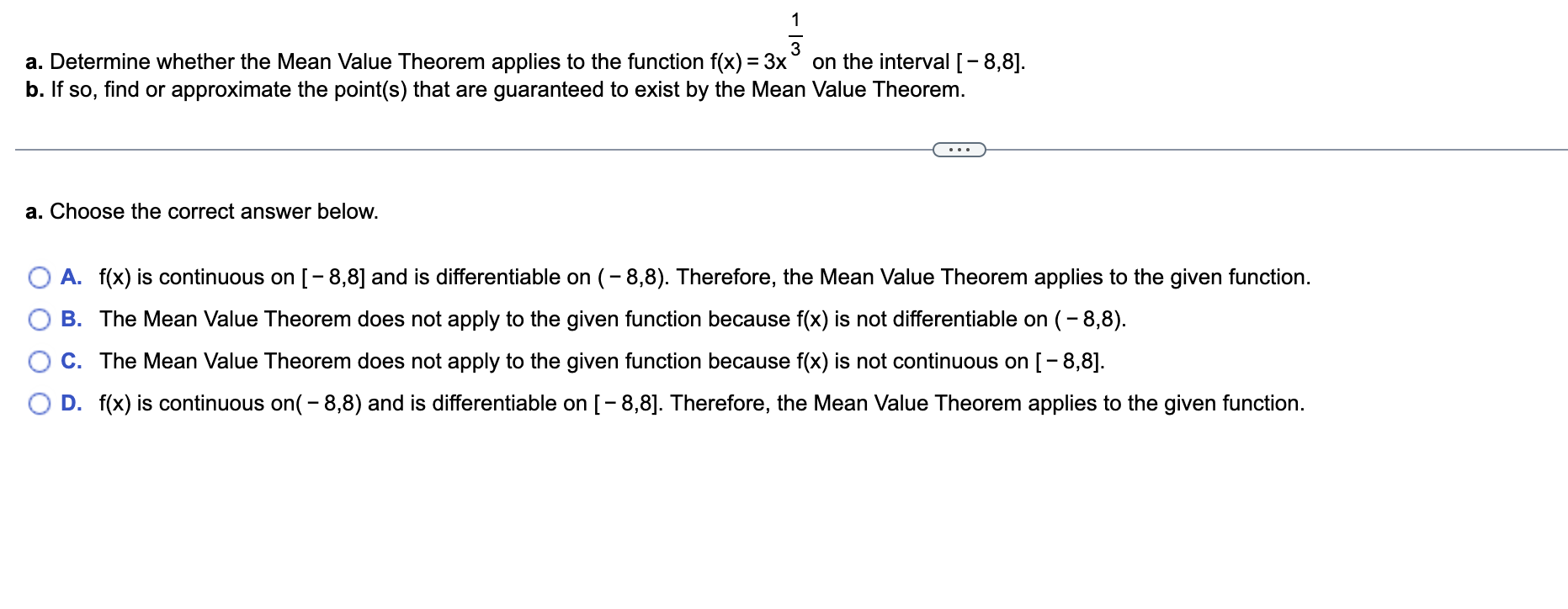
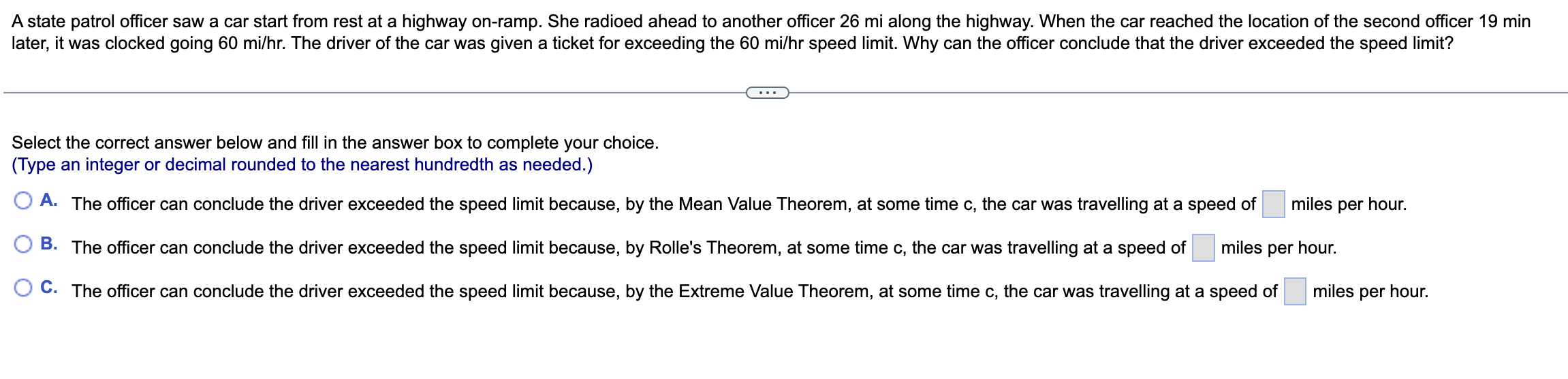
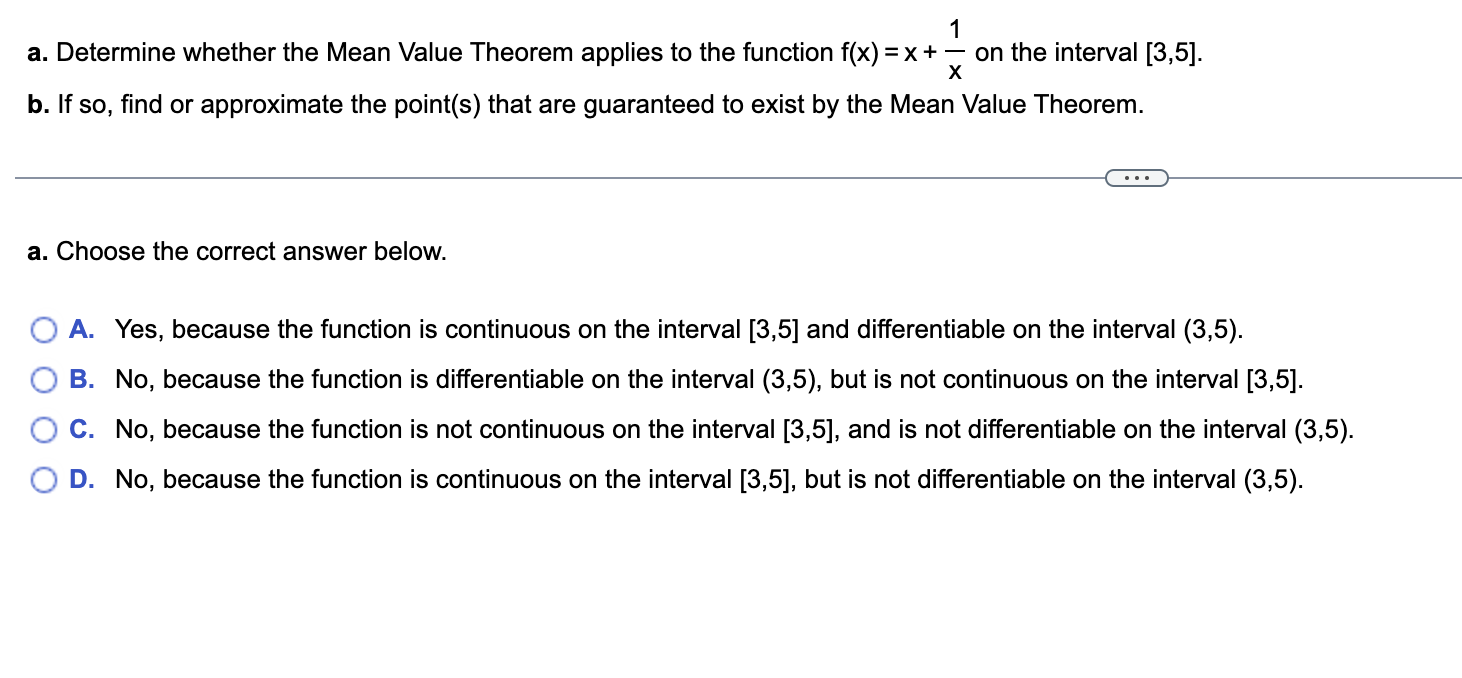
3. Determine whether the Mean Value Theorem applies to the function f(x) = 5 - x2 on the interval [ 2,1]. b. If so, find the point(s) that are guaranteed to exist by the Mean Value Theorem. a. Choose the correct answer below. {I} A. Yes, because the function is continuous on the interval [- 2,1] and differentiable on the interval ( - 2,1). {I} B. No, because the function is differentiable on the interval (- 2,1), but is not continuous on the interval [- 2,1]. {I} C. No, because the function is continuous on the interval [2,1], but is not differentiable on the interval (- 2,1). {:1- D. No, because the function is not continuous on the interval [- 2,1], and is not differentiable on the interval ( - 2,1). 1 a. Determine whether the Mean Value Theorem applies to the function f(x) = x + ; on the interval [3,5]. b. If so, find or approximate the point(s) that are guaranteed to exist by the Mean Value Theorem. (I) a. Choose the correct answer below. {I} A. Yes, because the function is continuous on the interval [3,5] and differentiable on the interval (3,5). {:2- B. No, because the function is differentiable on the interval (3,5), but is not continuous on the interval [3,5]. {:2- C. No, because the function is not continuous on the interval [3,5], and is not differentiable on the interval (3,5). {:2- D. No, because the function is continuous on the interval [3,5], but is not differentiable on the interval (3,5). 1 a. Determine whether the Mean Value Theorem applies to the function f(x) = 3x3 on the interval [- 8.8]. b. If so, find or approximate the point(s) that are guaranteed to exist by the Mean Value Theorem. (3 a. Choose the correct answer below. f(x) is continuous on [- 8,8] and is differentiable on ( - 8,8). Therefore, the Mean Value Theorem applies to the given function. The Mean Value Theorem does not apply to the given function because f(x) is not differentiable on ( - 8,8). The Mean Value Theorem does not apply to the given function because f(x) is not continuous on [- 8,8]. $5.656} f(x) is continuous on( - 8,8) and is differentiable on [ 8,8]. Therefore, the Mean Value Theorem applies to the given function. A state patrol officer saw a car start from rest at a highway on-ramp. She radioed ahead to another officer 26 mi along the highway. When the car reached the location of the second officer 19 min later, it was clocked going 60 mi/hr. The driver of the car was given a ticket for exceeding the 60 mi/hr speed limit. Why can the officer conclude that the driver exceeded the speed limit? Select the correct answer below and fill in the answer box to complete your choice. (Type an integer or decimal rounded to the nearest hundredth as needed.) A. The officer can conclude the driver exceeded the speed limit because, by the Mean Value Theorem, at some time c, the car was travelling at a speed of miles per hour. O B. The officer can conclude the driver exceeded the speed limit because, by Rolle's Theorem, at some time c, the car was travelling at a speed of miles per hour. O C. The officer can conclude the driver exceeded the speed limit because, by the Extreme Value Theorem, at some time c, the car was travelling at a speed of miles per hour.An Olympic athlete set a world record of 9.81 s in the 100m dash. Did his speed ever exceed 36 km / hr during the race? Explain. E) Select the correct choice below and fill in any answer boxes to complete your choice. (Round to one decimal place as needed.) ":3? A- The average speed is km/hr. By the Mean Value Theorem, the speed was exactly km/hr at least once. By the Intermediate Value Theorem, all speeds between and km/hr were reached, therefore the athlete's speed exceeded 36 km/hr. ":3? B- The average speed is km/hr. Since this value is below 36 km/hr, it is impossible to tell if his speed exceeded 36 km/hr. ":3? C- The average speed is km/hr. By the Mean Value Theorem, the speed was exactly km/hr at least once. By the Intermediate Value Theorem, all speeds between and km/hr were reached, therefore the athlete's speed never exceeded 36 km/hr
Step by Step Solution
There are 3 Steps involved in it

Get step-by-step solutions from verified subject matter experts
 Study Help