







Question: A developmental psychologist is examining problem solving ability for grade school children. Random samples of?5-year-old, 6-year-old, and?7-year-old children are obtained. Each child is given a
A developmental psychologist is examining problem solving ability for grade school children. Random samples of?5-year-old, 6-year-old, and?7-year-old children are obtained. Each child is given a standardized?problem-solving task, and the psychologist records the number of errors. Test whether there are any significant differences among the three age?groups; use the .05 level of significance.
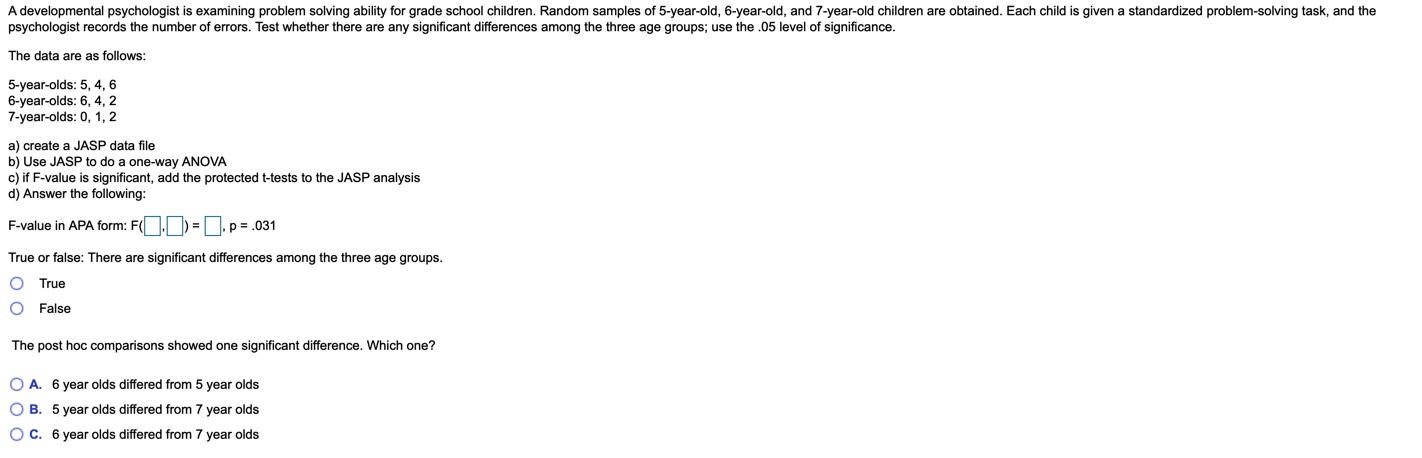

A developmental psychologist is examining problem solving ability for grade school children. Random samples of 5-year-old, 6-year-old, and 7-year-old children are obtained. Each child is given a standardized problem-solving task, and the psychologist records the number of errors. Test whether there are any significant differences among the three age groups; use the .05 level of significance. The data are as follows: 5-year-olds: 5, 4, 6 6-year-olds: 6, 4, 2 7-year-olds: 0, 1, 2 a) create a JASP data file b) Use JASP to do a one-way ANOVA c) if F-value is significant, add the protected t-tests to the JASP analysis d) Answer the following: F-value in APA form: F(].) = ]. p = .031 True or false: There are significant differences among the three age groups. O True O False The post hoc comparisons showed one significant difference. Which one? O A. 6 year olds differed from 5 year olds O B. 5 year olds differed from 7 year olds O C. 6 year olds differed from 7 year oldsWhat is your interpretation of the findings? O A. 5 year olds made more errors than 6 year olds O B. 6 year olds made more errors then 7 year olds O C. 5 year olds made more errors than 7 year olds O D. 7 year olds made fewer errors than 6 year olds
Step by Step Solution
There are 3 Steps involved in it

Get step-by-step solutions from verified subject matter experts
 Study Help