







Question: Thank you!! Study Description A developmental psychologist is examining problem-solving ability for grade school children. Random samples 5-year-old, 6-year-old, and 7-year-old children are given a
Thank you!!
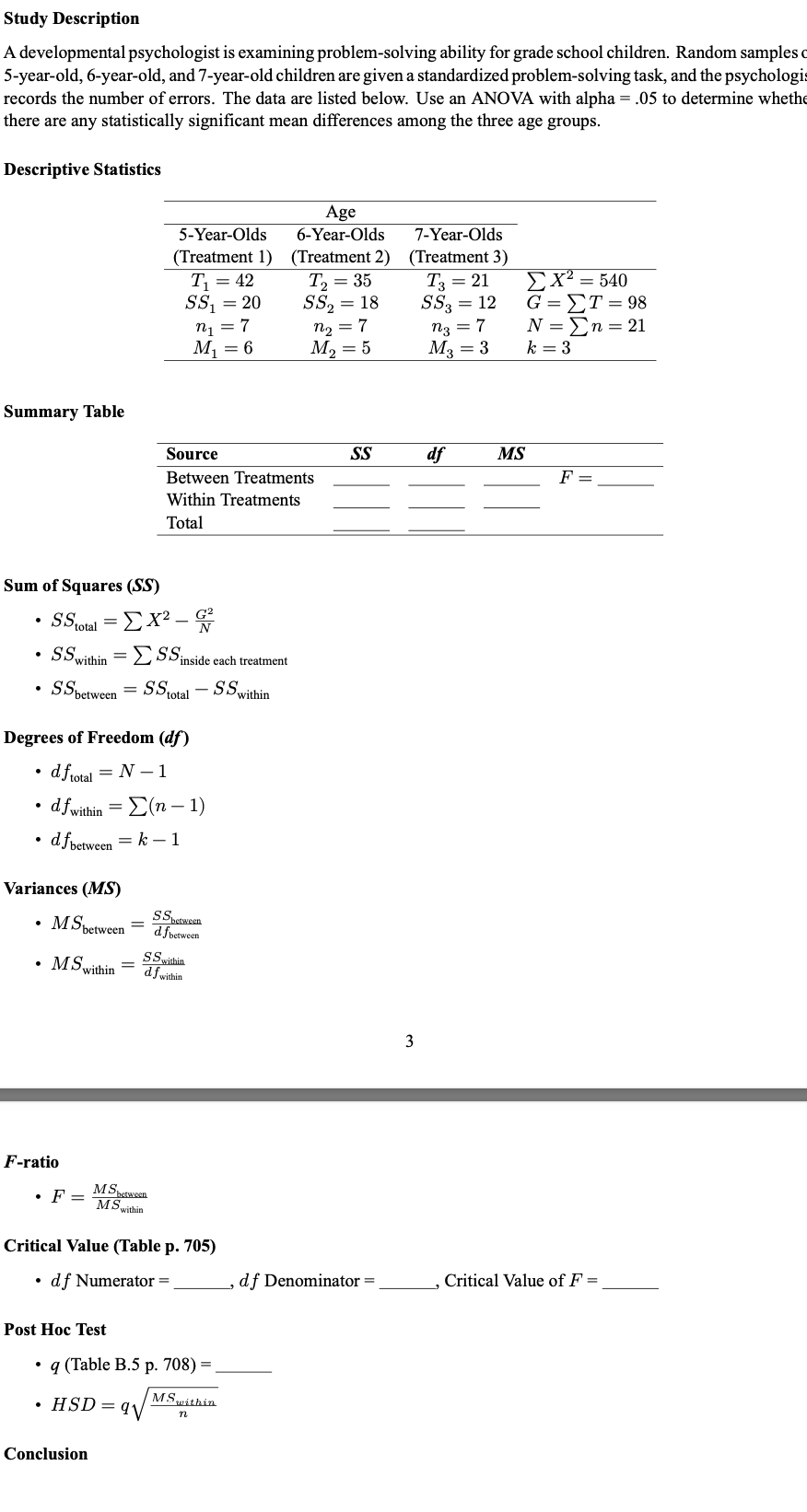
Study Description A developmental psychologist is examining problem-solving ability for grade school children. Random samples 5-year-old, 6-year-old, and 7-year-old children are given a standardized problem-solving task, and the psychologi records the number of errors. The data are listed below. Use an ANOVA with alpha = .05 to determine wheth there are any statistically significant mean differences among the three age groups. Descriptive Statistics Age 5-Year-Olds 6-Year-Olds 7-Year-Olds (Treatment 1) (Treatment 2) (Treatment 3) T1 = 42 T2 = 35 T3 = 21 CX2 = 540 SS1 = 20 SS, = 18 SS3 = 12 G = CT = 98 n1 = 7 12 = 7 n3 = 7 N = Cn =21 M1 = 6 M, = 5 M3 = 3 k = 3 Summary Table Source SS df MS Between Treatments F = Within Treatments Total Sum of Squares (SS) . SStotal = EX2 _ G2 . SSwithin = E SS inside each treatment . SS between = SStotal - SS within Degrees of Freedom (df) . dftotal = N - 1 . dfwithin = E(n - 1) . d fbetween = k - 1 Variances (MS) . MS between = SSbetween d fbetween . MS within = SS within df within W F-ratio . F = M'Sbetween MS within Critical Value (Table p. 705) . df Numerator = ,df Denominator = , Critical Value of F = Post Hoc Test . q (Table B.5 p. 708) = . HSD = qV MSwithin n Conclusion
Step by Step Solution
There are 3 Steps involved in it

Get step-by-step solutions from verified subject matter experts
 Study Help