







Question: a. Did the multifactor productivity ratio increase, decrease or remain the same? If it changed, by what percentage did it change? b. Did the labor
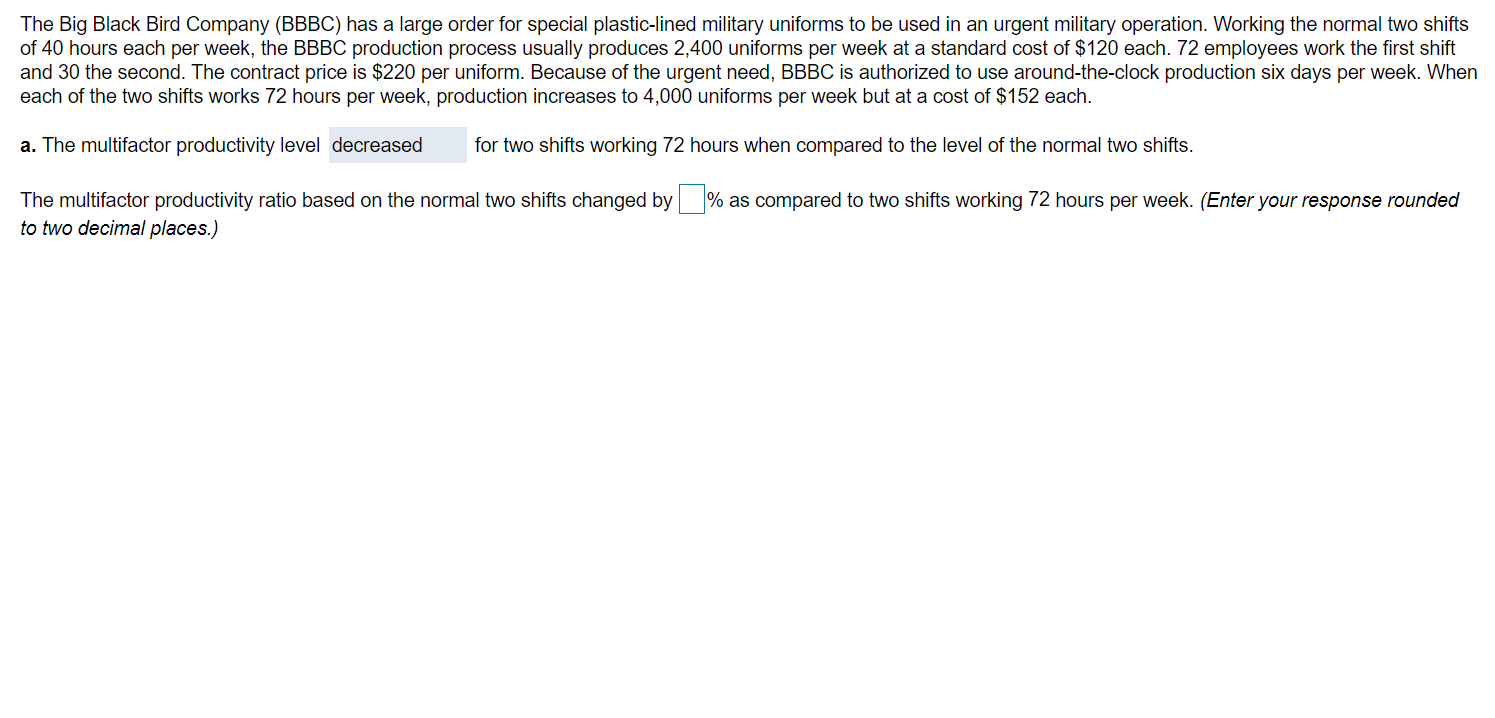
a. Did the multifactor productivity ratio increase, decrease or remain the same? If it changed, by what percentage did it change?
b. Did the labor productivity ratio increase decrease or remain the same? If it changed, by what percentage did it change?
c. Did weekly profits increase decrease, or remain the same?
The Big Black Bird Company (BBBC) has a large order for special plastic-lined military uniforms to be used in an urgent military operation. Working the normal two shifts of 40 hours each per week, the BBBC production process usually produces 2,400 uniforms per week at a standard cost of $120 each. 72 employees work the first shift and 30 the second. The contract price is $220 per uniform. Because of the urgent need, BBBC is authorized to use around-the-clock production six days per week. When each of the two shifts works 72 hours per week, production increases to 4,000 uniforms per week but at a cost of $152 each. a. The multifactor productivity level decreased for two shifts working 72 hours when compared to the level of the normal two shifts. The multifactor productivity ratio based on the normal two shifts changed by [% as compared to two shifts working 72 hours per week. (Enter your response rounded to two decimal places.)Step by Step Solution
There are 3 Steps involved in it
1 Expert Approved Answer
Step: 1 Unlock

Question Has Been Solved by an Expert!
Get step-by-step solutions from verified subject matter experts
Step: 2 Unlock
Step: 3 Unlock
 Study Help