







Question: A directed graph G is shown in the figure below. Assume that the adjacency lists are in alphabetical order. Apply depth - first search (
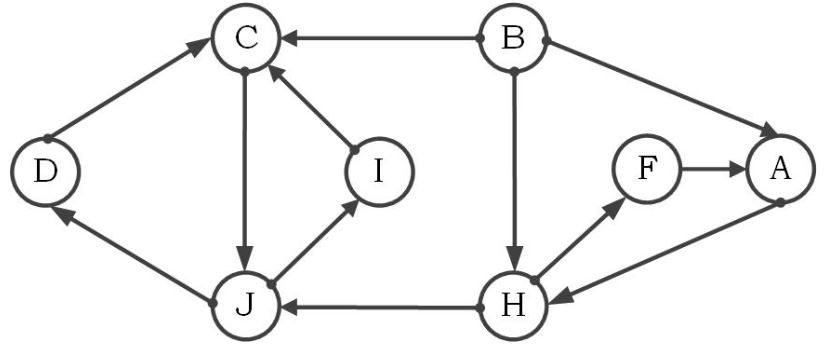
A directed graph G is shown in the figure below.
Assume that the adjacency lists are in alphabetical order. Apply depthfirst search DFS on graph G In the main loop of DFS check the vertices in alphabetical order.
Answer the following questions after the DFS is completed:
a What is the value of Bf
b What is the value of Cf
c What is the value of Df
d What is the value of Hd
e What is the value of I.d
f What is the value of Jd
g What is the value of Cpi
h What is the value of Dpi
i What is the value of Fpi
Preliminaries
We start from a source vertex, s
Discover vertices in the graph
Three possible color values of a vertex
white, not discovered yet
gray, discovered but not explored
black, discovered and explored
Initially, all vertices are white
The source vertex is discovered first
PredecessorParent
While exploring gray node u we check the adjacency list uAdj
If v on uAdj is white, we say v is discovered by u We also say u is the parent or predecessor of v This is denoted by vpiu
DFSG
for each vertex u E GV
ucolor WHITE;
upi NIL;
time ;
for each vertex U E GV
if ucolor WHITE
DFSVisitG u;
;
DFSVisitG u
time time ;
ud time;
ucolor GRAY;
for each vertex v E GAdju
if vcolor WHITE
vpi u
DFSVisitG v
time time ;
uf time;
ucolor BLACK;
Step by Step Solution
There are 3 Steps involved in it
1 Expert Approved Answer
Step: 1 Unlock

Question Has Been Solved by an Expert!
Get step-by-step solutions from verified subject matter experts
Step: 2 Unlock
Step: 3 Unlock
 Study Help