







Question: A discrete memoryless channel is used to transmit binary data. The channel is discrete in that it is designed to handle discrete messages and
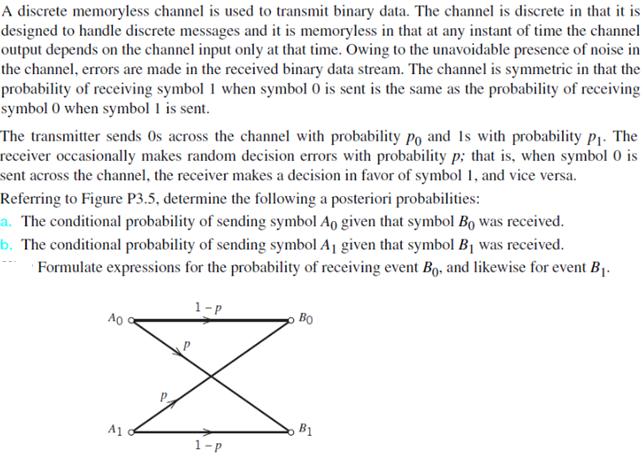
A discrete memoryless channel is used to transmit binary data. The channel is discrete in that it is designed to handle discrete messages and it is memoryless in that at any instant of time the channel output depends on the channel input only at that time. Owing to the unavoidable presence of noise in the channel, errors are made in the received binary data stream. The channel is symmetric in that the probability of receiving symbol 1 when symbol 0 is sent is the same as the probability of receiving symbol O when symbol I is sent. The transmitter sends Os across the channel with probability Po and Is with probability P1. The receiver occasionally makes random decision errors with probability p; that is, when symbol 0 is sent across the channel, the receiver makes a decision in favor of symbol 1, and vice versa. Referring to Figure P3.5, determine the following a posteriori probabilities: a. The conditional probability of sending symbol Ao given that symbol Bo was received. b. The conditional probability of sending symbol Aj given that symbol B1 was received. Formulate expressions for the probability of receiving event Bo, and likewise for event B1. 1-p Ao BO A1 o B1 1-p
Step by Step Solution
3.35 Rating (161 Votes )
There are 3 Steps involved in it
To solve this problem we need to apply the principles of conditional probability and Bayes theorem S... View full answer

Get step-by-step solutions from verified subject matter experts
 Study Help