







Question: A drug patch is typically designed to provide a constant flux of an active ingredient to the skin surface. For the simplified case of transport
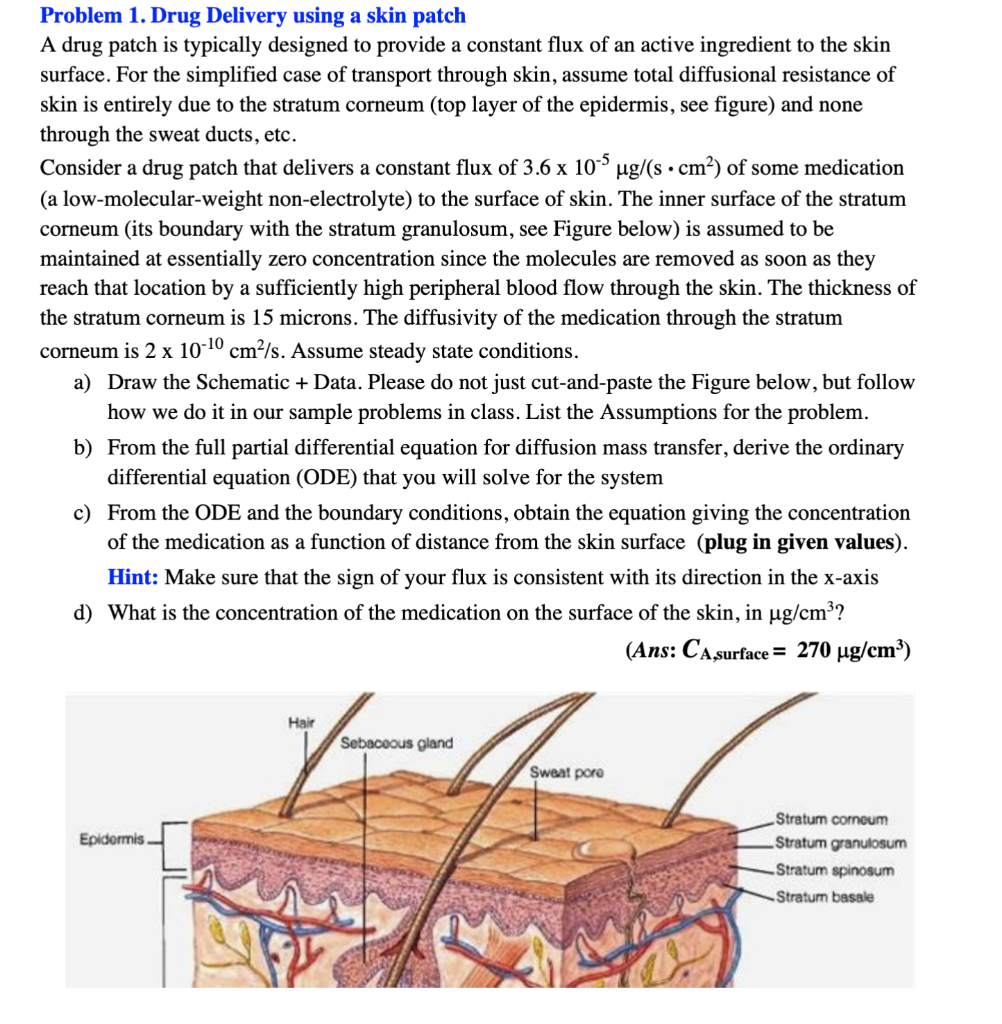
A drug patch is typically designed to provide a constant flux of an active ingredient to the skin surface. For the simplified case of transport through skin, assume total diffusional resistance of skin is entirely due to the stratum corneum (top layer of the epidermis, see figure) and none through the sweat ducts, etc. Consider a drug patch that delivers a constant flux of 3.6105g/(scm2) of some medication (a low-molecular-weight non-electrolyte) to the surface of skin. The inner surface of the stratum corneum (its boundary with the stratum granulosum, see Figure below) is assumed to be maintained at essentially zero concentration since the molecules are removed as soon as they reach that location by a sufficiently high peripheral blood flow through the skin. The thickness of the stratum corneum is 15 microns. The diffusivity of the medication through the stratum corneum is 21010cm2/s. Assume steady state conditions. a) Draw the Schematic + Data. Please do not just cut-and-paste the Figure below, but follow how we do it in our sample problems in class. List the Assumptions for the problem. b) From the full partial differential equation for diffusion mass transfer, derive the ordinary differential equation (ODE) that you will solve for the system c) From the ODE and the boundary conditions, obtain the equation giving the concentration of the medication as a function of distance from the skin surface (plug in given values). Hint: Make sure that the sign of your flux is consistent with its direction in the x-axis d) What is the concentration of the medication on the surface of the skin, in g/cm3 ? (Ans: CA,surface=270g/cm3)
Step by Step Solution
There are 3 Steps involved in it

Get step-by-step solutions from verified subject matter experts
 Study Help