







Question: A Dynamic General Equilibrium Model Determine and explain the general equilibrium effects of the following two parameter changes in our two-period model: 1. An increase
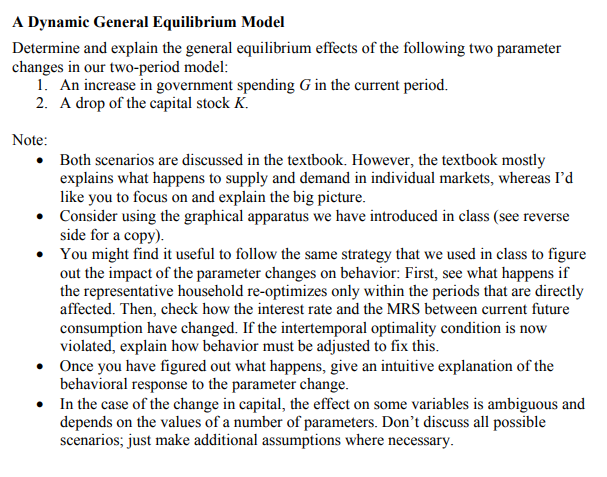
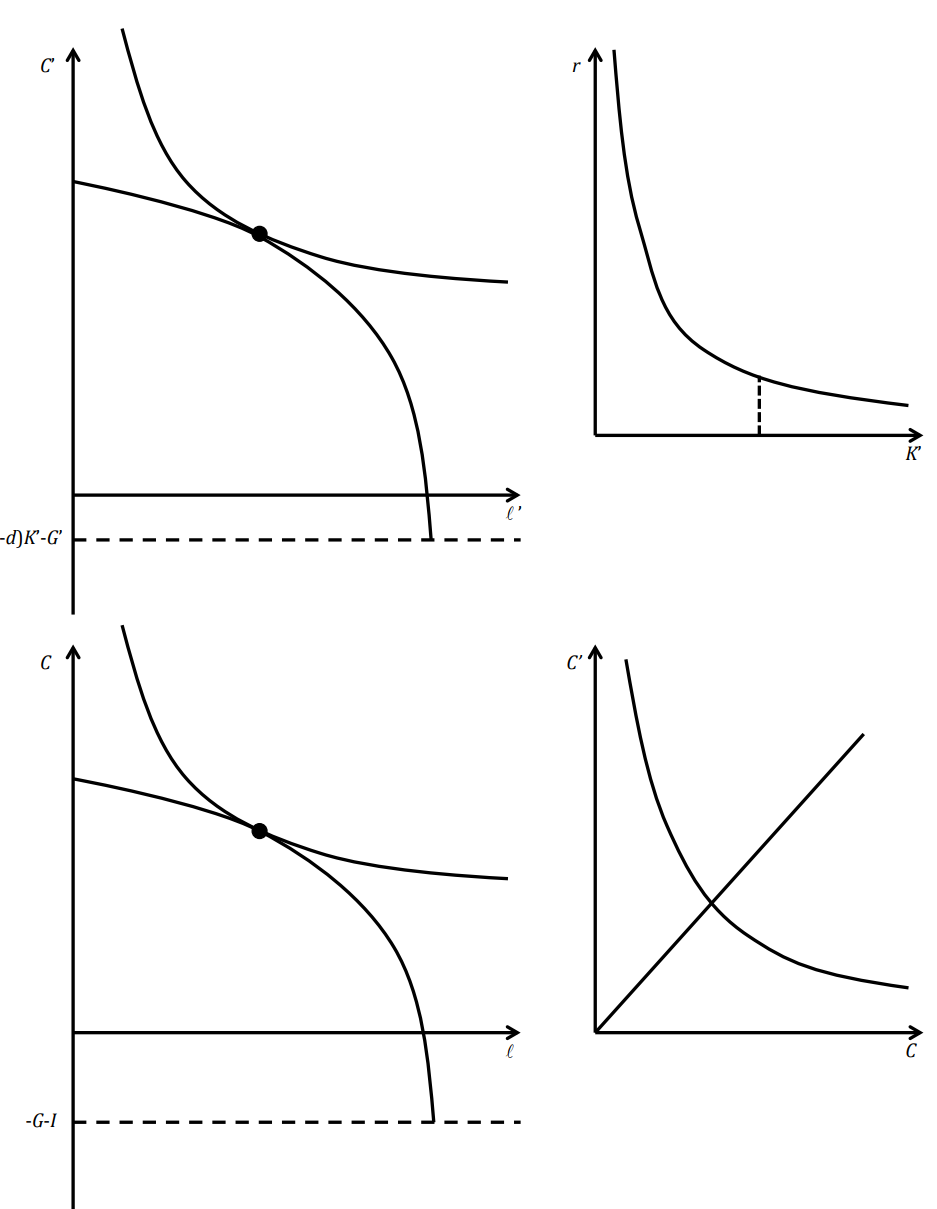
A Dynamic General Equilibrium Model Determine and explain the general equilibrium effects of the following two parameter changes in our two-period model: 1. An increase in government spending G in the current period. 2. A drop of the capital stock K. Note: Both scenarios are discussed in the textbook. However, the textbook mostly explains what happens to supply and demand in individual markets, whereas I'd like you to focus on and explain the big picture. Consider using the graphical apparatus we have introduced in class (see reverse side for a copy). You might find it useful to follow the same strategy that we used in class to figure out the impact of the parameter changes on behavior: First, see what happens if the representative household re-optimizes only within the periods that are directly affected. Then, check how the interest rate and the MRS between current future consumption have changed. If the intertemporal optimality condition is now violated, explain how behavior must be adjusted to fix this. Once you have figured out what happens, give an intuitive explanation of the behavioral response to the parameter change. In the case of the change in capital, the effect on some variables is ambiguous and depends on the values of a number of parameters. Don't discuss all possible scenarios; just make additional assumptions where necessary. A Dynamic General Equilibrium Model Determine and explain the general equilibrium effects of the following two parameter changes in our two-period model: 1. An increase in government spending G in the current period. 2. A drop of the capital stock K. Note: Both scenarios are discussed in the textbook. However, the textbook mostly explains what happens to supply and demand in individual markets, whereas I'd like you to focus on and explain the big picture. Consider using the graphical apparatus we have introduced in class (see reverse side for a copy). You might find it useful to follow the same strategy that we used in class to figure out the impact of the parameter changes on behavior: First, see what happens if the representative household re-optimizes only within the periods that are directly affected. Then, check how the interest rate and the MRS between current future consumption have changed. If the intertemporal optimality condition is now violated, explain how behavior must be adjusted to fix this. Once you have figured out what happens, give an intuitive explanation of the behavioral response to the parameter change. In the case of the change in capital, the effect on some variables is ambiguous and depends on the values of a number of parameters. Don't discuss all possible scenarios; just make additional assumptions where necessary
Step by Step Solution
There are 3 Steps involved in it

Get step-by-step solutions from verified subject matter experts
 Study Help