







Question: 1. The dynamic general equilibrium model. Based on the dynamic general equilibrium model discussed in class and Williamson (2014), determine if the following propositions are
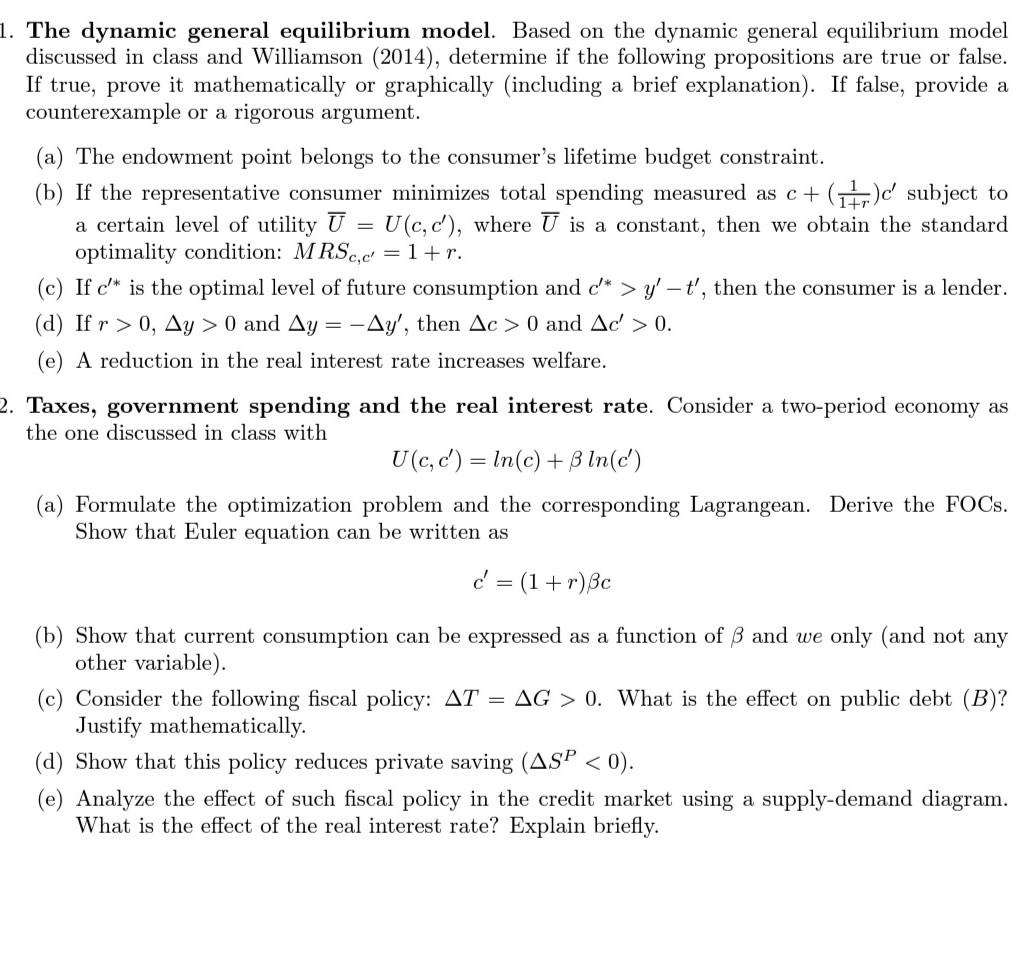
1. The dynamic general equilibrium model. Based on the dynamic general equilibrium model discussed in class and Williamson (2014), determine if the following propositions are true or false. If true, prove it mathematically or graphically (including a brief explanation). If false, provide a counterexample or a rigorous argument. (a) The endowment point belongs to the consumer's lifetime budget constraint. (b) If the representative consumer minimizes total spending measured as c +(11.1.)c' subject to a certain level of utility U U(c, c'), where is a constant, then we obtain the standard optimality condition: MRScc = 1+r. (c) If c* is the optimal level of future consumption and cl* > y' -t', then the consumer is a lender. (d) If r > 0, Ay > 0 and Ay = -Ay', then Ac > 0 and Ad' > 0. (e) A reduction in the real interest rate increases welfare. 2. Taxes, government spending and the real interest rate. Consider a two-period economy as the one discussed in class with U(c,d) = ln(c) + B In(c) (a) Formulate the optimization problem and the corresponding Lagrangean. Derive the FOCs. Show that Euler equation can be written as d' = (1 + r)c (b) Show that current consumption can be expressed as a function of B and we only (and not any other variable) (c) Consider the following fiscal policy: AT = AG > 0. What is the effect on public debt (B)? Justify mathematically. (d) Show that this policy reduces private saving (ASP y' -t', then the consumer is a lender. (d) If r > 0, Ay > 0 and Ay = -Ay', then Ac > 0 and Ad' > 0. (e) A reduction in the real interest rate increases welfare. 2. Taxes, government spending and the real interest rate. Consider a two-period economy as the one discussed in class with U(c,d) = ln(c) + B In(c) (a) Formulate the optimization problem and the corresponding Lagrangean. Derive the FOCs. Show that Euler equation can be written as d' = (1 + r)c (b) Show that current consumption can be expressed as a function of B and we only (and not any other variable) (c) Consider the following fiscal policy: AT = AG > 0. What is the effect on public debt (B)? Justify mathematically. (d) Show that this policy reduces private saving (ASP
Step by Step Solution
There are 3 Steps involved in it

Get step-by-step solutions from verified subject matter experts
 Study Help