







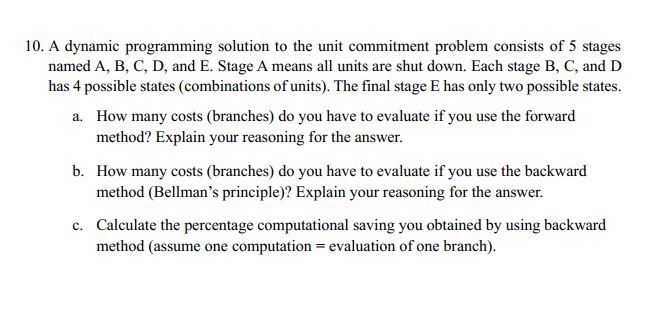
Question: A dynamic programming solution to the unit commitment problem consists of 5 stages named A , B , C , D , and E .
A dynamic programming solution to the unit commitment problem consists of stages
named A B C D and E Stage A means all units are shut down. Each stage B C and D
has possible states combinations of units The final stage has only two possible states.
a How many costs branches do you have to evaluate if you use the forward
method? Explain your reasoning for the answer.
b How many costs branches do you have to evaluate if you use the backward
method Bellmans principle Explain your reasoning for the answer.
c Calculate the percentage computational saving you obtained by using backward
method assume one computation evaluation of one branch
Step by Step Solution
There are 3 Steps involved in it
1 Expert Approved Answer
Step: 1 Unlock

Question Has Been Solved by an Expert!
Get step-by-step solutions from verified subject matter experts
Step: 2 Unlock
Step: 3 Unlock
 Study Help