







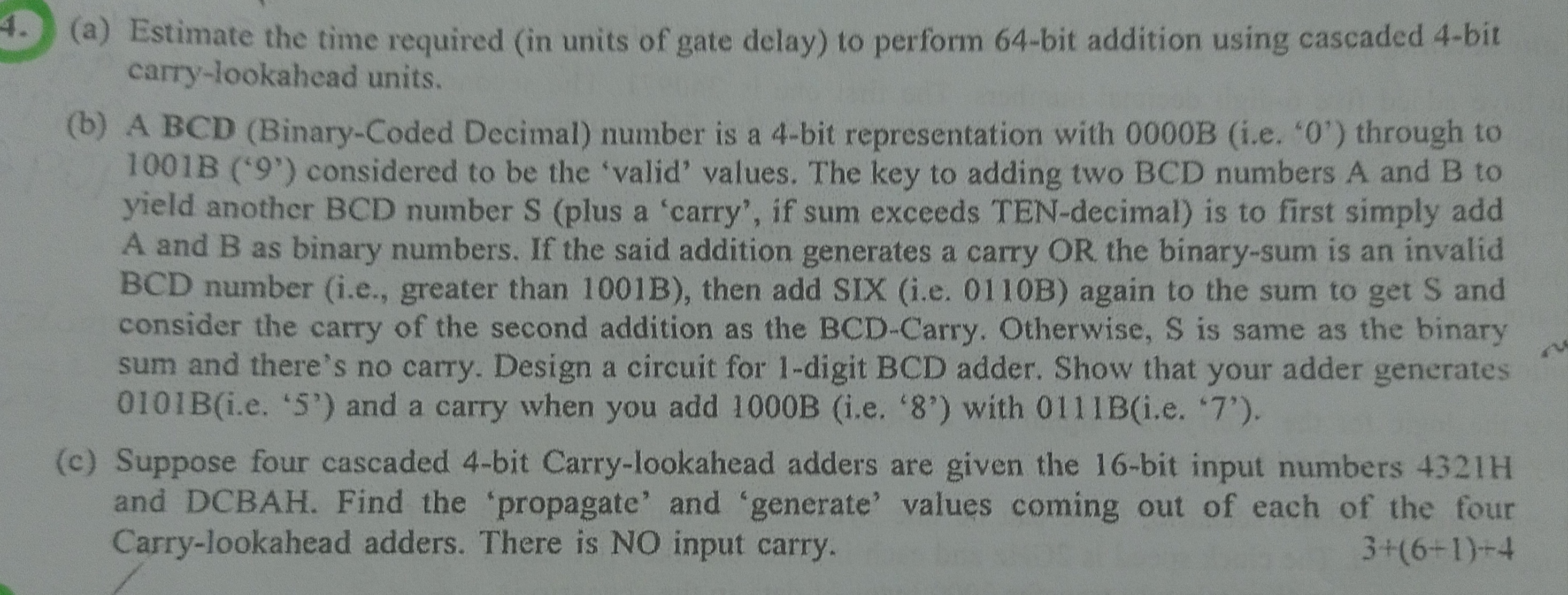
Question: ( a ) Estimate the time required ( in units of gate delay ) to perform 6 4 - bit addition using cascaded 4 -
a Estimate the time required in units of gate delay to perform bit addition using cascaded bit
carrylookahead units.
b ABCD BinaryCoded Decimal number is a bit representation with ie through to
considered to be the 'valid' values. The key to adding two numbers A and to
yield another BCD number S plus a 'carry', if sum exceeds TENdecimal is to first simply add
A and as binary numbers. If the said addition generates a carry the binarysum is an invalid
BCD number ie greater than B then add SIX ieB again to the sum to get S and
consider the carry of the second addition as the Carry. Otherwise, is same as the binary
sum and there's no carry. Design a circuit for digit BCD adder. Show that your adder generates
ie and a carry when you add ie with ie
c Suppose four cascaded bit Carrylookahead adders are given the bit input numbers
and DCBAH. Find the 'propagate' and 'generate' values coming out of each of the four
Carrylookahead adders. There is NO input carry.
Step by Step Solution
There are 3 Steps involved in it
1 Expert Approved Answer
Step: 1 Unlock

Question Has Been Solved by an Expert!
Get step-by-step solutions from verified subject matter experts
Step: 2 Unlock
Step: 3 Unlock
 Study Help